Key takeaways
- In forex, a pip is ten points, and a point is the smallest change the price can make, usually the fifth decimal place.
- In stocks, the tick is the smallest price increment and, in most cases, it is USD 0.01.
- In stocks, a point is one whole dollar, which is one hundred ticks.
- The word point names different amounts depending on the market, so do not turn a distance into money until you know which market you trade.
- Measure first in the market's own unit, then multiply by position size to get the risk in money.
In forex, a point is 0.00001 of the price. In stocks, a point is a whole dollar.
The same word names two amounts that sit five decimal places apart. A trader who moves between markets without noticing gets the risk wrong before even looking at the chart.
Each market measures price with its own ruler, and the ruler depends on what is being traded. Forex trades a ratio between two currencies. Stocks trade the price of a thing.
Why do forex and stocks use different rulers?
In forex, the asset is an exchange rate, the price of one currency expressed in another. Every pair has a base currency, the first in the pair, and a quote currency, the second.
A price of 1.17170 tells you how many units of the quote currency it takes to get one unit of the base. If the pair were EUR/USD, that would be 1.17170 dollars per euro.
That number expresses the strength of one economy against another. Its level says little on its own. What a trader needs to measure is how far it moves.
A ratio sitting around 1 moves in decimals. To capture those changes, the currency market works with a long decimal scale: five decimal places in most pairs.
In stocks, the price is the direct value of an object in money. A share at USD 171 is worth 171 dollars per unit of the company, and its changes are counted in cents and dollars.
That is why forex measures in decimals of a ratio and the stock market measures in fractions of a dollar.
In forex, ten points make a pip
Picture a ruler running from 1.17170 to 1.17180, with ten small marks and one tall mark at the end.
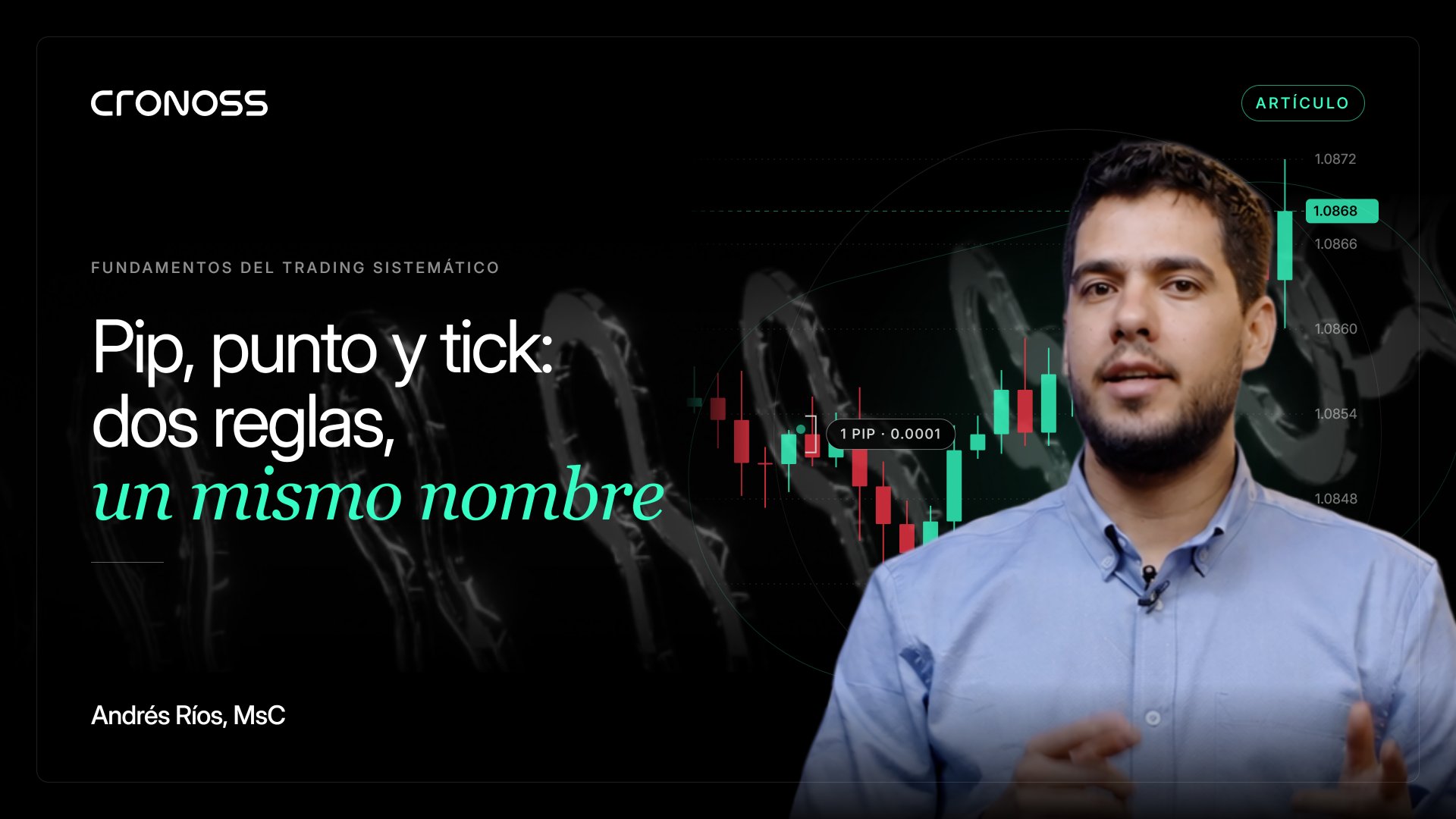
Each small mark is a point, the smallest change the price can make. In most pairs, the point is the fifth decimal place. If the price goes from 1.17170 to 1.17171, the market moved one point.
The tall mark is the pip, short for percentage in point and the industry's standard unit. It sits on the fourth decimal place. If the price goes from 1.17170 to 1.17160, the market moved one pip.
The relationship is fixed: one pip equals ten points. A move from 1.17170 to 1.17175 adds five points, which is half a pip.
Pairs with the Japanese yen are the exception. In those, the pip is the second decimal place.
Banks, funds, brokers and traders use the pip as a shared unit for gains, losses, costs and risk. As a result, a 20-pip move means the same thing on any platform, in any country and with any account size.
In stocks, a hundred ticks make a point
Now picture another ruler, from USD 171.00 to USD 172.00, with a hundred small marks and one tall mark at the end.
Each small mark is a tick, the smallest price increment the exchange allows. For most stocks, the tick is USD 0.01. If a share trades at USD 171.00, the next possible price up is USD 171.01.
The tall mark is the stock market point, worth one whole dollar. A hundred ticks make a point.
If the share goes from USD 171.00 to USD 172.00, it moved one point. If it goes from USD 171.00 to USD 171.50, it moved half a point, or 50 ticks.
That is how to read a headline saying "the stock rose three points". Each share is worth three dollars more than at the previous close, however many ticks it took to get there.
The forex point is the smallest mark on its ruler. The stock market point is the largest mark on its own.
Position size turns the ruler into money
Both rulers measure distance. Money comes in when that distance is multiplied by what the trader holds.
In stocks the math is direct: number of shares times ticks or points moved. With 500 shares, each USD 0.01 tick changes the position's value by USD 5. With 100 shares, one point is worth USD 100.
The scale grows fast. The same 500 shares gain or lose USD 500 for every point. A 50-tick loss limit and a 50-point loss limit look alike in a notebook, and the second one puts a hundred times more money at risk.
In forex, the money value of a pip depends on position size. That is why it makes sense to evaluate in pips first and convert to money afterwards.
Two traders with different capital can capture the same number of pips and end up with different amounts. Measured in pips, the quality of their market reading is comparable.
Measuring in the market's own unit separates the quality of a decision from the size of the account. Measuring well cuts calculation errors, but every trade still carries the risk of losing money.
The two mistakes that distort risk the most
The first is reading points as if they were pips. When the price shows five decimal places, the last digit that moves is the point. Someone who counts ten points as ten pips multiplies the distance they think they are measuring by ten, and their loss limit ends up far from what they planned.
In numbers: a move from 1.17170 to 1.17370 is 20 pips, or 200 points. Writing it down as 200 pips changes the calculated risk by a factor of ten.
The second is carrying the word point from one market to the other. In forex, a point is the smallest change in the ratio. On the stock market, a point is a hundred ticks added up.
Anyone trading both markets needs to know which one they are in before turning any distance into money. The word is the same and the scale is not.
What you can check on your platform today
Three tests confirm or disprove all of the above in a few minutes:
- Open the EUR/USD chart and count the decimal places in the price. If there are five, the last one is the point and the fourth is the pip.
- Find a recent 10-point move and convert it to pips. The answer should be exactly 1 pip.
- Open a stock and look at the smallest jump in its price. If it is one cent, that is its tick. If it is another amount, that asset uses a different ruler.
If any test does not match, the asset specification published by your platform is what counts.
Measure first, decide second
All three units answer the same question: how far did the price move. A trader can get the analysis right and still get the translation of that distance into risk wrong, and the market charges for both mistakes alike.
Try it with your last trade. Could you say, without a calculator, how many pips or ticks there were to your exit and how much money they represented? If you hesitated, the risk you thought you had defined was an estimate. Fundamentos del Trading Sistemático (Fundamentals of Systematic Trading), the Cronoss program led by Andres Rios, MSc, starts right there. The classes Punto y Pip: el sistema de medición del movimiento en Forex (Point and Pip: the forex measurement system), ¿Qué es un Tick? (What is a tick?) and ¿Qué es un Punto en mercados diferentes a Forex? (What is a point outside forex?) teach you to measure before you trade. The rest of the program builds on those rulers to explain the cost of each trade, order types and how to build a system with clear rules.
Educational content. Cronoss is not a broker, investment firm or financial adviser, and nothing above is an investment recommendation.
Frequently asked questions
What is a pip in forex?
A pip is the standard unit for measuring the move of a currency pair, and in most pairs it is the fourth decimal place of the price. For example, if EUR/USD goes from 1.17170 to 1.17160, the price moved one pip.
How many ticks make a point in stocks?
In stocks, a point is one whole dollar, and a hundred ticks make a point when the tick is USD 0.01. If a share moves from USD 171.00 to USD 171.50, it moved half a point, or 50 ticks.
Is a forex point the same as a stock point?
No. In forex, a point is the smallest change in a currency pair's price, while in stocks a point is one whole dollar. The same word measures different scales.
How do you turn a pip or a tick into money?
Multiply the distance by the position size. With 500 shares, each USD 0.01 tick changes the position's value by USD 5, so measure first in the market's unit and convert to money afterwards.