Key takeaways
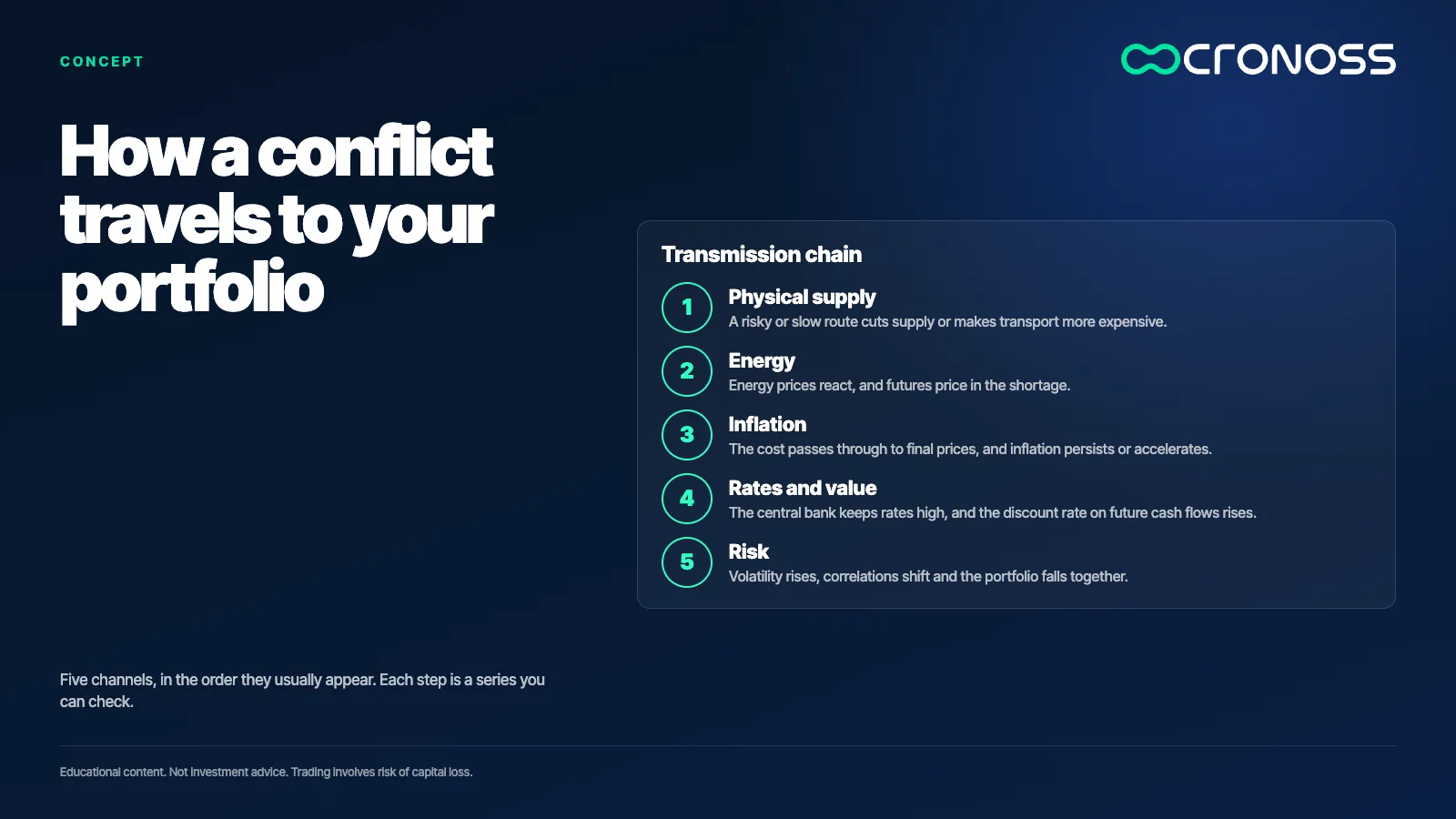
- A conflict reaches markets through economic channels: energy, inflation expectations, rates, volatility and supply chains.
- Energy has a small share of total spending, but it enters the cost of almost every good, so its effect spreads across many prices.
- Futures prices reflect what the market expects, not what will happen, so separate expectations from observed data.
- A higher discount rate lowers the present value of distant cash flows, and that effect weighs more on long-term assets.
- Before you read a news item, define which data change would alter your plan and how often you will review it.
A conflict can appear in the morning headlines and, weeks later, in the price of gasoline, in an energy bill or in the rate on a loan. Many people expect a single blow that shows up in the stock market right away, but money moves through several channels at once, and each one has its own timing.
The most common mistake is to read the headline as if it were the data. A headline says a route has closed, that an agreement was reached or that someone expects a quick solution. What matters for your portfolio is which variables change and how long they take to show up in economic series.
A conflict reaches your portfolio through economic channels, and the headline only tells you that one of them has opened.
How a conflict travels to your portfolio
The first link is usually physical supply. If a shipping route that carries a large share of the world's oil and gas becomes risky or slow, the available supply falls or its transport gets more expensive. Energy prices react fast, because futures contracts price in scarcity before the delayed cargo reaches its destination.
From there the effect spreads. Energy is an input to almost everything: transport, fertilizers, plastics, food and industrial electricity. When that cost passes through to final prices, inflation appears. If inflation persists, the central bank may keep rates high for longer, and that changes the present value of any future cash flow, from a stock to a bond.
Finally, the conflict changes risk appetite. Investors cut exposure, volatility rises and correlations between assets shift. A portfolio that looked diversified can fall in the same direction as everything else.
Oil enters almost every cost
Energy has a small weight in the spending of the average person, but it appears in almost every price. The U.S. Bureau of Labor Statistics (BLS) publishes the weights of the Consumer Price Index (CPI). In the weights table published with December 2025 data, energy carries a weight of 6.383% of the CPI for urban consumers (CPI-U).
This is a worked example with hypothetical numbers, not a forecast. Suppose energy prices rise 10%, with no second-round effects.
- Step 1. Convert the weight to a fraction: 6.383% = 0.06383.
- Step 2. Multiply the increase by the weight: 0.06383 × 10% = 0.638 percentage points.
- Step 3. Round it: the headline CPI would rise about 0.64 points from the direct effect alone.
The result looks small, but it arrives every month. The BLS notes that energy is priced monthly, so a sustained change shows up in the inflation reading quickly.
Expectations move prices before the data does
Futures prices are not a forecast. They are an agreement to deliver a good at a later date, and their shape, called the curve, shows what market participants expect for each maturity. If the contracts further out are lower than the nearby ones, the market assumes the shortage will be temporary. If they are higher, the market assumes it will last.
This matters because a curve can move faster than the real economy. The market adjusts risk premiums when news arrives, even before production or consumption has changed. That is why it helps to separate two questions: what the market expects, and what shows up in the data.
The difference between a short-term and a structural impact is also key. A temporary supply shock can reverse once flows normalize. A structural change, such as new routes, new investment or the substitution of inputs, takes longer but leaves a more lasting mark on costs and prices.
Rates change when inflation stays
The federal funds rate has a target set by the Federal Open Market Committee (FOMC), and the central bank works to keep the rate near that target. When inflation accelerates or persists, the natural response is to keep the rate high for longer or raise it.
For an investor, that changes the valuation math. A cash flow that arrives in ten years is worth less now if the discount rate rises, and that effect weighs more on assets whose value depends on distant earnings. Long-term bonds also react strongly when expectations for rates change, because their price is sensitive to every future payment they promise. Shorter instruments usually move less, which is one reason the maturity of a bond matters as much as its issuer when you read a rate shock.
Risk: a change in rates can reduce the value of your investments, even if the underlying business is doing well.
Volatility and risk appetite
When volatility rises, the same price move becomes harder to tolerate. A useful response is to reduce the size of each position so that risk stays similar. That way you do not depend on guessing how the conflict will end.
A sector described as defensive is not free of risk either. Its correlation with the index can change during a stress episode, and a marketing label guarantees nothing. The test is to measure how each asset moved during high-volatility periods, not how it is described in a summary. Another useful test is to check how much your portfolio would have fallen in its worst week of the last year, and ask yourself whether that loss would have been tolerable without selling at the worst moment.
Narrative versus data
A narrative is a story about the outcome: it will be resolved soon, it has already been won, or nothing is happening. Data is what gets recorded: ship flows, inventories, futures prices, monthly inflation and company results. A speech can move the price during one session, but it does not change the physical chain that supports it. For example, an announcement may say that a route will stay open, but the data that matters is how many ships pass each week, how long they take to arrive and what it costs to insure the transport. If the announcement does not appear in those series, the physical channel is unchanged.
A practical rule helps separate the two. A claim becomes evidence when it appears in a series you could name before you looked at it. If the story says the problem is over and no series changes, you have an opinion, not a fact.
How to read a conflict without reacting to headlines
- Map the five channels. Write down what data would show each one: energy, inflation expectations, rates, volatility and supply chains.
- Set your review dates. Use the monthly inflation and energy data as checkpoints, not every news item of the day.
- Define your action threshold in advance. Decide which change in the data would make you adjust the portfolio, and which would not make you react.
Answer these three questions before you open a news story. That way the headline arrives after your judgment, not before it.
The headline informs, the data decides
A geopolitical conflict does not enter your portfolio through the front door of the headlines. It enters through the cost of energy, through the rate the central bank sets and through the volatility that changes how much risk you can tolerate. Whoever measures those channels can wait for the data without reacting to every headline.
The headline says what happened; the data says how much your portfolio changes.
If you want to learn to read indicators such as interest rates, inflation and employment, the program Análisis Macroeconómico para Trading (Macroeconomic Analysis for Trading) shows you how to connect them to your decisions.
Educational content. Cronoss is not a broker, investment firm or financial adviser, and nothing above is an investment recommendation.
Frequently asked questions
Why does a conflict affect inflation even when it happens far away?
Because energy and inputs such as fertilizers enter the cost of producing and transporting many goods. When that cost rises, part of it passes through to final prices, even in countries that are not part of the conflict.
What is the difference between narrative and data in markets?
The narrative is the story told about the outcome, while data is what gets recorded in prices, inventories, flows and inflation. Data can be measured and compared over time; a narrative cannot.
How is the futures curve used to read a conflict?
The curve shows the agreed prices for delivery on different dates. If later maturities sit below nearby ones, the market expects the shock to be temporary; if they sit above, it expects it to last.
What should I check before reacting to geopolitical news?
Check which channel is affected, which series would show it and when that series is published. If the data does not change, the news is not yet a signal to adjust your portfolio.