
Key takeaways
- Inflation usually arrives as a gradual process, with early signals in producer prices, raw materials and expectations.
- A nominal return below inflation means a negative real return, even when the account balance goes up.
- TIPS and UVR adjust principal with an inflation index, but their protection depends on that index reflecting your own spending.
- Short duration reduces sensitivity to rates, though it adds reinvestment risk if rates fall later.
- Equities with pricing power and commodities help in different regimes, and both can lose value in a recession.
Inflation rarely arrives as a shock. It builds gradually: producer prices move first, expectations shift next, and by the time the number shows up in the consumer price index, the purchasing power of your money has been eroding for months. A portfolio built only for growth can see that erosion years later, when fixing it is already expensive.
So the useful question is not whether inflation will fall, but which assets keep working when it rises and where each one fails. This article walks through the tools most often used for protection, and their limits.
No asset protects against inflation in every scenario. What protects you is a mix that changes with the type of price pressure.
Inflation starts as a gradual process
The consumer price index (CPI) is the most cited measure. The U.S. Bureau of Labor Statistics defines it as a measure of the average change over time in the prices consumers pay for a representative basket of goods and services. It is a national average covering urban households, so it does not necessarily reflect your own cost of living.
Other signals usually appear before the CPI moves. Producer prices show whether the cost of making things is already rising. Raw materials, such as oil, show pressures that later reach the price chain. Inflation expectations show whether businesses and households expect the rise to continue. No single signal is enough, but when several move in the same direction for months, the pressure is real.
How inflation hits a portfolio
A portfolio loses purchasing power when its nominal return falls below inflation. The balance can rise and still buy less. That gap is called the real return, and it is the number that matters when the goal is to preserve value.
Inflation also connects to interest rates. The Federal Reserve sets a longer-run inflation goal of 2 percent, measured with the personal consumption expenditures price index, and describes that level as the one most consistent with its mandate of maximum employment and price stability. When inflation moves away from that goal, rates tend to react, and a fixed-rate bond becomes less attractive next to newly issued ones.
Illustrative example, with our own arithmetic: if your money earns no return and prices rise 2 percent a year, after 5 years $1,000 USD buys what $905.73 USD buys today. The calculation is $1,000 / 1.02^5 = $1,000 / 1.104081 = $905.73 USD. This is not a forecast of inflation. It only shows how much a constant rate weighs over five years.
Inflation-linked fixed income: TIPS and UVR
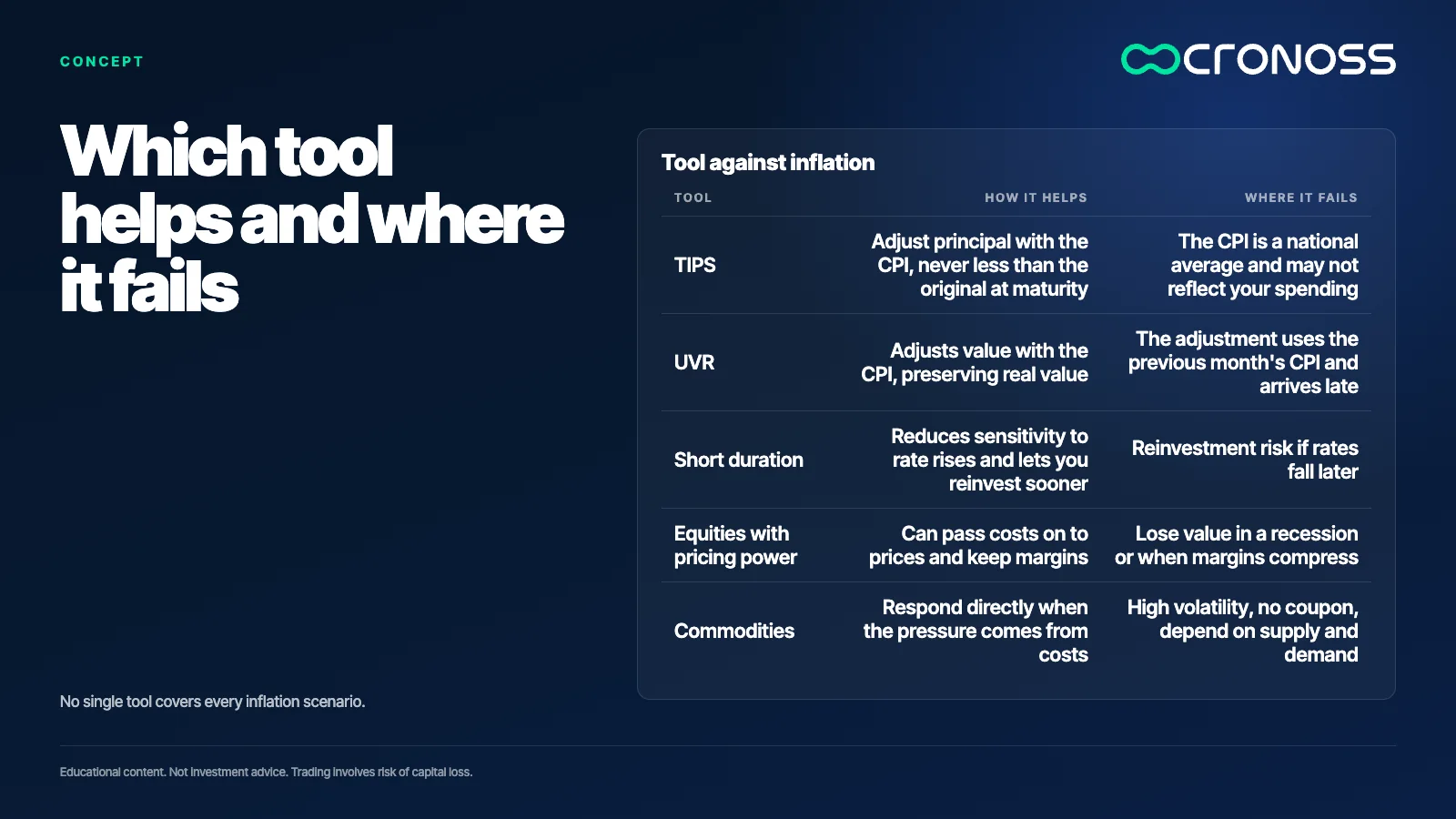
TIPS are U.S. Treasury bonds whose principal rises with inflation and falls with deflation. The Treasury states that it adjusts principal using the CPI from the Bureau of Labor Statistics, and that at maturity you never receive less than the original principal. That floor is their main appeal. Their limit is that the adjustment follows a national index: if your own spending rises faster than that average, the protection is partial.
In Colombia, the UVR plays a similar role. The Banco de la República describes it as a unit that reflects purchasing power based on the change in the CPI. Its best-known use is in mortgage loans, where it helps preserve the real value of the loan. Its limit is the lag: the UVR is computed from the CPI change of the previous month, so in a sudden jump in prices it arrives late.
Short duration: less sensitivity to rates
When rates rise, a long-duration instrument loses more market value than a short-duration one, because its payment stream stays tied to the old rate for longer. That is why short duration is usually the first line of defense within nominal fixed income: it lets you reinvest sooner at new rates. Duration is the measure of that sensitivity, and it is worth checking before you buy any fixed-income product.
Its limit is reinvestment risk. If rates fall after you buy, you will earn less when you roll over. A portfolio made only of short maturities swaps price risk for the risk of low rates, and it does not preserve purchasing power if inflation stays high while the yield stays low. That effect is quiet, because it never shows up as a loss on the screen. It shows up as a purchase that no longer goes as far.
Equities with pricing power and commodities
Shares of companies that can raise prices without losing customers tend to keep their margins when costs rise. That ability, known as pricing power, is the trait to look for, not the sector label. They fail when inflation mixes with recession: costs rise, demand falls and valuation multiples compress at the same time. They can lose value in a market decline, and that risk is real.
Commodities respond directly to a cost shock. If inflation starts in energy or food, exposure to those commodities can offset part of the pressure. But their volatility is high, they pay no coupon, and their price depends on global supply and demand, not only on inflation. A weekly inventory report can move a price sharply within a single session. Without a maximum size and exit rules, protection becomes a bet. Gold is another alternative, covered in a separate article.
A regime-based approach, not a single bet
A regime-based approach classifies the environment with two questions: is inflation rising or falling, and is growth supporting it or weakening? Each combination calls for a different mix. With rising inflation and strong growth, equities with pricing power and some commodity exposure carry more weight. With rising inflation and weak growth, short duration and inflation-linked instruments gain weight.
The portfolio is adjusted when the regime changes, not every time a headline appears. Following the CPI, producer price and inventory calendars helps you spot a change early, although no single signal is conclusive. That discipline avoids reacting too late, and it also avoids selling everything over one isolated data point.
Three steps to review your portfolio
- Identify the source of the pressure. Note whether CPI and producer prices are rising together or whether only one component, such as energy or food, is moving.
- Measure your real exposure. Calculate how much sits in nominal fixed income, how much in inflation-linked fixed income, how much in equities with pricing power and how much in commodities.
- Set the review trigger before you need it. Write down which data point or regime change will make you adjust, and by how much, so you do not decide out of fear in the moment. Also note the date and the data point behind each change, so you can later check whether the decision was right.
Protecting yourself is not guessing inflation
You do not need to predict the next CPI print to protect your portfolio. You need to know which tool responds to which kind of pressure, where each one fails, and when the mix should be reviewed. Once that is clear, inflation stops being a headline that scares you and becomes a variable you monitor with rules set in advance. Your goal is not to get every move right, but for your mix to survive when you are wrong. That discipline is worth more than any single prediction.
If you want to learn how to measure risk and diversify capital with a method, review the program Gestión Aplicada de Riesgo y Diversificación de Capital (Applied Risk Management and Capital Diversification).
Educational content. Cronoss is not a broker, investment firm or financial adviser, and nothing above is an investment recommendation.
Frequently asked questions
Which investment protects best against inflation?
No single investment protects in every scenario. TIPS and UVR adjust principal for inflation, short duration reduces rate risk, and equities with pricing power help protect margins. The right mix depends on the type of inflationary pressure.
What are TIPS?
TIPS are U.S. Treasury bonds whose principal rises with inflation and falls with deflation. At maturity, according to the Treasury, you never receive less than the original principal. The adjustment uses the CPI from the Bureau of Labor Statistics, a national average.
What is the UVR?
The UVR is a unit that reflects purchasing power based on the change in the CPI, according to the Banco de la República. Its best-known use is in mortgage loans. Because it is computed from the previous month's CPI, its adjustment arrives with a lag.
Do commodities help protect against inflation?
They can help when the pressure comes from energy or food costs, since their prices respond directly to those costs. Their volatility is high and they pay no coupon. That is why they work best as a small part of a portfolio, with clear rules.