
Key takeaways
- Concentrating in a few businesses and balancing risk across assets are different logics, and each carries its own risk.
- Volatility measures how much a portfolio moves, but it does not tell you whether that portfolio is good or bad.
- A 50 percent fall requires a 100 percent gain to return to the starting point, which is why deep drawdowns are costly.
- The Sharpe ratio divides the extra return over a risk-free rate by the volatility taken on to earn it.
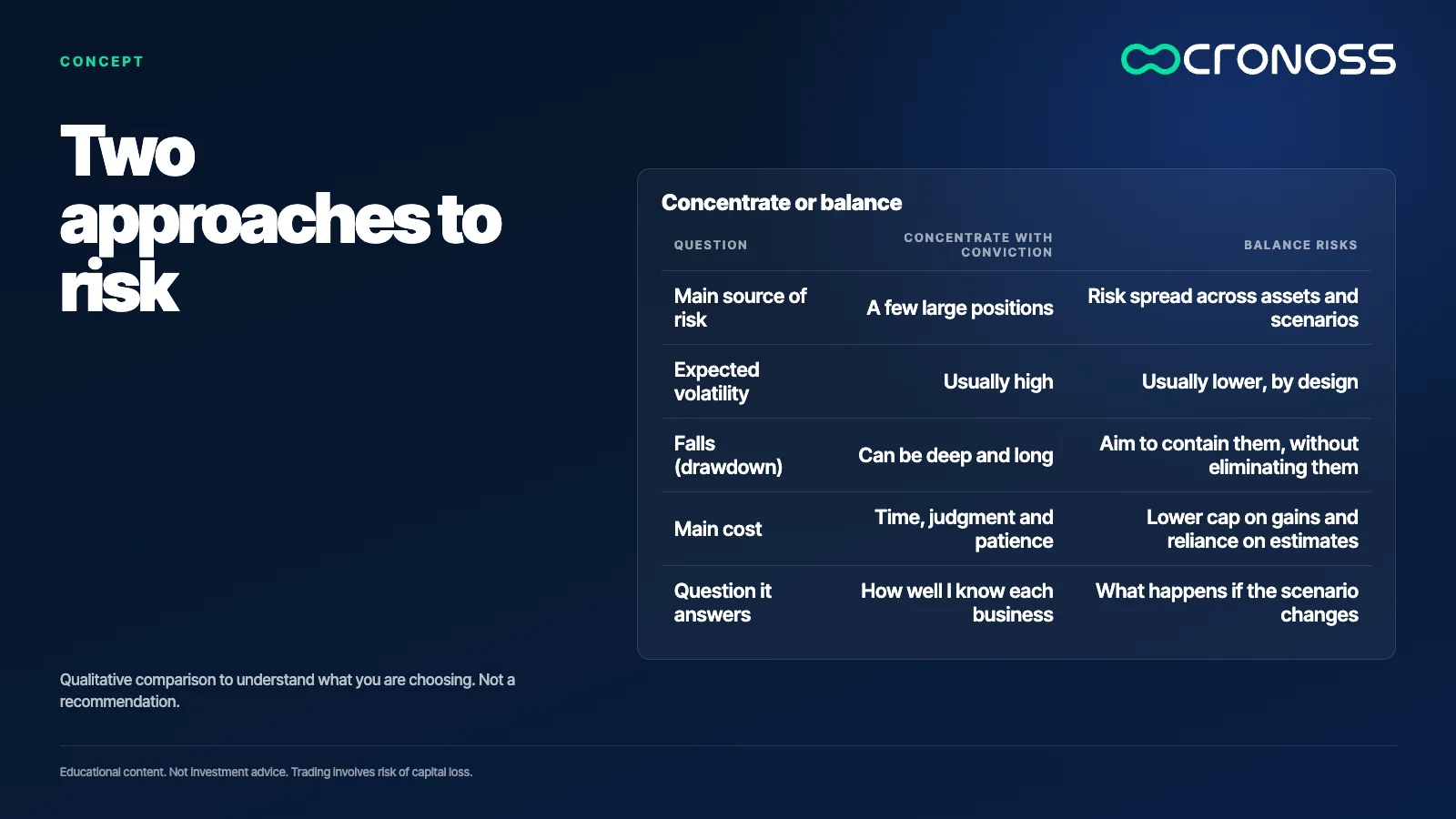
- Each approach has a cost: time and patience in one, a cap on gains and reliance on estimates in the other.
When an investor sees that one company delivered a large gain, the temptation is to put more money into it. Another investor sees the same situation and asks how much could be lost if that company fails or if the market changes mood. These are different questions, and each one leads to a different portfolio.
This contrast is often illustrated with two well-known names: Warren Buffett, associated with a few large positions in businesses that are understood in depth, and Ray Dalio, associated with spreading risk across assets that react differently to economic cycles. The names work as labels. What matters is the logic behind each one.
Choosing between concentrating and balancing means choosing which kind of risk you accept, and how much time and patience you can sustain it.
This article does not say which approach is better. It explains what volatility, the Sharpe ratio and drawdown measure, and what each path costs.
Two logics for the same market
The concentration approach starts from a thesis: if you understand a few businesses well, including their quality and their price, you can hold large positions even when the price falls along the way. Its advantage is that each decision has a clear owner and the value of a good business builds up in the portfolio. Its risk is that the result depends on a few bets. Conviction is not certainty: it means having studied the thesis well enough not to depend on daily noise.
The balancing approach starts from a different question: what happens to the portfolio if inflation rises, growth slows or credit gets more expensive. Risk is spread across assets with different behaviour, so that no single scenario destroys it completely. Ray Dalio explains his way of thinking in the book Principles (2017). Aswath Damodaran, in Investment Philosophies (2003), surveys several investment philosophies and the rules of the investors who applied them.
Neither approach is an automatic recipe. Both are ways of organising uncertainty.
Volatility: how much the value moves
Volatility measures how far returns stray from their average. A highly volatile portfolio can rise sharply one year and fall sharply the next. A less volatile one moves more calmly, although its climb upward is also slower.
This measure matters because it describes the investor's day-to-day experience, not only the final result. Two portfolios can end at the same point and feel very different to live with. Those who concentrate in a few businesses usually accept more volatility. Those who balance risk aim to smooth the extremes, even though that limits the strongest gains. A practical test is to ask how many times in a year the portfolio's value would force you to review your plan. If the answer is many, volatility is already a burden, even if the final result is good.
Volatility does not tell you whether an asset is good or bad. It only tells you how much it moves. A solid company can be very volatile, and an apparently calm asset can be risky if it depends on a single source of income or on heavy debt.
Drawdown: the fall you have to survive
Drawdown measures the decline from a previous peak to the next low point. It is the loss an investor lives through in practice, which is why it matters as much as volatility.
The arithmetic of losses is asymmetric. This is our own calculation, not a market data point: if a portfolio worth 100 falls to 50, it must go from 50 back to 100 to return to its original value. That is a gain of 100 percent on what remains. The deeper the fall, the harder the recovery.
Risk: a deep drawdown can force you to sell at the worst moment, and at that point the loss stops being a number on the screen and becomes permanent.
That is why the concentrated approach demands tolerance for large falls. If the thesis behind each business still holds, the fall may be an opportunity; if it does not, it may be a permanent loss. The balanced approach seeks to contain the fall, although it does not eliminate it.
Sharpe ratio: return for each unit of risk
The Sharpe ratio compares how much extra return a portfolio earns over a risk-free rate, for each unit of volatility it takes on. It is calculated as (portfolio return minus risk-free rate) divided by volatility. The risk-free rate is the return you could earn without taking meaningful risk, and it serves as the benchmark: a portfolio that barely beats it earns little for the risk it takes.
Worked example (illustrative figures, our own arithmetic):
Portfolio A: return of 12 percent, risk-free rate of 4 percent and volatility of 16 percent. Step 1: 12 minus 4 is 8. Step 2: 8 divided by 16 is 0.50.
Portfolio B: return of 15 percent, the same 4 percent risk-free rate and volatility of 30 percent. Step 1: 15 minus 4 is 11. Step 2: 11 divided by 30 is 0.37.
Portfolio B earns more in absolute terms, but it earns less return for each point of volatility. The ratio helps with comparison without making the decision for you. It has a limit: it uses past data, and historical volatility does not always anticipate what comes next.
What each approach costs
Concentration costs time, judgment and patience. You need to understand each business in depth, follow it in good times and bad, and accept that a mistake weighs heavily because there are few positions. It also requires holding through long falls without selling, something few people manage in practice.
Balancing has costs too. It can limit gains in the years when a concentrated asset rises sharply. It requires estimating risks and the relationships between assets, and those estimates change when the market changes. Some investors bring risk to a useful level with leverage, which amplifies losses as much as gains.
There is also an opportunity cost: money tied up in an asset that does not move for years is not available for another decision.
Neither approach removes the possibility of losing money. Any strategy can have negative years, and the real cost shows up in the decisions you make under pressure.
Three questions before you choose
- What fall would you accept without selling. Write down the worst fall you could bear in one year and compare it with the one your portfolio could suffer.
- How much time and judgment you can commit. If you cannot follow businesses in depth, concentrating exposes you without giving you an edge.
- Which scenario worries you most. If high inflation or a slowdown in growth concerns you, check whether your portfolio holds something that reacts differently to it.
The question underneath
The difference between these two paths is not about who is smarter. It is about which risk you can hold when the market tests you. That is why the useful question is not which return is promised, but which fall you can endure without abandoning your plan. A strategy you cannot keep through a drawdown is not your strategy, however good it looks on paper.
The best portfolio is the one you can still hold on the day it hurts most.
If you want to measure volatility, drawdown and the Sharpe ratio with your own data, see Medición y Optimización de Portafolios (Measurement and Optimization of Portfolios).
Educational content. Cronoss is not a broker, investment firm or financial adviser, and nothing above is an investment recommendation.
Frequently asked questions
What is the Sharpe ratio?
The Sharpe ratio measures how much extra return a portfolio earns over a risk-free rate for each unit of volatility it takes on. It is calculated as the return minus the risk-free rate, divided by volatility. It uses past data, so it does not guarantee anything going forward.
What is drawdown?
Drawdown is the decline from a previous peak to the next low point. It measures the loss an investor actually lives through. The deeper the fall, the larger the gain needed to recover.
Is concentrating in a few businesses always riskier?
Not always, but the risk sits in a few decisions. If one of them goes wrong, the effect on the portfolio is large. The risk depends on the thesis, the price and how much of a fall you can sustain.
Does balancing risk guarantee stability?
No. It reduces dependence on a single scenario, but it does not eliminate losses. Risk estimates change with the market, and during broad crises several assets can fall at the same time.


