Key takeaways
- A store of value aims to keep purchasing power; an investment aims for a return that compensates the risk you take.
- Gold pays no interest, dividends or earnings, so its return depends only on the price at which you sell it.
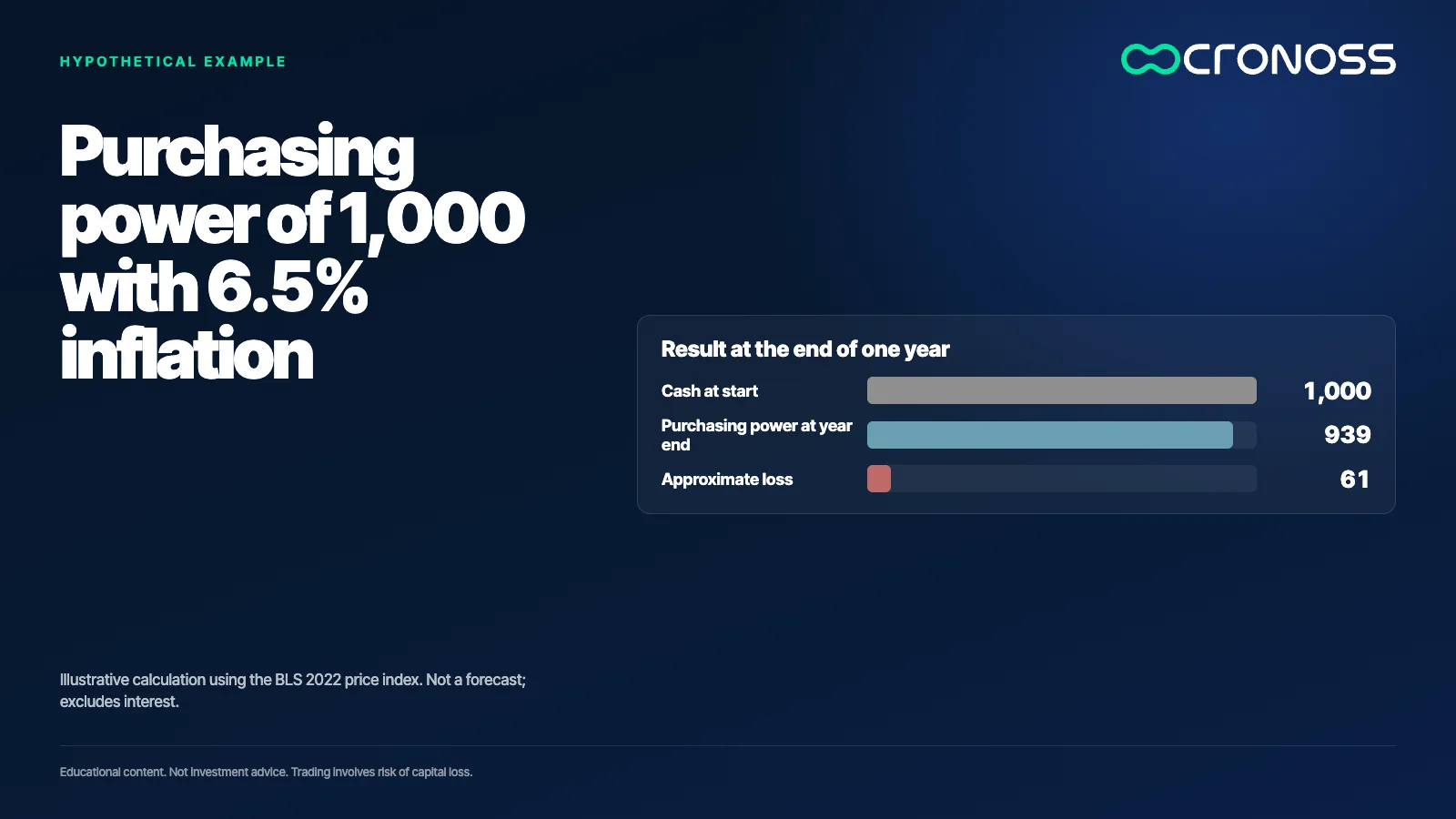
- With 6.5% inflation in 2022, USD 1,000 in cash would have bought about USD 939 in starting prices by year end.
- No asset is risk free: even U.S. Treasury bonds carry interest rate risk, since their price moves when rates change.
- Before choosing an amount, define the role gold would play in your portfolio: protection, diversification or short-term trading.
When prices rise, cash loses purchasing power, which is why many people look for assets that hold their value. Gold almost always comes up in that conversation, along with a harder question: is it a store of value, an investment, or both?
The answer depends on what each term means. A store of value aims to keep purchasing power over time. An investment aims for a return that compensates the risk you take. Mixing the two leads to decisions that do not match what a person expects from the asset. That confusion appears both among people who are just starting out and among those who already hold a portfolio.
Gold can play a role as a store of value, but it generates no income and carries no risk-free guarantee, so it should not be judged like a bond or a stock.
Does gold protect against inflation?
The idea that gold protects against inflation has a historical argument behind it. Gold is often presented as a way to preserve value during inflationary periods, and a simple historical comparison is used: how much gold it took to buy a house in the distant past and how much it takes today. That observation is an argument, not proof. An asset can hold its purchasing power for some years and lose it in others. Inflation, by contrast, has a measurable definition: a sustained rise in the general level of prices. So the useful question is more precise: did gold rise more than prices over the period you care about? The answer changes with the horizon, the purchase date and the currency in which you measure the result. A fair test compares gold with a broad set of prices over the same dates, not with a single headline or a single good year.
Store of value and investment are not the same
An asset is a store of value when its main job is to preserve the purchasing power of what you save. An asset is an investment when you expect a return that compensates the risk you take. A bond does both with clear rules: it pays interest and returns principal at maturity. A stock can grow because the company earns money and distributes profits. Gold does the first job more easily than the second, because its price depends on what someone will be willing to pay for it later. Mixing the two produces common mistakes: expecting a store of value to produce income, or accepting the volatility of an investment while thinking it is a safe haven.
Gold pays no cash flows
A bond pays periodic coupons. A stock may pay dividends and, above all, its value depends on the company's future earnings. Gold does neither. It pays no interest, distributes no dividends and has no productive operation that raises its value over time. Its return comes only from the gap between the purchase price and the sale price, minus storage and transaction costs. This does not make gold useless, but it changes the comparison. With a bond, much of the return arrives as known payments. With gold, the whole result depends on the price that exists at the moment you sell. A rental property, by contrast, produces rent that can be reinvested or saved, which is one reason the two are compared differently in a portfolio.
How gold behaved during the 2022 inflation
The 2022 inflation is a useful case. The U.S. Bureau of Labor Statistics (BLS) reported that the Consumer Price Index rose 6.5 percent over the 12 months to December 2022, before seasonal adjustment. Here is a simple calculation, not a forecast. If you hold USD 1,000 in cash through that year, its purchasing power at year end would be 1,000 / 1.065 = 938.97, or about USD 939 in starting prices. The approximate loss is USD 61, before any interest. The next question is how much of that loss gold would have offset over the same period. That answer requires exact starting and ending prices, and it cannot be inferred from one sentence. Inflation in 2022 was high and was contained toward 2023, but an investor's result depends on the entry and exit dates.
Long flat periods and breakouts
The price of gold can stay in a sideways range for years and then break out with a fast advance. That is the familiar pattern: stagnation followed by breakouts. That behavior has two readings. First, gold does not rise continuously, so the result depends heavily on when you buy. Second, fast advances attract buyers, and that does not guarantee the move will continue. Technical analysis can describe ranges and breakouts, but describing is not predicting. A person who buys after a breakout may be right over the long run and still lose patience during a long sideways period. That tolerance for time should be assessed before buying. A useful check is to write down, before purchase, how much time without progress you would accept.
No asset is risk free
The risk-free asset is often mentioned, and U.S. Treasury bonds usually fill that role as a reference. That idea deserves a closer look. But even that asset carries risks: its price changes when interest rates change, there is credit risk if the issuer fails to pay, although it is considered low, and there can be liquidity risk if no buyers exist when you need to sell. The precise statement is that some assets carry lower and different risks, not that they carry none. Gold has its own risk. It does not depend on an issuer paying, but its price depends on demand and investor behavior, and it can fall for years. Risk is also a property of the holder's situation, including the time horizon and the need for cash on a given date.
Risk note: any asset can lose value, gold included.
What role could gold play in your portfolio
Before thinking about a percentage, define the role. These three steps structure the decision:
- Define the role, not the amount. Write whether gold would serve as protection against inflation, as diversification, or as a short-term trading tool. Each role requires a different horizon and a different way of measuring results.
- Check your horizon and your patience. Ask how long you could hold it if it went five years without rising. If that idea makes you uncomfortable, a long-term protection role may not fit you.
- Compare with what you already hold. Identify which risks your cash, bonds and stocks already cover, and what risk gold adds that is not already in your portfolio. Diversification is measured by how assets behave together, not by how many you own.
Once the role is clear, the amount is a later decision based on your risk profile and situation. This text does not set that amount or recommend an allocation.
Holding value is a decision too
Holding gold can be a reasonable way to preserve purchasing power, as long as you know it generates no income, that its price can stay flat for years, and that no asset is free of risk. Anyone who buys it as a store of value should measure whether it performs that function in their situation. Anyone who buys it expecting a return should assess that expectation as seriously as any other investment. The difference between the two decisions lies in the role you assign before looking at the price. Gold answers the question of what you want to protect, not the question of how much it will rise.
If you want to build that judgment with a method, review the program Fundamentos de Portafolios de Inversión (Fundamentals of Investment Portfolios).
Educational content. Cronoss is not a broker, investment firm or financial adviser, and nothing above is an investment recommendation.
Frequently asked questions
Does gold protect against inflation?
Gold has a historical argument as a store of value during inflationary periods, but no period guarantees it. Its result depends on the horizon, the starting point and the currency used to measure it.
Is gold an investment or a store of value?
It can serve as a store of value, but because it generates no cash flows, its return depends only on selling at a higher price. Evaluate it first by the role it would play in your portfolio.
Why does gold have no yield?
Gold pays no coupons or dividends and generates no earnings. Its return comes only from the difference between buy and sell prices, minus storage and transaction costs.
Is there a risk-free asset?
No. U.S. Treasury bonds are used as a low-risk reference, but they carry interest rate risk and their price can fall before maturity.