
Key takeaways
- Investing, speculating and betting can be the same transaction; what changes is the reasoning behind it.
- Investing is allocating capital to a productive activity with a defined return, risk and horizon.
- Speculating is taking positions on price movement, and it can be done with method and discipline.
- Betting is taking risk without enough analysis, driven by emotion or fear of missing out.
- Three questions help classify a decision: what creates value, whether there is a method and horizon, and what happens if you lose what you put in.
One person buys a foreign currency, another buys a company's bond and a third buys an asset because everyone is talking about it. All three press the same buy button. From the outside, the three trades are identical.
The difference is not in the transaction. It is in the reasoning that comes before and after it. And that is where three behaviors that are constantly confused part ways: investing, speculating and betting.
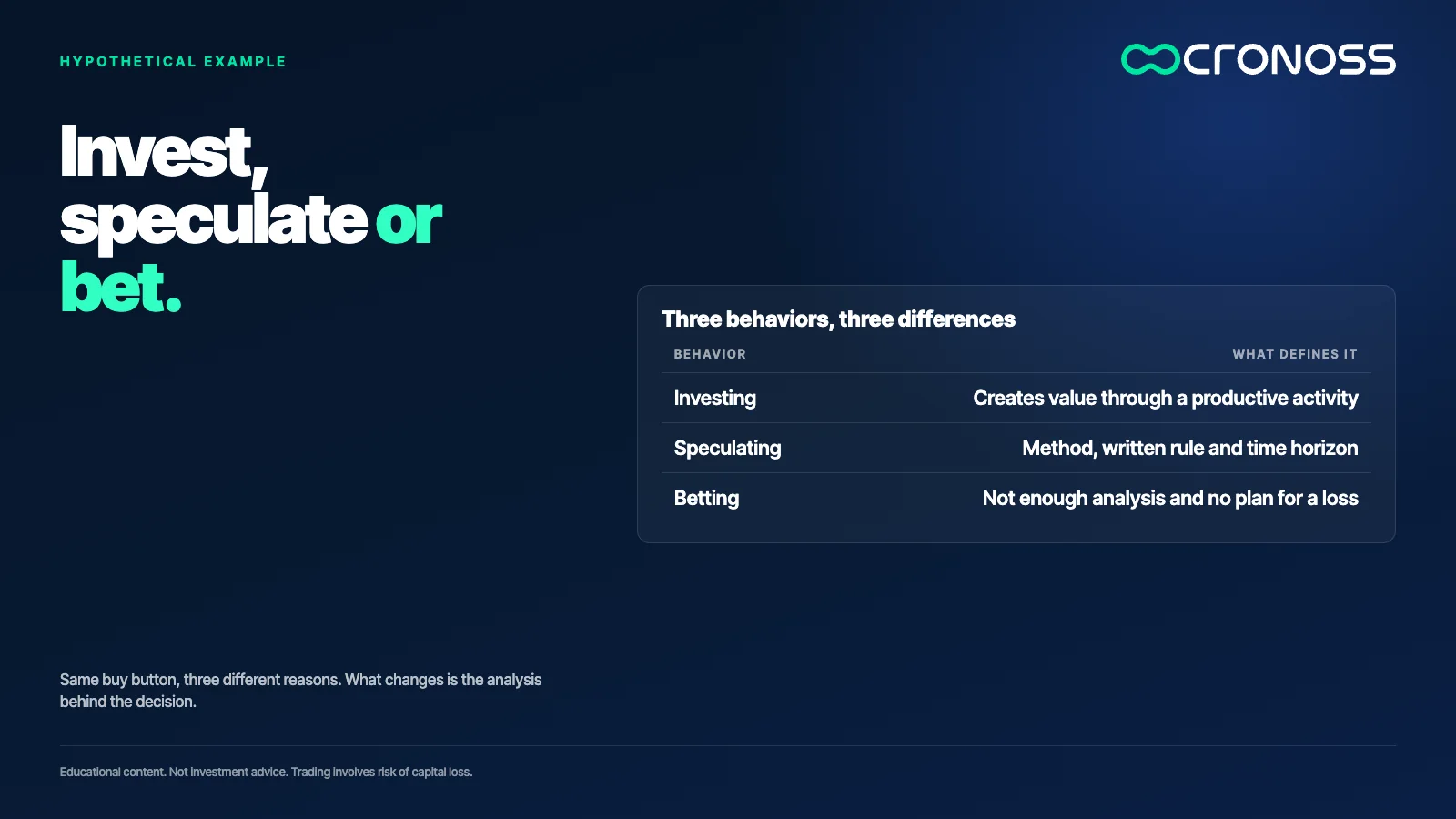
Investing, speculating and betting are three different behaviors with the same transaction: what separates them is the analysis, the method and the time horizon behind each decision.
Why are they so often confused?
Because buying a stock is just a transaction. The same asset can be bought for any of the three reasons, and nothing on your account statement tells you which one it was. So the useful question is not "what did I buy?" but "why did I buy it and what did I expect to happen?".
Investing: allocating capital to a productive activity
Investing is putting capital into a productive activity with the expectation of a future return. It has three components: the expected return, the risk (always present) and the time horizon. And it has one distinguishing feature: it creates value, because that capital finances something that produces.
- Corporate debt or a term deposit: you lend to a company or a bank that finances productive activity. The risk is usually low, but never zero.
- A property: its value relates to replacement cost and to inflation.
Speculating: betting on the price move with a method
Speculating is taking positions on how a price will move, without creating value, relying on patterns more than on fundamentals. It contrasts with value investing, which looks at what an asset produces. Speculating is not a synonym for something bad: it can be done with method and discipline, but it has a different nature.
A basic difference is that, in operations that depend only on price movement (a currency, a derivatives contract), what one side gains the other side loses, before costs. An example with invented numbers: a currency bought at COP 3,700 and sold at COP 3,900 leaves a COP 200 gain per unit, a bit over 5%. That gain comes out of the pocket of whoever sold earlier or bought against it.
Betting: risk without enough analysis
Betting is taking a risk without enough analysis, without a method, and driven by emotion or by fear of missing out. You can recognize it because there is no reason you could explain and no plan for the loss.
Leverage makes the problem worse. With 10 to 1 leverage, a 10% drop in price wipes out 100% of the capital put in. What looked like a small bet becomes a total loss.
How to classify a case
Three questions help place any decision:
- What creates value here? If there is a productive activity behind it (a company, a loan, an asset that produces income), it looks more like investing.
- Is there a method and a horizon? A written rule for entry, exit and position size points to speculating with discipline. Its absence points to betting.
- What happens if I lose everything I put in? If there is no answer, there is no risk management.
These criteria do not say what suits each person. They help each person recognize their own behavior.
Three illustrative, invented cases to practice:
- A person buys a company's bond because they understood how the company generates the income it pays interest from, and they know how long they will hold it. It looks like investing.
- Another buys a currency because the chart shows a pattern that, under their written rule, tends to precede a rise, and they decide in advance where they would exit if wrong. It looks like speculating with a method.
- A third buys an asset because all their acquaintances are buying it and they fear "being left out", with no exit plan. It looks like betting.
When the same person changes roles
It is common for someone to start by investing and, after a streak, move to speculating, or for a trade with a method to turn into a bet after a loss. Recognizing the change in time is part of financial education: the problem is not doing any of the three, but doing one while believing you are doing another.
A diagnosis before deciding
Someone who knows what they are doing can measure what they expected, accept the risk they chose and adjust when something does not work out. Someone who does not know ends up explaining results with luck or bad luck.
Naming what you do properly is the first step to doing it better.
To go deeper into how saving, investing and risk work from scratch, take a look at the program Fundamentos de las Finanzas (Fundamentals of Finance): Fundamentos de las Finanzas.
Educational content. Cronoss is not a broker, investment firm or financial adviser, and nothing above is an investment recommendation.
Frequently asked questions
What is the difference between investing and speculating?
Investing is allocating capital to a productive activity expecting a future return, and it creates value. Speculating is taking positions on the movement of a price relying on patterns, without creating value. Both carry risk, but their nature is different.
What is betting in finance?
It is taking a risk without enough analysis or method, driven by emotion or fear of missing out. You can recognize it because there is no reason you could explain and no plan for the loss.
Is speculating bad?
Not necessarily. It can be done with method and discipline, but it involves risk of loss and does not create value on its own. The problem appears when you speculate believing you are investing.
How do I know if I am investing, speculating or betting?
Ask what creates value in your decision, whether you have a defined method and horizon, and what would happen if you lost everything you put in. The answers help place your behavior without judging it.