Key takeaways
- Closing out of fear responds to discomfort, not to what the chart shows, so it carries no information about the market.
- Cutting gains at 1R instead of 3R raises the hit rate needed to break even from 25% to 50%.
- The second decision, impulsive re-entry, often does more damage to the account than the first.
- A plan that fails is a cost of doing business; an execution that fails is fixed with process, not more analysis.
- After closing outside the plan, a five-minute pause with a physical change helps break the emotional cycle.
The scene is a familiar one. A trade follows the plan to the letter, price moves in your favor and the floating profit is already considerable. Then a whisper shows up: that profit is not yours yet, it can come back. A hand on the mouse, a racing pulse, one click. The trade closes with a small gain. Half an hour later, price reaches the original target without any trouble.
What is left is not lost money, because the account shows a profit. It is something harder to name: the feeling of having failed, not for lack of analysis but for lack of character. And that feeling often pushes the next decision, which is almost always worse.
Closing early out of fear does not protect the gain: it trims the system's edge and opens the door to a second mistake.
The fear of giving a gain back has a name
Loss aversion is a bias described by Daniel Kahneman and Amos Tversky: losing an amount hurts more than gaining the same amount pleases, by common estimates about twice as much. That is why the instant relief of closing a winning trade outweighs the uncertainty of waiting for the target.
Closing out of fear does not respond to what the chart shows. There are no candles against the trade and no broken level. The trade is closed to stop the discomfort, and that difference matters because discomfort carries no information about the market.
Cutting gains changes the system's arithmetic
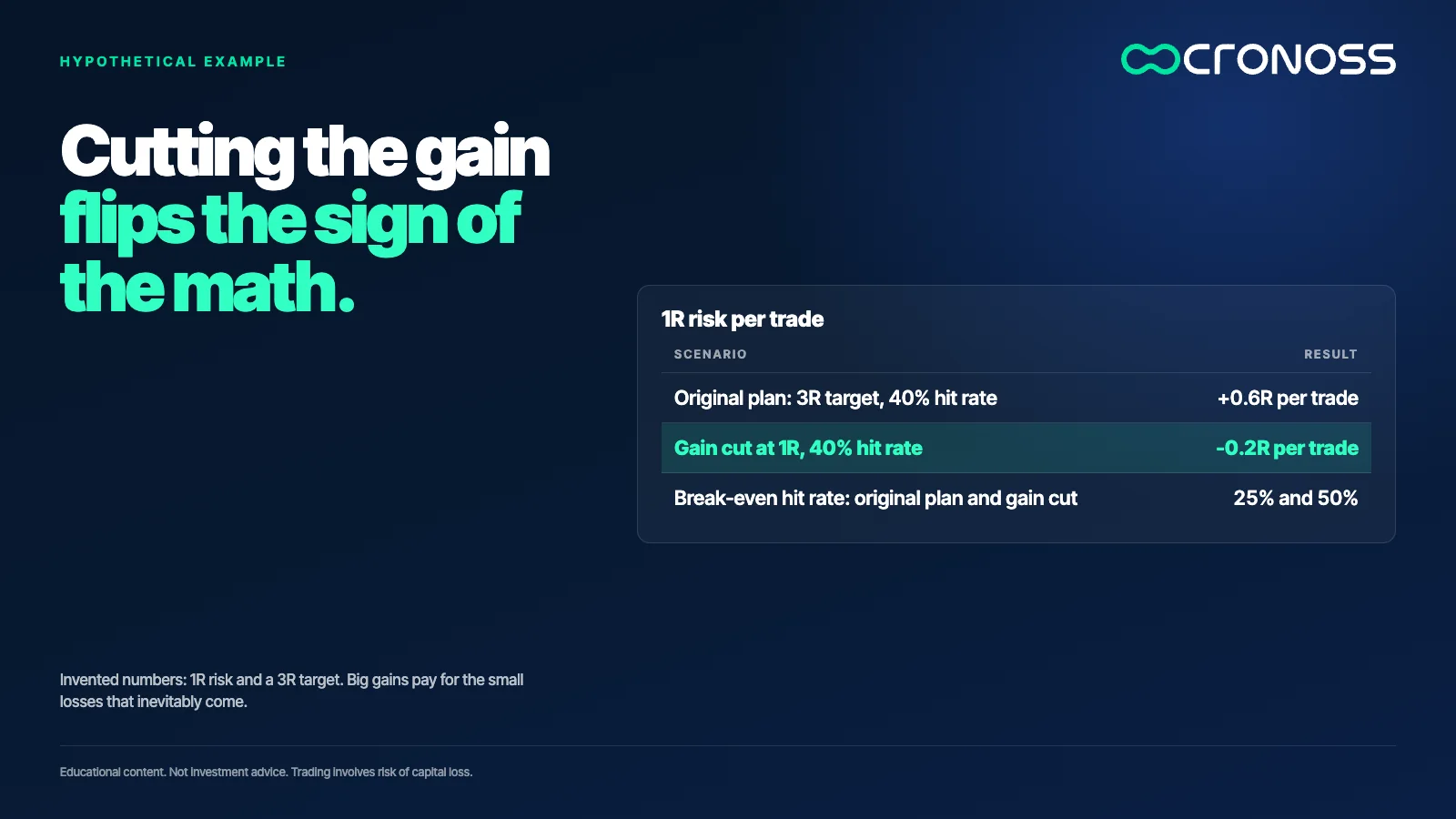
Picture a plan with made-up numbers: 1R risk per trade, a 3R target and a 40% hit rate. Expectancy per trade is 0.4 × 3 minus 0.6 × 1, which is +0.6R. The plan has an edge.
Now imagine every gain is closed early, at 1R. Even if more trades reach 1R than 3R, breaking even with 1R gains and 1R losses requires winning half the time, versus one in four with the original plan (1 ÷ (1 + 3) = 25%). If the hit rate stays at 40%, expectancy becomes 0.4 × 1 minus 0.6 × 1, equal to −0.2R. Big gains exist to pay for the small losses that inevitably come, and cutting them leaves the losses with nothing to pay them.
The second loss is usually the one that hurts the account
After closing and watching price keep going, the first frustration turns into something else. A feeling appears that the market "owes" what was not earned, and with it the temptation to enter again with no valid signal, just because watching the move from the outside is unbearable.
An example with made-up numbers: the trade is closed at +40 when the plan aimed for +500. Out of anger or fear of missing out, you enter again, late and without confirmation, and price hits the stop at −100. The day ends at −60, when the original plan would have left +500. The difference is not 40 against 100: it is one low-quality decision chained to another.
The money on the screen is not yours until it closes by the plan
Two ideas help lower the emotional load. The first: while the trade is open, the floating profit is a number that changes, not your money. Counting it as earned is a mental trap that makes any pullback unbearable.
The second is the reverse: what the trade could have paid and did not materialize is not lost money either. It is a probability that did not play out because of an execution failure. Keeping a tally of bills the market "owes" only feeds resentment, and resentment is the shortest path to the next mistake.
A plan that fails is a cost of doing business
There are two very different kinds of failure. If the plan fails, because price hit the stop or the scenario did not develop, it is an operating cost, like the expenses of any business. There is no blame to hand out.
If execution fails, because you closed out of fear or entered on impulse, the problem is different and so is the fix: it is corrected with process, not with more analysis. Separating the two categories keeps you from punishing yourself for normal losses and from excusing conduct errors as bad luck.
The five-minute rule
After closing a trade outside the plan, out of fear or impulse, the rule is not to look at the platform for five minutes. Letting go of the mouse is not enough: change your physical state, stand up, leave the room, drink some water or do a few push-ups. The idea is to break the activation cycle that clouds judgment.
It is not a cure or a medical technique; it is a deliberate pause. And it rests on a simple idea: jumping back onto a train that has already sped up is worse than waiting for the next one with a cool head.
The journal should include what you felt
Many journals record entry and exit prices. They help, but they fall short. It also pays to record what was felt and where: tightness in the chest when the candle turned red, sweaty hands, anxiety at a certain hour. Recognizing the physical pattern of emotions is the first step toward interrupting it in time.
With the record, regularities appear: trading at night brings more anxiety, a loss triggers the urge to win it back. Each has a concrete answer, such as stepping away from the chart for a while.
A 24-hour experiment
Your next trade can have a different goal than usual: not to win a given amount, but to execute flawlessly.
- Write the plan before entering. Technical reason for entry, exit level for a gain and exit level for a loss.
- Do not change those levels while the trade is open. If price hits the target and keeps going, the plan worked.
- Judge the execution, not the result. The question of the day is whether you kept your own word, not how much you made.
This does not mean letting every trade run. It means any change of plan is decided calmly and in writing, not in the middle of a rush of adrenaline.
The "what if" does not exist
Trading rewards what nearly everything else in life punishes: doing nothing once the trade is running. That is why it is so hard, and why discipline shows most when everyone else is losing their head.
The "what if" does not exist; only the next trade exists, and the ability to execute it with integrity. If you want to understand better how the mind reacts under pressure and how to train it, the program Fundamentos del Psicotrading y Neurotrading (Foundations of Psychotrading and Neurotrading) works through these topics step by step: Fundamentos del Psicotrading y Neurotrading.
Educational content. Cronoss is not a broker, investment firm or financial adviser, and nothing above is an investment recommendation.
Frequently asked questions
Why do I close winning trades too early?
Because of loss aversion: the pain of giving back a gain outweighs the pleasure of waiting for a bigger one. Closing relieves immediate discomfort, even if the chart gave no exit signal.
Is letting gains run always the best option?
No. What matters is following the plan written before entering. If the plan includes partial exits or a trailing stop, applying them is part of the plan; what hurts is changing it out of fear mid-trade.
What is the five-minute rule?
After closing a trade out of fear or impulse, you do not look at the platform for five minutes and change your physical state, for example by standing up or drinking water. It aims to break the emotional cycle before an impulsive re-entry.
What should an emotions journal include?
Besides entry and exit prices, what was felt and where in the body, at what hour and in what situation. Over time it shows patterns, such as anxiety when trading at night, that you can anticipate.