Key takeaways
- Recovering from a loss takes a gain of 1 / (1 - loss) - 1; losing 40% requires gaining 66.7%.
- The link between drop and recovery is not linear: from 30% or 40% the road back gets much longer.
- An optimized portfolio seeks the highest return per level of risk; a resilient one seeks not to break in any scenario.
- The permanent portfolio splits 25% across stocks, long bonds, gold and cash for four economic environments.
- Resilience costs return in strong up years; the choice depends on your horizon and risk tolerance.
A person has USD 100 and loses 40%. They are left with USD 60. If the market gives back 40% the following year, they are not even: 40% of USD 60 is USD 24, and the balance is USD 84. They are still USD 16 short of where they started.
A loss demands a recovery larger than itself. Getting from USD 60 back to USD 100 takes a 66.7% gain, not 40%. That asymmetry is why some investors design their portfolio by first asking how far it can fall, and only then how far it can rise.
A portfolio can be built to earn as much as possible or to withstand any economic environment, and the arithmetic of drawdowns explains why the second goal makes sense for capital you do not want to see cut in half.
The arithmetic almost nobody calculates
The gain needed to recover from a loss is 1 / (1 - loss) - 1. With that formula:
- A 10% loss: requires an 11.1% gain.
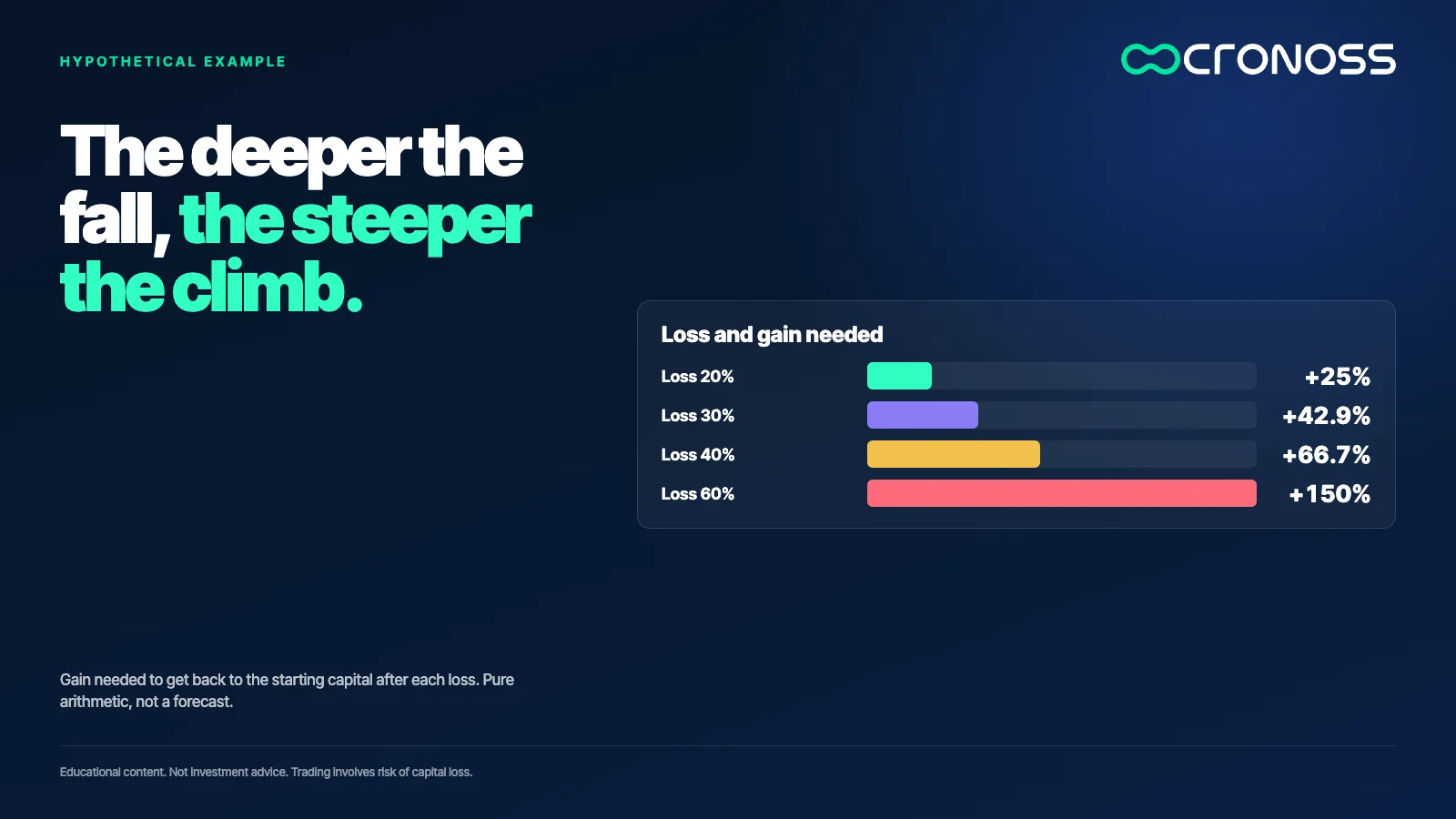
- A 20% loss: requires a 25% gain.
- A 30% loss: requires a 42.9% gain.
- A 40% loss: requires a 66.7% gain.
- A 50% loss: requires a 100% gain.
- A 60% loss: requires a 150% gain.
The relationship is not linear. The first drops are manageable; from 30% or 40% on, the road back gets much longer, and the time it takes is time during which the capital is not working.
Optimizing and withstanding are different goals
An optimized portfolio aims to sit on the Markowitz efficient frontier: the highest expected return for a given level of risk, calculated from historical returns, volatilities and correlations. It works well as long as the future resembles the past that was measured.
A resilient portfolio starts from a different question: what would have to happen for things to go very badly, and which asset protects me in that case? It does not try to predict which scenario will arrive. It is built so that none of them destroys it.
Four environments and one asset for each
The best-known design of this kind is the permanent portfolio, proposed by Harry Browne in the 1980s and developed in his book Fail-Safe Investing. Its starting point is that the economy moves through four environments, and no single asset works well in all of them:
- Prosperity. Stocks tend to benefit.
- Deflation. Long-term government bonds tend to gain value when prices and rates fall.
- Inflation. Gold tends to hold value when money loses purchasing power.
- Tight money or recession. Cash provides liquidity and stability when everything else is moving.
The proposal is to split the capital equally, 25% in each. You do not need to guess which environment is coming, because one quarter of the portfolio is designed for each one.
What you give up in exchange
Resilience has a cost. A portfolio with half its capital in assets that are not stocks does not keep pace with a stock market in strong up years, and that gap can weigh for a long time. Whoever adopts it accepts earning less in good years in exchange for falling less in bad ones.
That is why it is not a recipe for everyone. It depends on the horizon, the risk tolerance and the stage of life. Someone accumulating capital over decades may prefer more stocks; someone who already has wealth they want to protect may value stability more. Neither stance is wrong, what matters is choosing it deliberately.
Simplicity is also a defense
A four-piece portfolio with clear rules leaves few decisions to make. In a panic, when prices fall fast and decisions turn into reflexes, a plan that does not require guessing lowers the risk of selling out of fear. The discipline of reviewing the portfolio once a year and returning each part to its original weight is part of the design.
This does not mean a simple strategy is better than a sophisticated one. It means its value lies in being sustainable when the situation is uncomfortable, and a plan that is abandoned at the first crisis protects nobody.
What to check in your own portfolio
This test works for any portfolio, including one that looks nothing like the permanent one:
- For each of the four environments, write down what happens to each part of the portfolio. If in two of them almost everything falls, there is a hidden concentration.
- Calculate the maximum drop you could tolerate and the gain needed to recover from it with the formula above.
- Compare the result with your horizon. A recovery that takes several years is only viable if you will not need the money before then.
A small drop is not the same as a large one
Drops of 10% and 50% differ by more than five times the loss. They differ in the time, effort and patience needed to get back to the same point. Before asking how much a portfolio can earn, it is worth calculating how much it would cost to recover from its worst year.
If you want to go deeper into how portfolio risk is measured and how different assets are combined, the program Fundamentos de Portafolios de Inversión (Fundamentals of Investment Portfolios) works through it with applied exercises: see the program.
Educational content. Cronoss is not a broker, investment firm or financial adviser, and nothing above is an investment recommendation.
Frequently asked questions
How much do I need to gain to recover from a 40% loss?
You need a 66.7% gain on the capital that is left. USD 100 that falls to USD 60 must get back to USD 100, which takes 66.7% and not 40%. The general formula is 1 / (1 - loss) - 1.
What is the permanent portfolio?
It is a design proposed by Harry Browne that splits capital equally among stocks, long-term government bonds, gold and cash. Each piece targets a different economic environment. It aims to withstand opposite scenarios rather than maximize return.
Does a resilient portfolio earn less than a stock portfolio?
In strong up years for stocks it usually does, because part of the capital sits in assets with a different logic. In exchange, it tries to fall less in bad years. The decision depends on your horizon and how much of a drop you can tolerate.
How do I check whether my portfolio withstands different environments?
Write down what happens to each part in prosperity, deflation, inflation and recession. If almost everything falls in two environments, there is hidden concentration. Then calculate the maximum drop you could tolerate and the gain needed to recover from it.