Key takeaways
- Trading income is probabilistic: it does not arrive the same each month, but it can be fairly predictable on average.
- Separating trading capital from living capital keeps withdrawals from distorting how you measure the strategy.
- A distribution fund absorbs variability and lets you spend a steady amount, even in negative months.
- You can only save what is left over: setting the budget on the average, not the best month, protects the surplus.
- The emergency fund covers three to six months of essential expenses, and with variable income it usually needs more months.
A trader closes a month in the red and, the next day, has to pay the rent. Another closes three months in the green and raises their lifestyle all at once. Both make the same underlying mistake: they treat a variable income as if it were a salary.
The problem is rarely the strategy. It is the financial structure around the strategy.
Someone who trades the markets has a probabilistic income, and their financial life has to be built to absorb that variability, not to ignore it.
Why is trading not a salary?
In a job, a contract defines what you receive for each month worked, whether the company does well or badly. In trading there is no contract: you set the rules, you take all the risk and you are responsible for managing it. It looks much more like owning a business than holding a job.
The income is also probabilistic. It does not arrive the same each month, but it can be fairly predictable on average. You can have two positive months, three negative ones and one positive one, or even more negative months than positive ones, and still end the cycle with a positive cumulative result. Expecting a fixed amount every month is what turns that variability into a problem.
Good months are a risk too
Variability does not hurt only in bad streaks. A positive streak can create overconfidence and push you into a lifestyle you cannot yet sustain. When the bad month arrives, expenses have already gone up and the pressure lands on your trading.
That is why the core rule is this: set your spending level on the expected average, not on your best month.
Separate trading capital from living capital
If paying the rent depends on the next trade going well, the structure is already wrong. When working capital is mixed with the money for fixed expenses, the account value starts depending on two variables at once: the trading result and the withdrawals to live on.
That noise does three kinds of damage:
- It is harder to measure the strategy. You cannot tell whether the account fell because of losses or because of withdrawals.
- The account is drained too early. If the trading is not yet consistent, it is like taking money out of a business that has not matured.
- Bias creeps in. Trading starts to answer the need to withdraw, and a good strategy can be discarded just because it does not cover the income you expected.
The fix is a wall: one account to trade and another, separate one, to live on.
A fund that absorbs the variability
Separating is not enough if everything you earn goes straight to expenses. A practical tool is the distribution fund: a third account, neither the trading one nor the living one, that is fed when results are positive and pays out an orderly amount to supplement your expenses.
An example with invented numbers, only to illustrate the mechanism and not representing results you should expect. Imagine 12 months with these results in USD: +900, -400, +1,500, -700, +600, +1,200, -300, +800, -500, +1,100, +400 and +200. The total is USD 4,800, an average of USD 400 per month, with four negative months.
The fund rules: start with USD 1,000, move 50% of each positive month's profit into the fund, and distribute USD 300 every month for your expenses, an amount below the average. Result: contributions of USD 3,350, distributions of USD 3,600 and a fund that ends at USD 750, never dropping below that level. Personal spending was the same USD 300 every month, even in the four months when trading lost money.
Flexible and inflexible expenses
The second adjustment is in spending. If you cannot change the variable nature of the income, you can make part of what you spend flexible. Sort your expenses into two groups:
- Inflexible: rent or mortgage payment, utilities, basic food, debts. They follow a fixed rule.
- Flexible: outings, trips, non-urgent purchases. They can be moved earlier or later depending on how the cycle is going.
The more inflexible expenses you have, the less room your trading has and the stronger your controls need to be. A budget set on the average, not on the good months, is what keeps that pressure low.
Saving comes before investing, and it needs a surplus
Saving means postponing spending to build liquid money for a specific goal. It is not the same as investing, which serves a different purpose. And it has a simple condition: you can only save what is left over. If you earn 100 and spend 90, you save 10. If you earn 100 and spend 100, there is nothing to save.
For someone with variable income, this reinforces the average rule. A budget set on the best month uses up the surplus exactly when it is needed most. One set on the average, or below it, ensures something is left each month for the next layer of protection.
The emergency fund: the reserve for the unexpected
Do not confuse the distribution fund with the emergency fund. The first smooths the monthly flow of trading. The second is a reserve for unexpected events, such as an illness, a large repair or a period without income. It is built in three steps:
- Calculate your essential expenses: housing, food and a minimum of wellbeing that includes health.
- Set the target: the usual range is three to six months of those expenses, adjusted for how stable your income is and your risk profile. With variable income, the target usually covers more months than for an employee with a fixed income.
- Plan how to fill it: with the monthly surplus, with extra income and, only as a last resort, with credit.
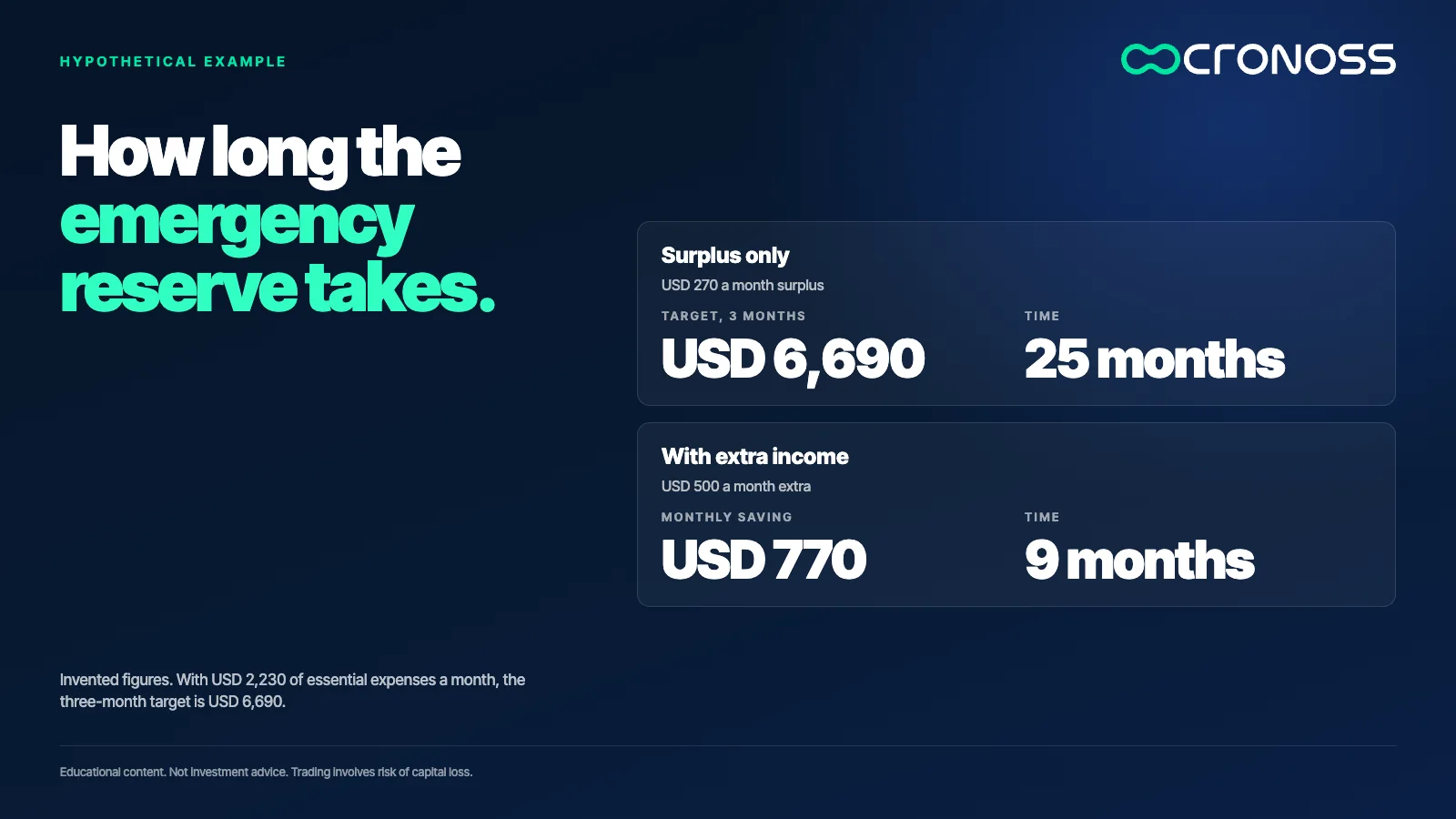
An example with invented numbers: essential expenses of USD 2,230 a month imply a target of USD 6,690 for three months and USD 13,380 for six. If the surplus is USD 270 a month, reaching the three-month target would take about 25 months. If USD 500 a month of extra income is added, saving rises to USD 770 a month and the time drops to about 9 months. The reserve should be kept in something liquid and low risk, because its job is to be available when needed.
Diagnosis first, goals second
Before building the funds or the budget you need to know where you stand. Three questions organize the diagnosis: what you own and what you owe, how much saving capacity you have, and how much cash is available. The three financial statements (position, results and cash flow) can be adapted to personal finance to answer them.
Proportions matter more than absolute amounts: how much of your income goes to expenses, how much to debt, how much is left to save. And the diagnosis is not a judgment of what you did before. It is a starting point.
What to review this week
- Calculate your average. Take your results from the last 12 months and work out the monthly average, leaving out your best month.
- Sort your expenses. Split what you spend into flexible and inflexible and see what share each group represents.
- Separate the accounts. Decide how much capital is for trading and how much is for living, and set a rule for when and how much is withdrawn.
- Work out your emergency target. Multiply your essential expenses by the months you want to cover and divide by your monthly surplus.
Structure first, results later
The discipline of a strategy starts off the chart: in how you receive, split and spend what it produces. None of this guarantees trading results, which always carry a risk of loss. But a solid structure keeps a bad month from turning into a bad decision.
Trading without cash pressure does not make you earn more. It makes you think better.
If you want to build this structure with templates and a guided diagnosis, take a look at the program Finanzas Personales para Traders Profesionales (Personal Finance for Professional Traders): Finanzas Personales para Traders Profesionales.
Educational content. Cronoss is not a broker, investment firm or financial adviser, and nothing above is an investment recommendation.
Frequently asked questions
Why is trading income not like a salary?
Because no contract defines what you receive each month: you set the rules, take the risk and results vary. It is a probabilistic income, closer to a business of your own. Expecting a fixed amount is what turns the variability into a problem.
What is a distribution fund?
It is a third account, separate from the trading one and the living one, fed with part of the profits and paying out a steady amount for your expenses. It works as a cushion that absorbs trading variability without it showing up in your day-to-day life.
What is the difference between the distribution fund and the emergency fund?
The distribution fund smooths the monthly flow of trading. The emergency fund is a reserve for unexpected events and usually covers three to six months of essential expenses. With variable income, the target usually needs more months.
How much should I spend if my income is variable?
Set the budget on the expected average, not on your best months, and keep most discretionary spending flexible. This does not guarantee results, but it lowers the pressure on your trading when negative months arrive.