Key takeaways
- Diversifying means combining assets that react differently to the same news, not piling up similar positions.
- Idiosyncratic risk belongs to a single company; it is contained by limiting the weight of each position.
- Correlation runs from -1 to 1; the less alike two assets are, the lower the volatility of the mix.
- Replicating an index diversifies with few decisions; active management demands time and method and carries the risk of error.
- There is no perfect portfolio: horizon, goal, available time and risk tolerance decide which one fits.
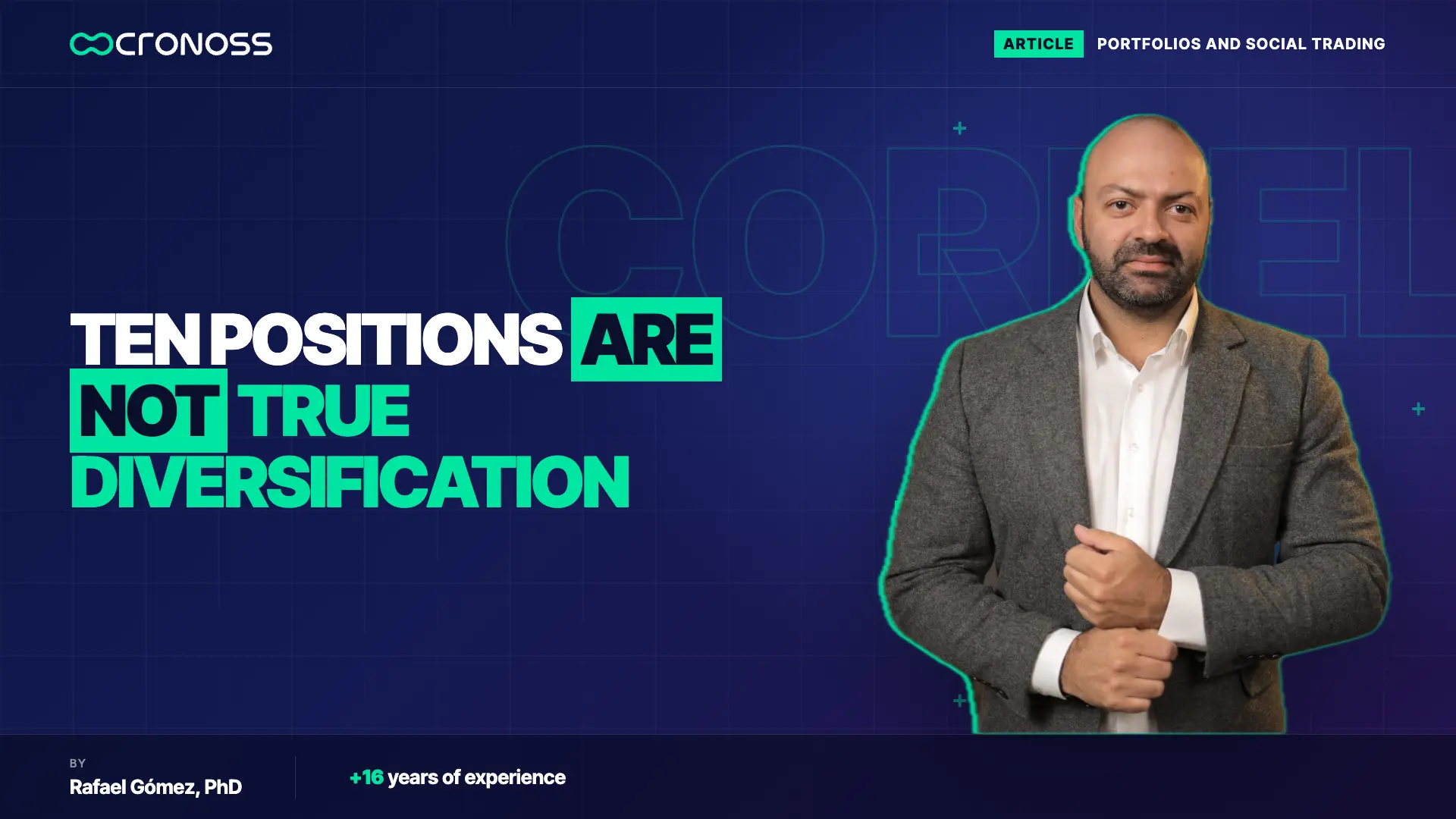
Ten stocks from technology companies look like a diversified portfolio. There are ten names, ten businesses and ten different charts. But if all ten depend on the same interest rates, the same technology spending cycle and the same investor mood, on a bad day they fall almost together. Owning many assets is not the same as owning different sources of risk.
The difference matters because almost nobody loses money by holding one bad asset. They lose it by holding that asset in the wrong place in the portfolio: too large, too similar to everything else.
Diversifying means combining assets that do not react the same way to the same news, and the tool to check it is correlation, not a count of positions.
What idiosyncratic risk is
It is the risk tied to a single company or a single asset: a weak quarterly result, a regulatory change that hits that one firm, a bubble in its niche. Even when the analysis was serious, there is always a chance of being wrong, and that error can land on the very asset you trusted most.
The arithmetic shows it. If all the capital sits in one asset that falls 50%, the portfolio falls 50%. If that same asset is 10% of a ten-position portfolio and falls 50%, the portfolio loses 5%. The fall is the same; the effect on the person is very different.
Correlation measures how similarly two assets move
It runs from -1 to 1. A value of 1 means they move identically; 0 means they are independent; -1 means that when one rises the other falls. In practice most pairs sit in the middle, and what matters is how close the numbers get to 1.
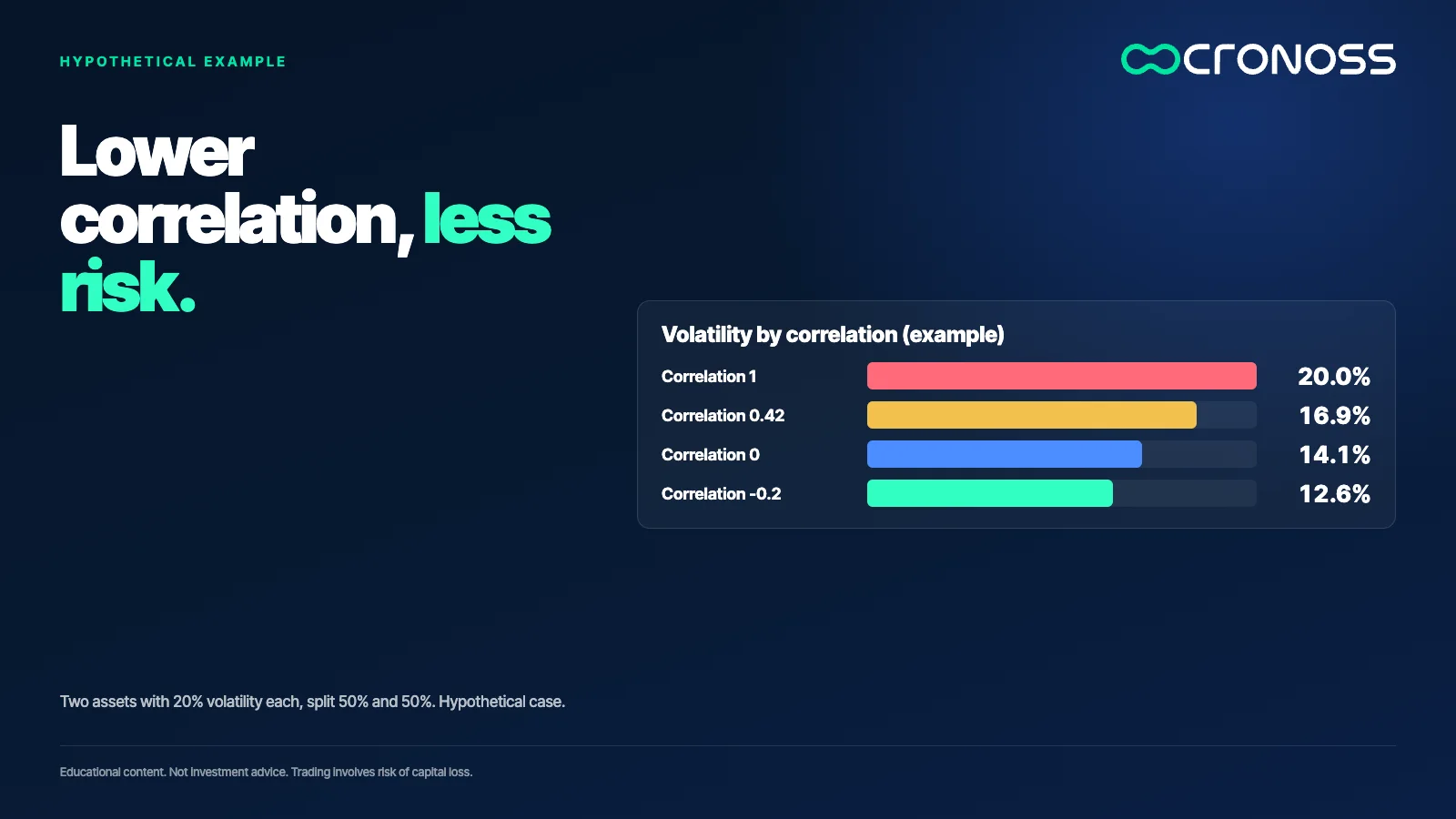
A hypothetical case shows the effect. Two assets with 20% volatility each, split 50% and 50%. The portfolio volatility is 20% x square root((1 + correlation) / 2):
- Correlation 1: 20.0%. Combining them reduces nothing.
- Correlation 0.42: 16.9%. An intermediate value.
- Correlation 0: 14.1%.
- Correlation -0.2: 12.6%.
Expected return did not change; risk dropped about 37% between the first and last rows. That is the payoff of diversification.
Diversify on three levels
A portfolio can be diversified by asset type (stocks, fixed income, alternatives), by sector (technology, consumer staples, energy, health care, utilities) and by geography (markets in different regions and currencies). Each level answers a different risk: the asset's own, the cycle of an industry, and a regional crisis.
One warning: correlations change over time. An external shock can make previously independent assets move alike. That is why they are measured periodically and the mix is corrected when they stop doing their job.
The index: a diversified basket that already exists
Diversifying asset by asset takes time and judgment. An alternative is to replicate an index, which is already a basket of many companies across several sectors. Most indexes are weighted by market capitalization, meaning shares outstanding times market price, and their rules usually cap the weight of any single company. That keeps them balanced and rebalances them naturally as prices change.
Someone who replicates an index, in what is known as passive management, chooses which market risk to be exposed to (stocks of one country, global stocks, fixed income) and not the specific risk of one company. If one company does badly, the effect on the basket is small. It is the logic of the previous section applied with a single decision.
Passive and active management: not which earns more, but which fits
Active management tries to beat the index by picking assets one by one. For it to work, it demands deep knowledge, more decisions, more buying and selling costs and constant discipline, plus accepting the risk of being wrong on the subjective elements of valuation models. Passive management demands few decisions and has low costs, but it forces you to accept market volatility: if the index falls 20%, the investment falls 20%.
Two hypothetical numbers help. A 0.5% annual cost on USD 100 invested is USD 0.50 a year. And someone who does not want the index's full volatility can combine it with fixed income: with USD 1,000, 70% in the index and 30% in fixed income of near-zero volatility, the combined volatility falls to about 70% of the index's (a simplification).
Neither approach is better in the abstract. Passive favors someone with a long horizon, little time or little interest in developing deep skills, and low tolerance for being wrong when picking assets. Active favors someone with a specific goal that a general index does not cover, plus method, time and the ability to go against consensus with judgment. They can also be combined within the same portfolio.
There is no perfect portfolio
What works depends on three things: the horizon (saving for retirement is not paying a semester next year), the goal, and your real tolerance for risk. Two people with the same money may need very different portfolios.
Modern portfolio theory, developed by Harry Markowitz, organizes this decision on two axes: risk measured as standard deviation and expected return. The possible combinations form an efficient frontier, where each point offers the highest return for a given level of risk. Choosing a point on that frontier is choosing a risk profile, which is why knowing yours comes first.
What you are comparing against
Feeling profitable is not the same as being profitable. A benchmark is the reference measure: it can be a market index, a reference rate, or inflation if the goal is to preserve purchasing power. If the portfolio earns less than the index it is measured against, the mix deserves a review and a rebalance. The benchmark should match the goal, not the other way around.
Three common mistakes
- Confusing quantity with diversification. Adding similar positions creates a feeling of safety that the numbers do not support. The useful question is not how many assets there are, but how many independent sources of risk.
- Chasing what is fashionable. Collective euphoria pushes people to buy what everyone else buys. Diversifying with judgment looks for real value in each asset, meaning a reason to own it beyond the fact that it went up.
- Letting the weights drift. Over time the asset that rises most ends up weighing most and concentrates risk without anyone deciding it. Rebalancing means returning each position to the weight you chose; an index does it by itself, a hand-built portfolio requires doing it yourself.
What to check before building a portfolio
This test works for evaluating an existing portfolio or designing a new one:
- Review the weight of each position. If a single one can visibly change the total result, idiosyncratic risk is concentrated.
- Calculate correlations between your assets. Pairs with very high values count almost as one position. If two are alike, keep the one with the better return-to-risk ratio.
- Decide how much time and knowledge you can give it. If little, an index covers diversification with few decisions; if a lot and you have a method, you can combine it with chosen positions.
- Define the benchmark before you start and compare against it periodically, not only when the market rises.
Diversification is also a way of thinking
The same principles apply to other decisions: depending on one source of income, one country or one currency concentrates risk in the same way. Thinking in portfolios is not about collecting assets, it is about reducing dependence on anything that can fail on its own.
The idea fits in one line: a portfolio holds up when its parts do not fall for the same reason.
If you want to practice calculating correlations, the efficient frontier and building portfolios with applied examples, the program Fundamentos de Portafolios de Inversión (Fundamentals of Investment Portfolios) walks through each step: see the program.
Educational content. Cronoss is not a broker, investment firm or financial adviser, and nothing above is an investment recommendation.
Frequently asked questions
What is idiosyncratic risk?
It is risk that depends on a single company or asset, such as a poor result or a regulatory change that hits it alone. You reduce it by limiting the weight of each position and combining different assets. It does not disappear, but it stops deciding the total result.
What does a correlation of 0.42 between two assets mean?
It means they tend to move in the same direction, but not identically. It is an intermediate value between 0 (independent) and 1 (identical). It adds some diversification, though less than a correlation near zero or negative.
How many assets do I need to be diversified?
There is no fixed number, because how different they are matters more than how many there are. Ten assets with very high correlations behave almost like one. Check weights and correlations before counting positions.
What is the difference between passive and active management?
Passive replicates an index and takes on market risk with few decisions and low costs. Active picks assets to try to beat the index, which demands more time, knowledge and discipline, and carries the risk of being wrong. The useful question is which one fits your time and goal, not which earns more.
What is a benchmark and what is it for?
It is a reference measure, such as an index, a rate or inflation, that you compare your portfolio against. It tells you whether your asset allocation adds anything. It should be chosen according to the portfolio's goal.