Key takeaways
- Money decisions start with a belief, move through an emotion and end in a behavior; the numbers usually arrive afterward.
- Loss aversion makes losing weigh more than winning, even when the bet has a positive expected value.
- Overconfidence comes from underestimating uncertainty: being able to explain the past is not the same as being able to predict the future.
- After a small loss that bruises the ego, the urge to win it back tends to come with more size and less rule; reviewing the process breaks that cycle.
- After a loss it pays to judge the process instead of blaming the market: that is the only part that depends on you.
You pay for a coffee, buy something you had not planned on, or put off for months a decision you know is good for you. In none of the three cases was there a spreadsheet involved. There was a phrase you already carried in your head, an emotion that came with it, and a behavior that followed.
Most people believe money decisions are rational because they involve numbers. In practice the numbers arrive later, to justify what a belief and an emotion had already decided.
Money decisions do not start at the calculator: they start with a belief that triggers an emotion, and that emotion drives the behavior.
Which phrase about money is deciding for you without you noticing?
Phrases like "money is for the few", "money corrupts" or "I deserve it" work like a script. You did not write it. You learned it as a child, at home, at school, from what you saw others do. Each script carries its own story, and that story repeats until it becomes a pattern.
A useful exercise is to review your last week. Look at the coffee, the bill, the last purchase, and ask which narrative showed up: scarcity, deserving, value, guilt. That narrative is neither good nor bad. It is information about how you work, and until you see it you cannot change it.
Emotion is the trigger
The belief creates an emotion and the emotion triggers the action. Pleasant emotions pull us closer and unpleasant ones push us away, like a magnet. That is why we repeat what makes us feel good about money (buying to feel loved, valued, safe) and avoid what hurts, even when it is exactly what deserves our attention.
This does not make emotions the enemy. They are data. The problem starts when we react automatically: anxiety, guilt and fear are terrible financial advisers, but excellent informants about what is happening inside.
Your brain takes shortcuts, and some fail with money
A bias is a repeating pattern that shows up in similar situations, a kind of software of the brain. It runs on mental shortcuts (heuristics): quick calculations that help you catch a ball in mid-air but fail when the decision involves probabilities, time horizons and losses.
Understanding a bias does not remove it, but it makes it visible. And what is visible can be checked against a rule.
Losing weighs more than winning
Consider a coin: heads you win USD 100, tails you lose USD 100. The expected value is zero (0.5 × 100 - 0.5 × 100). Many people turn that bet down. Now change the odds: a 70% chance to win and a 30% chance to lose. The expected value becomes +USD 40 (0.7 × 100 - 0.3 × 100), and some people still will not play.
That asymmetry is called loss aversion, and it was documented decades ago by Kahneman and Tversky in prospect theory. The pain of losing USD 100 outweighs the pleasure of winning USD 100, and that distorts very different decisions, from selling too early to clinging to something that no longer works.
Overconfidence: underestimating what you do not know
The brain is designed to generate certainty. That is an advantage: if we thought objectively about every probability of an accident, we would never get into a vehicle and we would never act. The problem appears when that certainty swings to an extreme and we start underestimating uncertainty. We believe a decision is not very risky when deep down it is far riskier.
There are two equally costly extremes. At one end is fear that paralyzes: someone who could have built wealth over a lifetime and never invested because they preferred to only save. At the other is overconfidence, which leads to using your resources as if they were a casino.
A key component is believing that if you can explain the past, you can predict the future. Looking at a chart of the past and finding clear patterns is easy. That does not mean the same pattern will repeat. That is why people who handle this bias well usually set objective, consistent parameters for deciding, instead of trusting their sense of certainty.
After a loss: was it the market or the process?
Blaming the market brings relief. It is a quick way to stop feeling responsible. But it also keeps you from reviewing the only thing you can adjust: the process. If the stop was badly placed, if leverage forced a decision made in panic or if the entry was impulsive, the loss speaks about the person, not the market. And a small loss that bruises the ego can push you to win it back immediately, with more size, exactly when the decision rests least on a rule.
The opposite is also true. Imagine someone who risks 1% per trade, follows every rule and loses 3% because of a sudden gap caused by an unforeseeable event. On review, the plan was executed well: the loss is a normal cost of trading, not a personal failure. The rule is to judge the process, not the isolated trade.
Your financial profile is a pair of tinted glasses
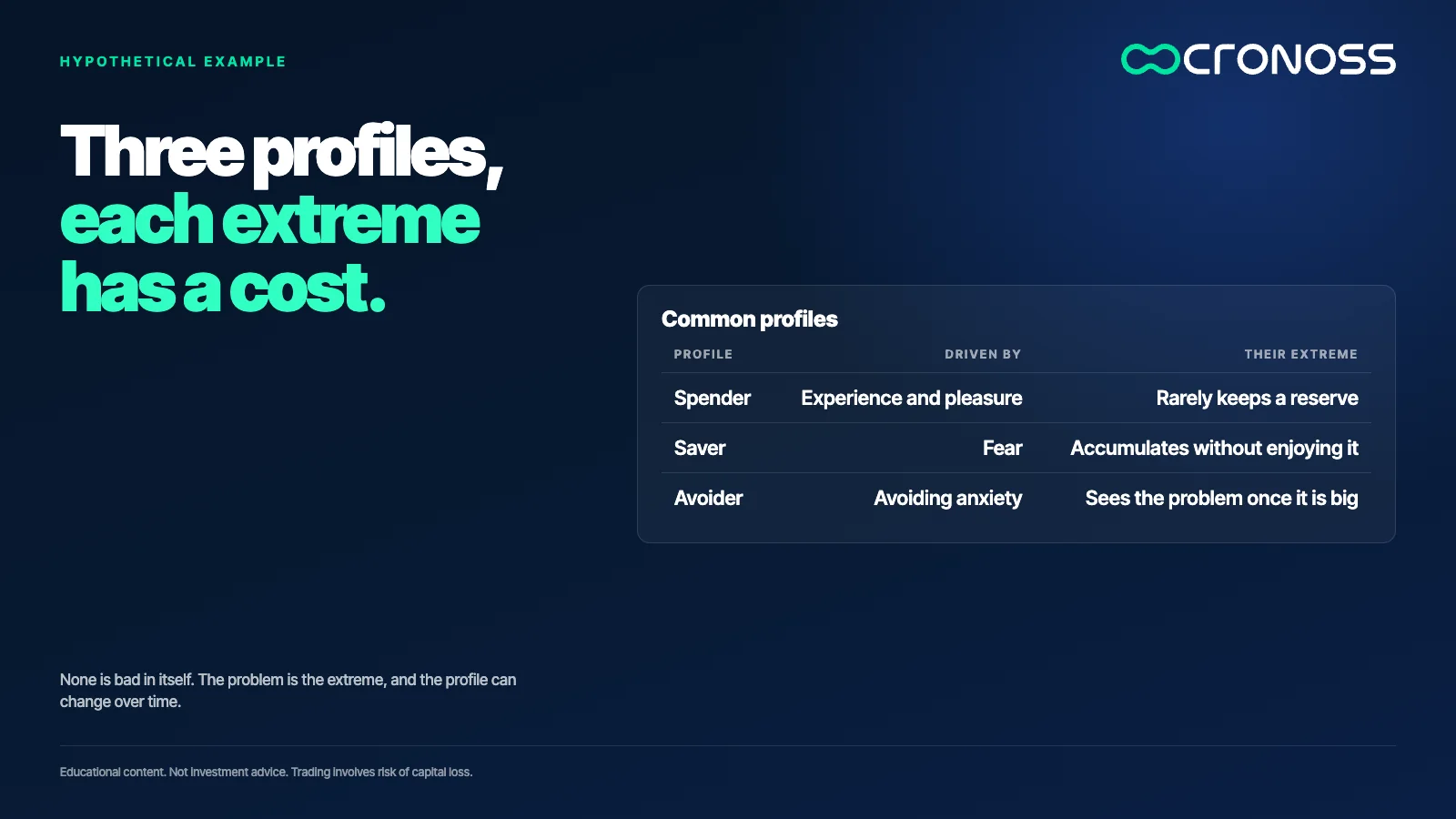
Everything above sums up in a profile, a pair of colored lenses you wear without noticing. Three profiles show up often:
- The spender looks for experience and pleasure. They enjoy life, but rarely keep a reserve for hard times.
- The saver lives from fear. They accumulate, but sometimes without enjoying any of it.
- The avoider ignores money to keep the peace. They are free of anxiety, but may not see a problem until it is already big.
None of them is bad in itself. The problem is the extreme. And because the profile is dynamic, you can take the best of each: the spender's ability to enjoy, the saver's planning and the avoider's trust in systems.
What you can do before your next decision
- Take a three-second pause between the impulse and the action, and ask what is driving it.
- Name the belief and the emotion. If you cannot name them, they are probably deciding for you.
- Check it two ways. Review the decision against a fixed rule (a limit, a plan, a date) and against information, then compare the answers.
The goal is not to judge yourself. When you look at your numbers and see what your profile has done, it is easy to fall into guilt. That does not help. Treat your starting point as data, and from there define what you want money to do in your life.
Deciding with awareness is also a decision
You do not need to spend less or save more to begin. You need to see the script you have been following. Once you see it, you can rewrite it, and every later decision stops being a reflex and becomes a choice.
Someone who knows their profile does not stop having impulses, but stops obeying them blindly.
If you want to work through this step by step, with exercises to map your money flow, discover your profile and design coherent goals, take a look at the program Mentalidad Financiera y Relación con el Dinero (Financial Mindset and Your Relationship with Money): Mentalidad Financiera y Relación con el Dinero.
Educational content. Cronoss is not a broker, investment firm or financial adviser, and nothing above is an investment recommendation.
Frequently asked questions
Why are money decisions more emotional than rational?
Because behind every purchase or postponement there is a learned belief that creates an emotion, and that emotion drives the action. The numbers are often used afterward to justify what was already decided. Recognizing the belief and the emotion lets you choose with more awareness.
What is loss aversion?
It is the tendency to feel more pain from losing an amount than pleasure from winning the same amount. With a USD 100 bet at a 70% chance to win and 30% to lose, the expected value is +USD 40, yet many people decline it. Kahneman and Tversky described it in prospect theory.
What is overconfidence and why is it a problem?
It is the tendency to underestimate uncertainty and believe you control more than you really do. It leads to taking more risk than it seems and to believing that explaining the past lets you predict the future. Setting objective, consistent parameters helps limit it.
How can I avoid deciding on impulse with money?
Take a three-second pause before spending and ask which belief or emotion is moving you. Then check the decision against a fixed rule and against information. After a loss, review the process instead of blaming the market.