Key takeaways
- An investment is defensible when its worst reasonable loss can be paid without compromising your net worth.
- Affordable loss is the lower of a person's capacity (objective) and tolerance (subjective).
- Higher expected return means higher variability; a high-return promise with no visible risk is hiding the risk.
- Risk can be measured with data, but what cannot be measured calls for limited exposure and a contingency plan.
- Prevention, protection, diversification and a contingency plan are the four basic responses, sized to the risk.
- After a planned loss, the plan still rules: a daily loss limit and a post-loss protocol prevent decisions made in an altered mood.
A lemonade stand at the end of the driveway is the smallest entrepreneurship exercise there is. It costs a few lemons, some sugar and water, and if nobody buys, the worst outcome is that the family drinks the lemonade. Nobody loses their home to a lemonade stand.
Investment decisions rarely look like that. They get made with the whole savings account, with borrowed money, or with the conviction that this time it will work out. And when something fails, the question is no longer whether the investment was good, but whether the person can keep living the way they did before.
An investment is defensible when its worst reasonable loss can be paid without touching the stability of your net worth, and managing risk means making sure of that before the loss happens.
What it means for a loss to be affordable
In entrepreneurship this is known as affordable loss: instead of asking how much can be gained, you ask how much you are willing to lose without the rest of your life falling apart. The difference looks small, but it changes the order of decisions. First you set the ceiling on the loss, then you evaluate the opportunity.
Affordable does not mean "money I don't care about". Nor does it have a single measure, because a person's risk profile combines two different questions:
- Capacity: how much risk I can take on. It is objective and checked with numbers: how many months of expenses the emergency fund covers, how stable income is, how much of net worth is liquid, how many obligations there are.
- Tolerance: how much risk I am willing to bear. It is subjective and depends on personality: how the person feels when the account falls, and whether they can sleep.
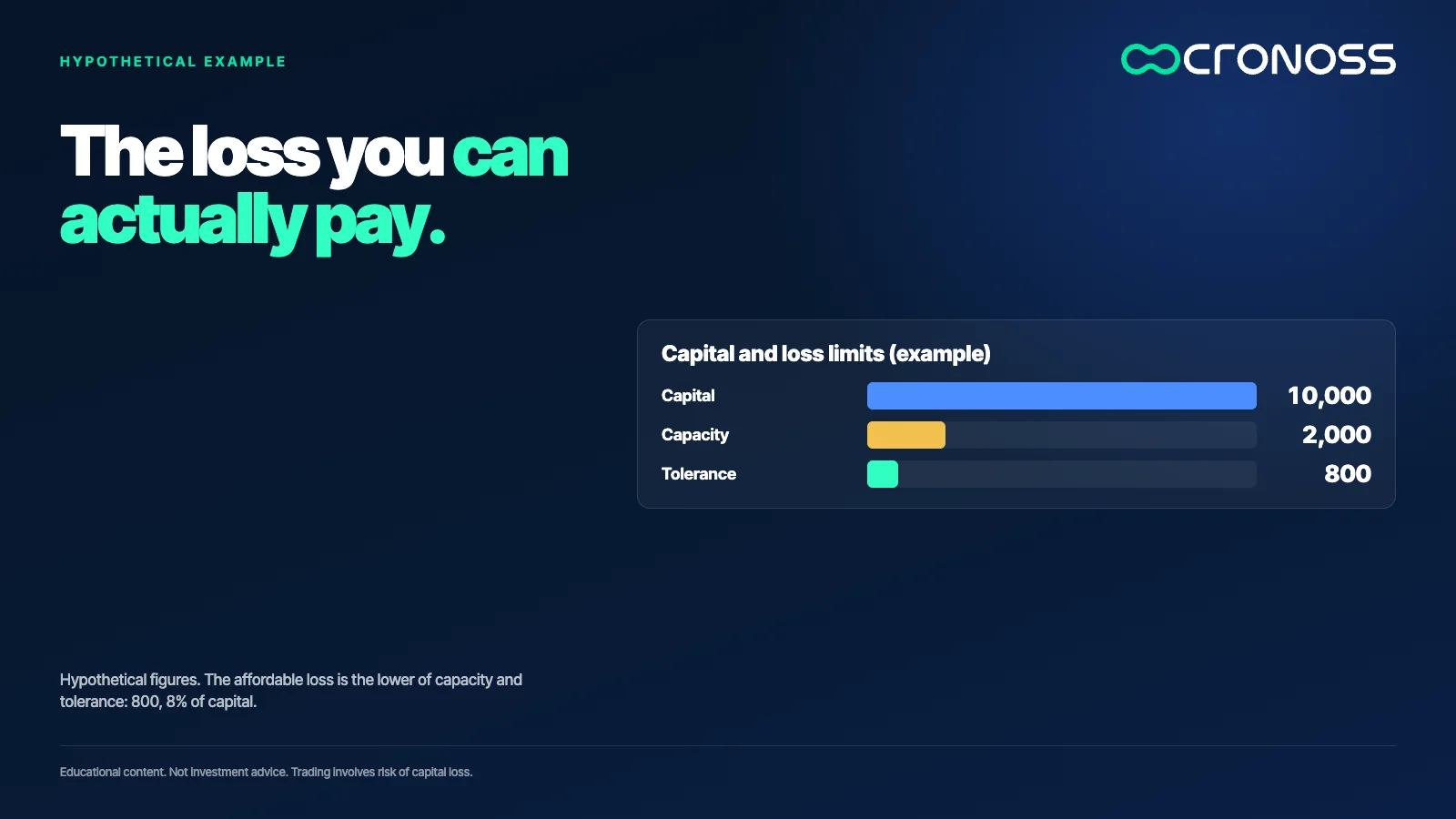
Each sets a limit, and the affordable loss is the lower of the two. With huge capacity and minimal tolerance, using all the capacity produces anxiety and ends in giving up on investing. With huge tolerance and limited capacity, the profile stops being dynamic and becomes reckless, because it puts household stability at risk.
A hypothetical example. A person has USD 10,000 to invest and a separate three-month emergency fund. Their capacity allows them to lose up to USD 2,000 without touching essentials, but they start losing sleep at a loss of USD 800. Their affordable loss for the whole portfolio is USD 800, 8% of the capital, not USD 2,000.
Investing on faith is the most expensive way to avoid measuring
When an investment decision rests on trust and belief more than on risk variables, the ground is fertile for pyramid schemes. Once the conversation turns to "these people really are paying on time", nobody asks where the returns come from.
Ponzi schemes share a pattern: they promise high, steady returns, pay early investors with new investors' money, and collapse when new deposits stop. Punctual payments do not prove the business exists. They prove money is still coming in.
The way out is not to distrust everything, but to change the question from "will it go well?" to "what happens if it goes badly, and what does it cost me?".
Higher expected return always comes with higher risk
If someone offers to double your capital in a year, the honest question is whether that offer describes a safe business or a very risky one. The relationship between expected return and risk is increasing: aiming higher means accepting more variability in outcomes. A promise of high returns with no visible risk is not an exception to that rule, it is a sign that the risk is hidden.
That is why spectacular numbers deserve suspicion, and modest results that repeat for decades deserve a closer look. Consistency is built from simple rules applied many times, not from extraordinary hits.
Risk you can measure and risk you cannot
Not everything that can go wrong can be calculated. The economist Frank Knight separated, a century ago, risk, where data exist to estimate probabilities, from uncertainty, where there are not enough references to assign them.
- Quantifiable risk. The volatility of an asset, the historical maximum drop of a portfolio, or the distance between an entry price and an exit price can be measured with data.
- Non-quantifiable risk. A regulatory change, a geopolitical decision or a new technology has no track record that allows a precise probability.
Professional practice does two things: it measures what can be measured and, for what cannot, it limits exposure so an extreme event does not destroy net worth. Measuring does not remove risk. It prevents finding it out by surprise.
A map to sort out what can go wrong
Financial risk (prices, rates, credit, liquidity) is only one category. Operational risk covers human error and system failures, and strategic risk covers decisions that erode competitiveness over the years. One event can trigger several at once: a system outage is operational, but it can also stop you from closing a position in time.
An impact and probability matrix helps prioritize. Each risk is placed by how likely it is and how much it would cost, and four zones appear:
- High probability and high impact: avoid it.
- High impact and low probability, such as holding leveraged positions over a weekend: limit it or transfer it.
- Low impact and high probability, such as small recurring mistakes: control them so they do not wear down the account.
- Low impact and low probability: accept it and monitor it.
Four responses to a critical risk
Mitigating is not eliminating. It is making the risk manageable with one of four strategies: prevention (not trading right before a news release or in assets you do not know), protection (a stop loss defined in advance), diversification (not depending on a single source of risk) and a contingency plan (knowing what to do the day the risk materializes).
The response should be proportional. A minor risk calls for monitoring; a critical one calls for several layers. And mitigation cannot cost more than the damage it avoids.
Following the earlier example, with an affordable loss of USD 800 on USD 10,000, the person decides to risk 1% per trade, which is USD 100. If the exit point sits 5% from the entry price, the maximum position is USD 100 / 0.05 = USD 2,000. Eight losing trades in a row (USD 800) would use up the limit, and there the plan says stop. Without that calculation, the same trade with USD 10,000 exposed would have cost USD 500 at once.
After a planned loss, the plan still rules
Setting a limit per trade is not enough if nothing defines what happens after a loss. A loss within the plan is normal information from the system, not a debt owed to the market. What does the most damage is the next decision, made in an altered mood and without rules: more size than usual, a different asset you do not trade, an exit left undefined. With hypothetical numbers, a planned loss of USD 100 can turn into one of USD 300.
Mitigation is also written as a rule before trading:
- A daily loss limit. If the plan allows eight losses in a row, it can set a shorter daily limit, for example three (USD 300, 3% of capital), after which the platform is closed.
- A post-loss protocol. Take a pause, do not change size, asset or exit, and write down what happened before looking at the chart again.
- Accepting the blank day. If there is no signal within the plan, not trading is a valid session, and closing at zero is better than an extra, unnecessary loss.
Discipline also has a statistical effect: each trade outside the plan contaminates the record, and then you can no longer tell whether the strategy works.
What to check before investing
This test works for buying a home, a fund or a trade:
- Write down your capacity and your tolerance. The first in numbers (months of expenses covered, liquidity, stable income) and the second as the loss you could still sleep through. Your affordable loss is the lower one.
- Compare it with your liquid net worth and your monthly commitments. If paying it forces you to sell other assets or take on debt, it is not affordable.
- Define in advance how you exit, how much you can lose in a day, and what you will do after a loss. The plan must answer before the emotion appears.
It also helps to remember the arithmetic of drawdowns: losing 50% of a capital requires a 100% gain to get back to the starting point. A USD 10,000 account that falls to USD 5,000 needs to double, and the affordable loss exists precisely to avoid ending up there.
You do not choose whether there is risk, you choose how much
Investing is not about guessing the future. It is about deciding, with rules, how much risk to accept and what to do when the result is adverse. Whoever works with that logic stops depending on a hunch, on isolated advice or on faith, and starts behaving like a small but disciplined investment desk.
The question that organizes all of the above fits in one line: before asking how much an investment can return, ask how much you can lose and whether you can afford it.
If you want to learn how to classify risks, build your own matrix and apply mitigation strategies step by step, the program Fundamentos de Riesgo en las Inversiones (Fundamentals of Risk in Investing) walks through that path with applied exercises: see the program.
Educational content. Cronoss is not a broker, investment firm or financial adviser, and nothing above is an investment recommendation.
Frequently asked questions
What is an affordable loss in investing?
It is a loss you can absorb without compromising basic expenses, debts or your emergency fund, and that you can also bear without losing sleep. You set it before investing, in money rather than in percentage. It is the lower of your capacity and your risk tolerance.
What is the difference between risk capacity and risk tolerance?
Capacity is objective: how much risk you can take given your emergency fund, income and liquidity. Tolerance is subjective: how much risk you are willing to bear emotionally. If one exceeds the other, the lower one sets the limit, because going past it creates recklessness or anxiety.
What is the difference between risk and uncertainty?
Risk is what can be estimated with data and probabilities; uncertainty is what lacks enough references to be calculated. The volatility of an asset is measurable risk. An unexpected regulatory change is closer to uncertainty.
How do I reduce investment risk without eliminating it?
By combining four responses: prevent, protect, diversify and keep a contingency plan. The intensity should match the risk and never cost more than the damage it avoids. It is a process you review continuously.
What should I do after a loss within my plan?
Follow the plan: take a pause, do not change size, asset or exit, and write down what happened. A daily loss limit, for example three trades, says when to close the platform. If there is no signal, not trading is a valid session.
How do I calculate how much to put into one trade?
Divide the loss you accept per trade in money by the percentage distance to your exit point. With a USD 100 loss per trade and an exit 5% away, the maximum position is USD 2,000. This illustrates the calculation and is not a recommendation.