
Key takeaways
- A system fixes three questions that never change: bias, zone and confirmation; if one answer is unclear, there is no trade.
- Liquidity is a reading framework that must be tested against data, not a law of the market.
- A split bias means the market offers no clear direction, and the sensible rule is to wait.
- With a 1 to 3 risk-reward ratio, winning one trade in four breaks even, yet losing streaks still weigh.
- A regime filter decides when the trigger is allowed to trade; it is usually more stable than tightening stops or targets, and it is tested like any rule.
- Bias is read by aligning the short, medium and long term: breaking an average without its slope turning is not enough to call a trend change.
When someone describes their trading method they usually start with entries: what they see on the chart and what makes them act. A well-built system does the opposite. It gives almost as much space to what it decides not to do, and that is where most of its discipline lives.
That idea runs through the price-reading approach taught in the program Lectura Institucional del Precio (Sistema M1-OS) (Institutional Price Reading, M1-OS System): a map of levels, a liquidity reading, a confirmation and a set of filters that discard trades before they exist.
A system is defined as much by the trades it takes as by the ones it discards, and only rules written in advance let you check which of the two is working.
A system always answers the same questions
A discretionary method improvises every day. A system fixes three questions and their order: which way is the market biased, which zone am I in, and what confirmation do I need before acting? If any answer is "I don't know", there is no trade.
This is what makes the method measurable. When the rules are always the same, you can count cases, compare results and find out which part of the system contributes and which one gets in the way.
First, a price map
The starting point is a map of the levels price tends to respect on each time frame: the open of the previous candle, the 50% of a candle's range, previous highs and lows that were never resolved, and imbalances (Fair Value Gaps) with their midpoint. Put together across the monthly, weekly, daily, 4-hour and 1-hour time frames, they form an ordered map.
The map predicts nothing. It answers "where can something happen", so attention goes to a few zones instead of the whole chart.
Liquidity as a reading framework
Under this approach, price tends to visit zones where pending orders pile up, such as recent highs and lows. Anyone who needs to execute a large volume needs a counterparty, and those zones offer one. A "liquidity grab" is the moment price sweeps through one of them.
It pays to treat this for what it is: a reading framework, not a law. It works as a hypothesis the system must test against data. An elegant idea nobody has checked is still just an idea.
A candle range as a unit of analysis
Candle Range Theory (CRT) treats a single candle as a range with a high and a low. What gets watched is whether price sweeps one of the extremes and what it does next. Each time frame produces its own ranges, and the most relevant ones are those that coincide with a level on the map and a liquidity zone.
A range is not invalidated just because price moves against it for a while. What matters is whether the system's conditions are still met.
Bias is read from structure, and sometimes there is none
Fractality is the way to decide which direction to trade. Structure breaks on one time frame define a bias: bearish, bullish or split. A split bias, which the system can show as 50-50, means the market offers no clear direction. In that case the sensible rule is to wait, not to pick a side.
A valid break is confirmed by the candle's body and volume, not by its wick. It is a small rule that avoids many false breaks.
Bias also pays to be aligned across time frames. Breaking a moving average does not change the trend by itself: as long as the slope of that average has not turned, the average keeps its momentum, and trading a trend change against a slope that stays the same often fails. The sturdier reading is the one that brings the short, medium and long term into agreement.
Confirm before entering, and stop staring at the screen
Confirmation is the last condition of the system. Instead of anticipating, you wait for something concrete to happen, for example the body of a candle breaking the volume of the previous candle after a liquidity grab. While that condition has not occurred, there is no trade.
This has a practical consequence: you do not need to watch the chart all the time. It is enough to set alerts at the key levels and check every so often. Watching price nonstop is one of the fastest ways to stop following the rules.
No-trade filters protect against streaks
A system can include filters: do not trade in a certain time window, do not trade a certain session, discard trades whose pip distance is too small or too large. These filters do not exist to avoid individual losses. They exist to avoid trades with no statistical backing and the losing streaks that come with them.
It helps to tell two pieces apart. The trigger is the condition that opens a trade; the filter is the condition that decides when it is allowed to fire. A filter tries to detect the market regime in which the strategy works well and to remove trades in the regimes where it works badly. That is why, when a system needs improving, it is usually more stable to add a regime filter than to tighten the stop or the target, since those tend to erode the edge and make the strategy unstable.
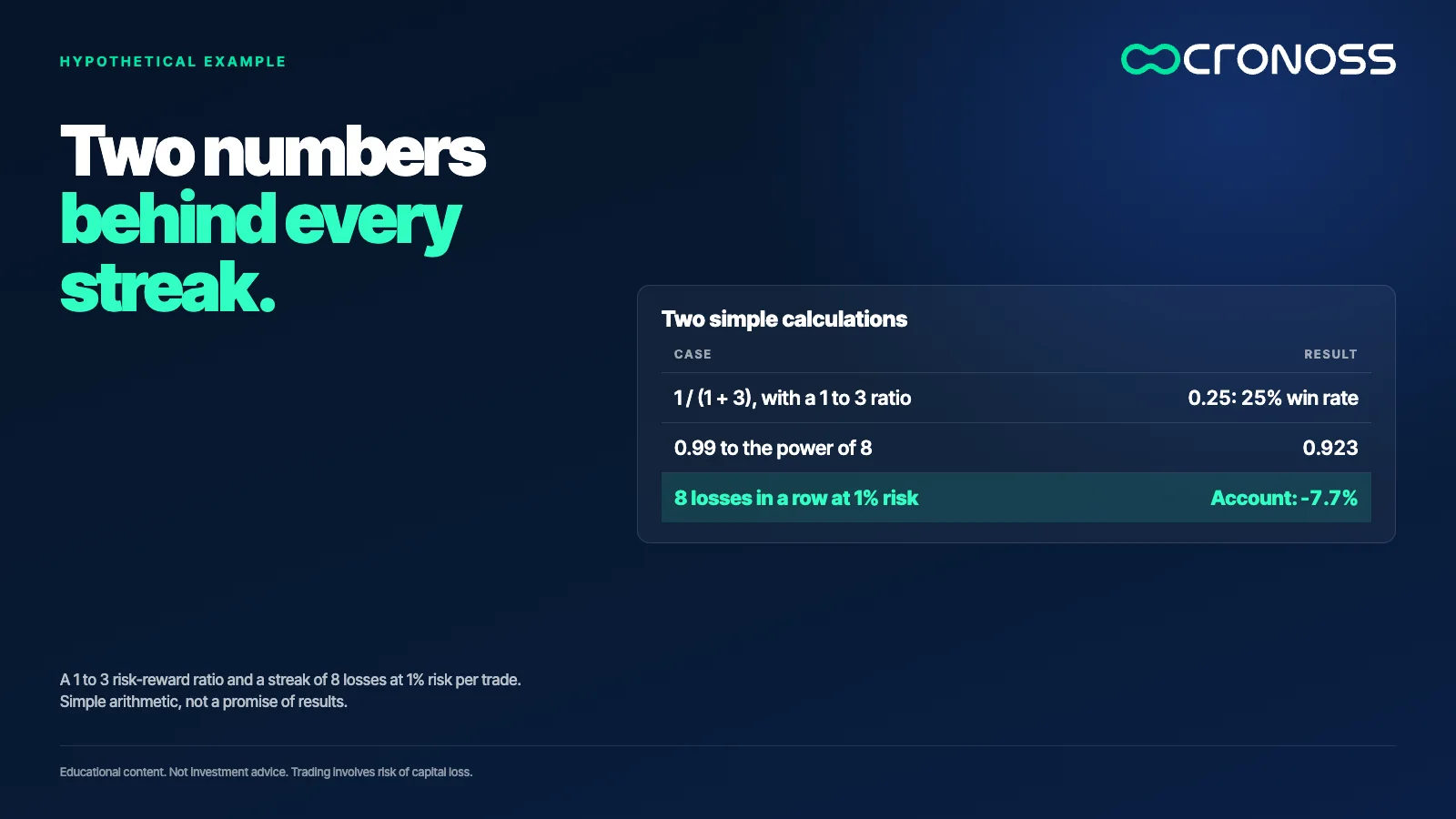
Two simple calculations show why they matter. With a risk-reward ratio of 1 to 3, the system needs to win only one trade in four to break even, because 1 divided by 1 + 3 is 0.25. But a streak of 8 losses in a row risking 1% each time cuts the account by about 7.7%, since 0.99 to the power of 8 is 0.923. The system can be right and the streak is still hard to sit through. Filters reduce how often those streaks happen.
A filter only makes sense if it is tested. That is what the journal and backtesting are for: compare results with and without each filter, and keep only those that improve the record consistently.
Managing the trade without improvising
Management rules are also written in advance. One option is to move the stop to the entry price when price covers 50% of the way to the target; that leaves the trade with no risk of loss, although it may close at zero and give up part of the favorable move. It is a trade-off between stability and range, and it should be measured like any other rule.
At the end of the week, the journal closes the loop: what was traded, what was discarded and why. Without that record, the system goes back to being memory.
A three-step test for evaluating any system
- Check that the rules are written down. Bias, zone, confirmation and management, with no conditions like "depending on how I see it that day".
- Count the trades it discards. If the system accepts nearly every opportunity, it probably has no real filters.
- Ask for evidence. A record with many trades, with and without each filter, is worth more than any explanation.
The system is what remains when the excitement fades
The clarity of a method shows on the boring days: when there is no confirmation and no trade is taken. That silence is also part of the result.
If you want to walk through the whole system, from the price map to post-trade management, the program Lectura Institucional del Precio (Sistema M1-OS) develops it step by step: Lectura Institucional del Precio (Sistema M1-OS).
Educational content. Cronoss is not a broker, investment firm or financial adviser, and nothing above is an investment recommendation.
Frequently asked questions
What is a liquidity grab in trading?
It is the moment price sweeps a zone where pending orders pile up, such as a recent high or low. It is a reading framework that should be verified with data before relying on it.
What are no-trade filters for?
They discard trades with no statistical backing, for example in certain time windows, sessions or pip ranges. Their goal is to reduce losing streaks, not to avoid individual losses.
How many trades must a system win with a 1 to 3 risk-reward ratio?
It needs to win one in four to break even, because 1 divided by 1 + 3 is 0.25. That excludes fees and slippage, and it guarantees no result.
What does a 50-50 bias mean in structure reading?
It means structure breaks give no clear direction. The consistent rule for a system is to wait for the bias to form instead of forcing a side.
What is the difference between a trigger and a filter?
The trigger is the condition that opens a trade. The filter decides when it is allowed to fire, for example according to the market regime. Separating the two lets you improve a system without touching its core logic.
Why is breaking a moving average not enough to call a trend change?
Because as long as the slope of the average has not turned, it keeps its momentum. Trading a trend change against a slope that stays the same often fails, which is why the short, medium and long term should line up.