Key takeaways
- An investment is putting a resource into something expecting more back; risk always comes with it, and return and risk are not analyzed separately.
- Comparing two investments by return alone is not enough: you must also look at how much can be lost to obtain it.
- Time is a resource that cannot be multiplied or returned, and how it is invested influences results.
- The return on investing in yourself does not always arrive as money: it can arrive as health, time or peace of mind.
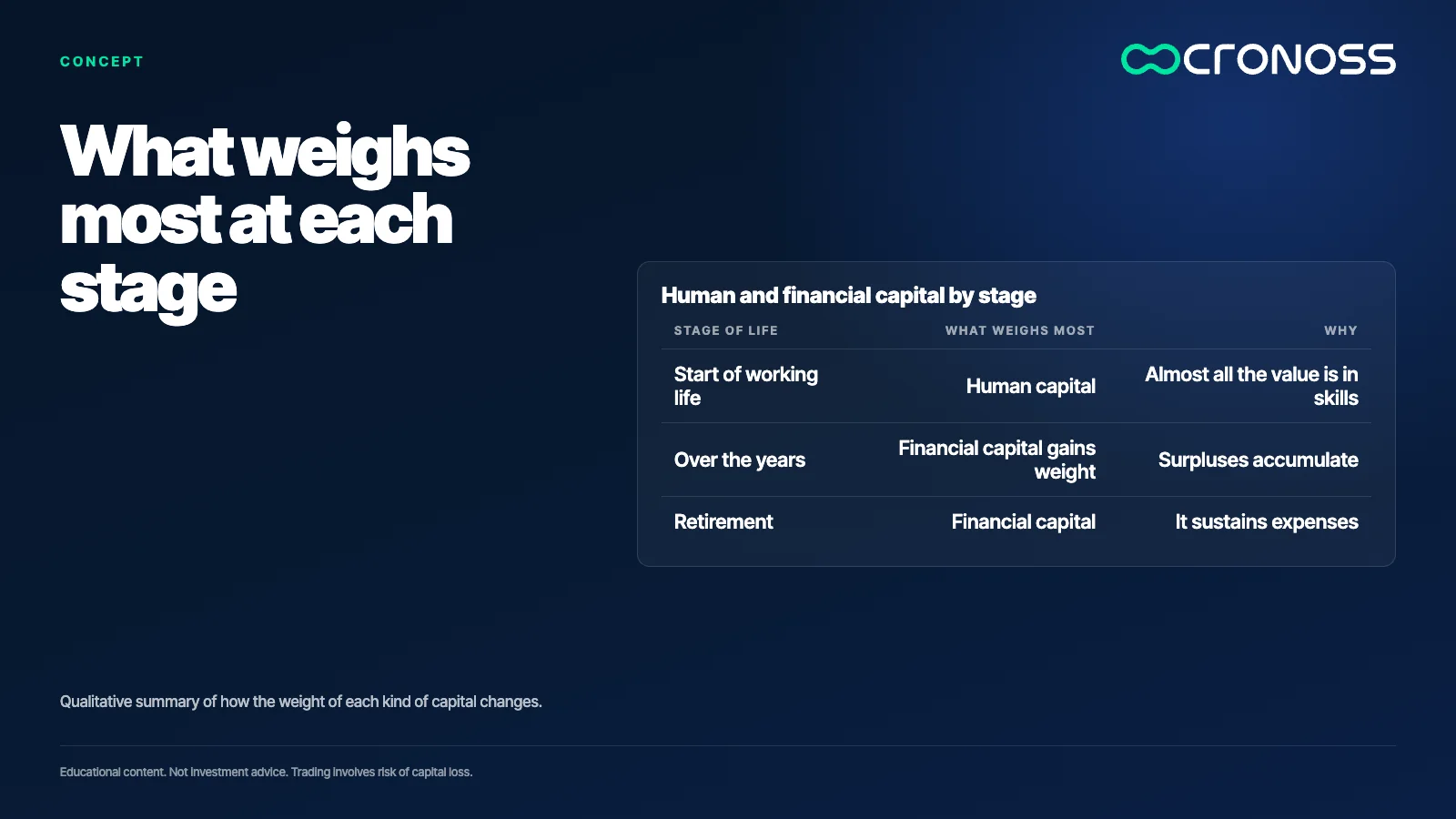
- Human capital weighs more early in life and financial capital gains weight over the years; it pays to look after both.
When someone says "I want to start investing", they almost always picture a screen with stocks, bonds or currencies. They rarely think that they are already investing every day: in how they use their time, in what they learn, in how much they rest, in where they live.
That broader view is not a rhetorical device. It changes decisions. If anything you put to work to obtain more than you put in is an investment, then the first question is not which asset to buy, but which resources I have, where I am putting them and what I receive in return.
An investment is any resource put into something with the expectation of getting more back, and the first asset almost everyone has to invest is not in a portfolio: it is their own time, knowledge and ability to work.
What an investment is and why it always carries risk
An investment is a mechanism that amplifies a resource: you put in an initial amount and expect the final amount to be larger. Return depends on two things, how much the resource multiplies and how fast. Multiplying it by 2 in one month is very different from multiplying it by 2 in ten years.
That promise of amplification does not come alone. Every investment carries risk, the possibility that the result differs from the plan. Part of that difference can be positive, but the part that worries is the negative one: ending up with less than you put in. Return and risk are two sides of the same coin and cannot be analyzed separately.
It is also worth knowing that more risk does not guarantee more return. It widens the range of possible outcomes, upward and downward. Investor Howard Marks explains it in his book The Most Important Thing: if taking more risk guaranteed earning more, it would not be risk.
How to compare two investments without relying on return alone
An illustrative example with simple numbers. Investment A can return 2.0 for each 1.0 invested if it goes well, but 0 if it goes badly. Investment B can return 1.5 if it goes well, and 0.8 if it goes badly.
A gains up to 1.0 and can lose 1.0. B gains up to 0.5 and can lose 0.2. One way to compare them is to divide the maximum gain by the maximum loss: for A it is 1.0 / 1.0 = 1.0 and for B it is 0.5 / 0.2 = 2.5. B offers more potential gain for each unit put at risk, even though its ceiling is lower.
This comparison is a simplification because it leaves out the probability of each outcome. But it shows something important: saying one investment yields 10% and another 9% is not enough to choose the first. You also have to look at how much can be lost to obtain that yield.
Investing is not only about money
All of the above talks about an initial resource and a final resource, without saying it is money. Money is one way to measure it, not the only one. Time is also invested: studying, practicing a skill, spending time with family.
Time has one peculiarity. It cannot be multiplied: everyone has 24-hour days, regardless of wealth. What does change is what you do with each hour, and that has consequences for results. And time cannot be returned either. A project that took months and led nowhere has already charged its cost.
What investing in yourself looks like
Some investments in yourself have an easy-to-see return, and others do not.
- Studying and acquiring skills. The cost is clear: tuition, materials, time. The expected return is better access to income or a better business. International evidence finds that, on average, one extra year of schooling is associated with an income increase of around 9% (Psacharopoulos and Patrinos, 2018). It is a global average, and the return on each program or path depends on its context, its cost and its length.
- Resting well. Nobody pays you to sleep better, but rest affects energy, concentration, mood and health. That translates, indirectly, into better quality work and calmer decisions, also when trading or investing.
- Enjoying yourself. A trip or a meal you like has no immediate monetary return. It can work as an emotional cushion that makes hard moments easier to bear.
- Living close to work. It may cost more in rent, but it saves commuting time. For someone who works remotely, the investment is another: good equipment and a good connection.
Two ideas organize these examples. The first: the return is not always collected in the same currency. Sometimes it arrives as income, sometimes as health, time or peace of mind, which is why you have to think about second-order effects. The second: there is no single answer. Living close to work can be excellent for one person and a poor decision for another. In financial assets the yield is the same for everyone, but what changes is risk tolerance and the ability to bear it.
Human capital and financial capital
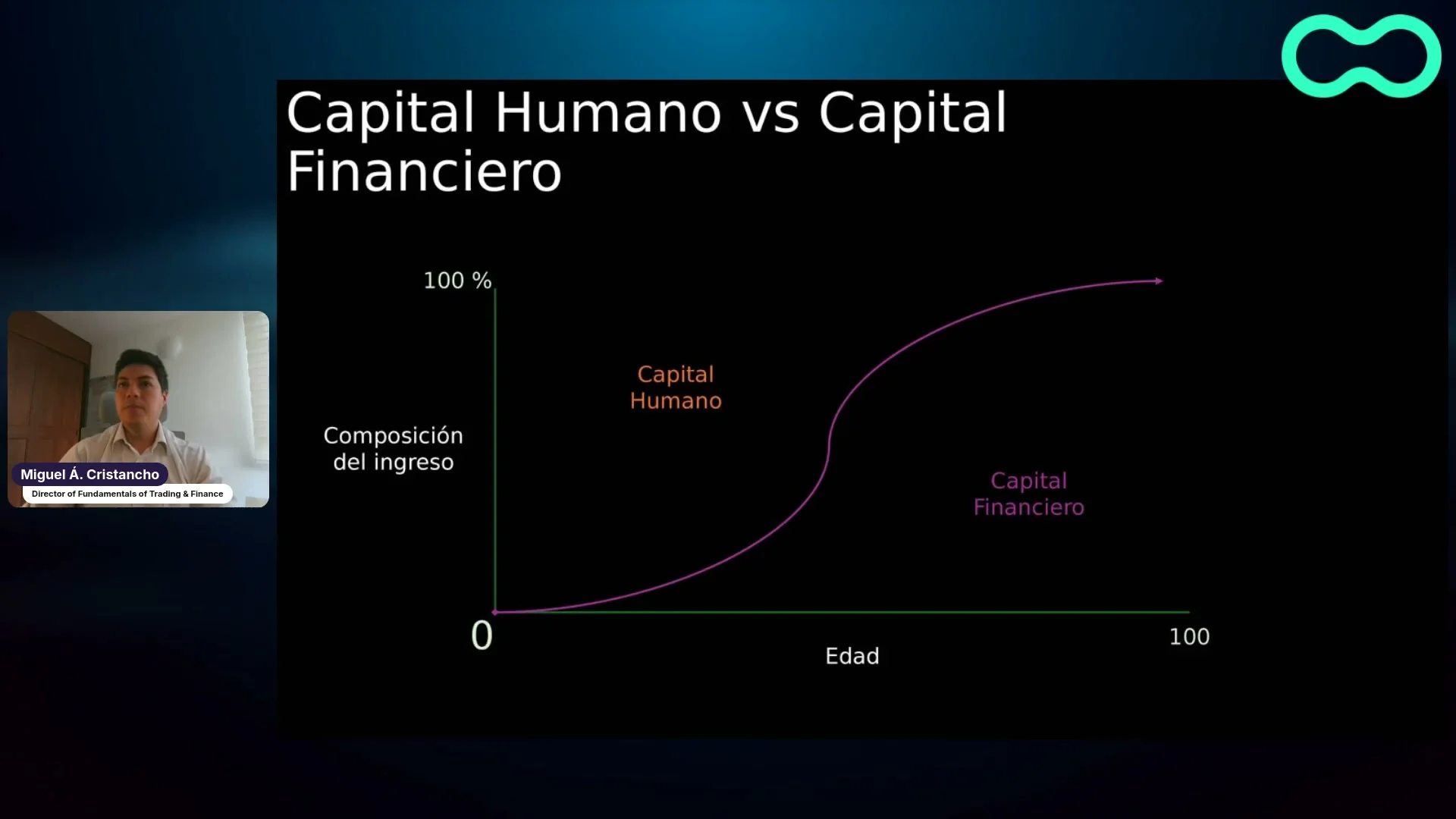
Every estate has two components. Financial capital is assets: savings, funds, stocks, bonds, property. Human capital is the ability to generate income: skills, education, experience and the future income they will produce.
Their weight changes with age. At the start of working life, most people hold almost all their value in human capital. It is the time to get the most out of experience and skills, and to generate surpluses between what you earn and what you spend to start building financial capital. Over the years, that financial capital gains weight. And when retirement arrives, it is what supports spending when you can no longer work as before.
That is why it is wise not to neglect either one. Someone who looks only at financial capital may forget that their income depends on their ability to work. Someone who looks only at human capital may reach retirement age without a backstop.
An effect that compounds
Investing in human capital has a triple effect. It raises the possibility of generating more income, extends the time during which you can generate it, for example by looking after your health, and improves how you use resources. It also works over time as a compounding effect: each improvement opens new possibilities, such as building a business or learning a skill you did not have before.
That is why it is often said that investing in yourself is very profitable. It is better taken as a reasonable hypothesis than as a guarantee: it depends on what you invest in, with what discipline and in what context.
Five dimensions in which you can invest
One way to organize that investment is to look at five dimensions.
- Intellectual. Learning, practicing, developing judgment and the ability to analyze and create.
- Emotional. Understanding and managing emotions, to decide with more clarity.
- Social. Cultivating quality relationships. Studies of high-longevity regions highlight social ties among common habits.
- Physical. Looking after the body, which sustains energy and working life.
- Spiritual. Feeling connected to something beyond the material, whatever the belief, and finding meaning.
Three questions to review your investments
- Where am I putting my time, my money and my energy? Make an honest list of the resources you have and what you devote them to.
- What return do I expect and in which currency? Define it for each one, whether income, health, time or peace of mind, and what risk it carries.
- Am I balancing human capital and financial capital? Check from time to time whether both are growing according to your stage of life.
The underlying question
Investments are much more than stocks, bonds or currencies. Before comparing financial products, it is worth reviewing the first portfolio all of us have: what we do with our time, our health and our abilities.
If you want to keep exploring how money decisions relate to the way we think, the program Mentalidad Financiera y Relación con el Dinero (Financial Mindset and Relationship With Money) works from there.
Educational content. Cronoss is not a broker, investment firm or financial adviser, and nothing above is an investment recommendation.
Frequently asked questions
What is an investment?
It is any resource, such as money, time or knowledge, put into something with the expectation of getting more in return. It always carries risk, which is the possibility that the result differs from what was expected.
What is the difference between human capital and financial capital?
Financial capital is the assets you own, such as savings, funds, stocks and bonds. Human capital is the ability to generate income: skills, education, experience and the future income they will produce.
Is investing in education always profitable?
Not always. On average, one extra year of schooling is associated with incomes about 9% higher, but that is a global average and the return depends on the program, its cost, its length and the context.
Can an investment be compared by return alone?
That is not enough. Two investments with different returns can carry very different risks. You should also compare how much can be lost to obtain that gain.