Key takeaways
- Learning to trade resembles learning a language: vocabulary first, then analysis and, with steady practice, fluency.
- A demo account works with realistic amounts, because 1% of USD 1,000 does not feel like 1% of USD 1,000,000.
- A plan only helps if it is executed the same way: without discipline, metrics cannot be compared or corrected.
- Risk is not eliminated: a 50% loss requires a 100% gain to recover.
- Not trading is also a decision: you enter when the plan's conditions line up, not to justify the time spent analyzing.
Many people imagine that learning to trade means opening an account, taking a course and getting started. After a few weeks comes the surprise: the analysis looked right on paper, the execution did not, and a single trade took away what had been so hard to earn.
The experience of those who have spent two decades in the markets, in banking, funds and portfolio management, leaves a recurring idea: what is hardest is not understanding an indicator, it is building a craft. What follows are four lessons from that experience, explained as principles anyone can check against their own practice.
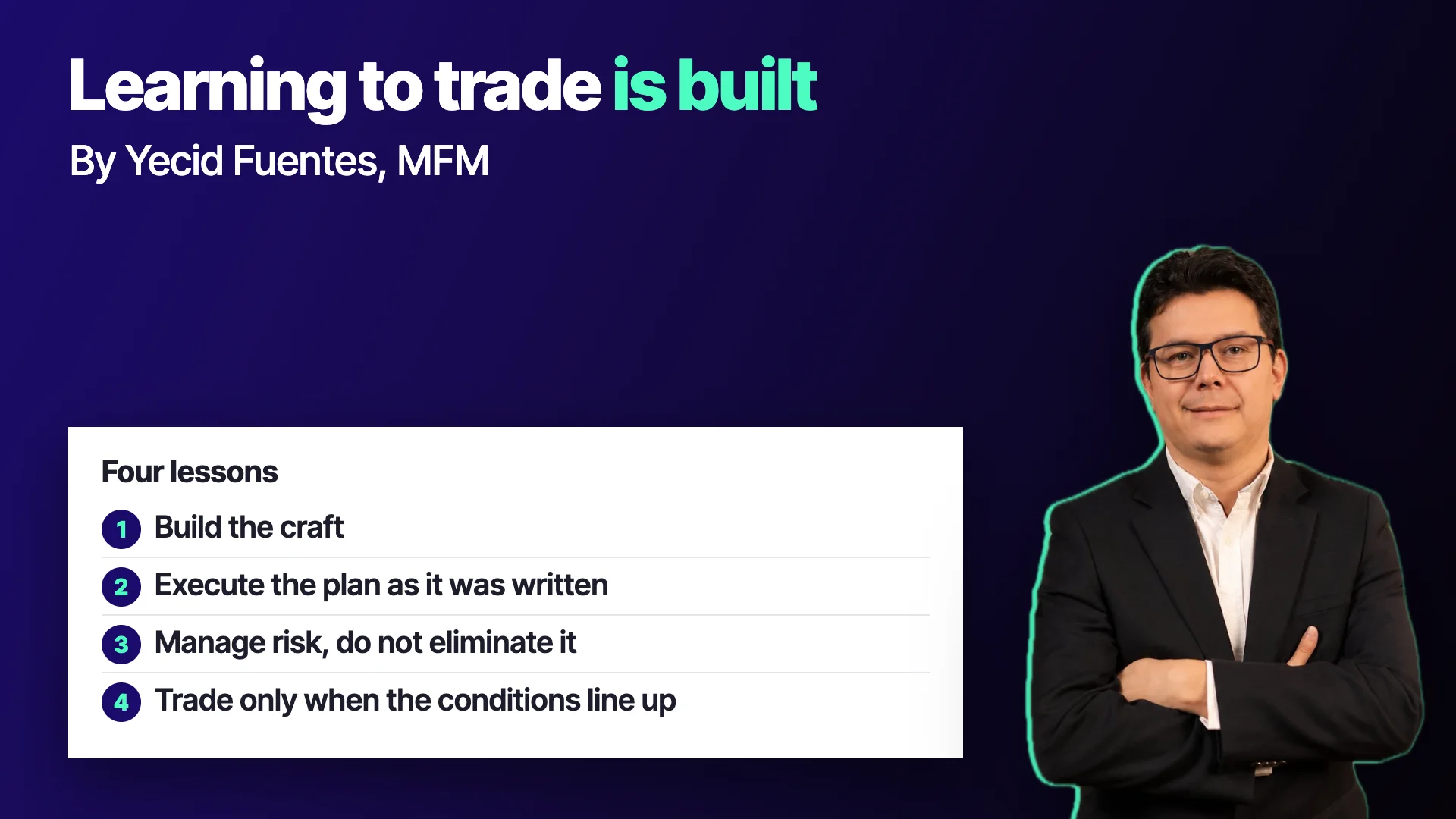
Trading is not learned all at once, it is built: with vocabulary, realistic practice, a plan executed exactly as written and a risk that is managed, never one that is eliminated.
First lesson: trading is learning a language
Someone starting a new language does not begin with long conversations. They learn vocabulary: how to greet, how to say thank you, how to name things. Markets work the same way. First you have to understand what a trend is, a correction, a pullback, a long and a short position, an economic calendar, a trade.
With that vocabulary you can build sentences, that is, do technical and fundamental analysis. Fluency comes from immersion and repetition, until the language feels natural and you can talk with others who speak it and read more advanced material.
This changes the expectation. It is not an all-or-nothing bet like the ones gambling apps offer, it is a profession with a learning curve, like any career. Academic evidence points the same way: in a classic study of individual investor accounts, those who traded the most earned lower net returns than those who traded less (Barber and Odean, 2000).
Simulator practice works if you take it seriously
A pilot does not fly a commercial aircraft without going through many scenarios in a simulator, and not only the ones that go well. Failures, emergencies and hard decisions are practiced. The demo account plays that role in the markets: it is the place to test the plan, make mistakes and measure.
It has a limit worth acknowledging. With real money emotions change, and a demo does not fully reproduce them. And it has an easy trap to avoid: using balances that have nothing to do with reality. An illustrative example shows it. A 1% gain on a USD 1,000 account is USD 10. The same 1% on USD 1,000,000 is USD 10,000. While exploring, any amount works. When it is about truly preparing, the practice account should be the size of the one you will actually use, because that is the only way to see how those gain and loss percentages feel.
Second lesson: a plan that is not executed is a dead letter
A trading plan sets out which assets you trade, at what hours, on which timeframe, which conditions must be met, how much you risk and where you exit. Building it well is useful. But often the plan stays on paper and the execution goes another way.
Typical examples: the plan said to trade the European session and you ended up trading the Asian one; you decided to trade one instrument and traded another; you set a maximum loss of 2% and ended up losing 10%; the loss limit was meant to be 50 points away and ended up 200. In all those cases the problem is not the strategy but discipline.
There is a practical reason too. Results can be measured: averages, deviations, the worst cumulative drop, which assets and which hours go better. But those metrics only help if the plan was always executed the same way. If one day you do it one way and another day another way, you are comparing apples with oranges. A plan written and executed the same way lets you adjust it with data. One that changes on every trade teaches nothing.
Third lesson: risk is not eliminated, it is managed
Anyone who comes to trading believing losses can be avoided is mistaken. At some point you will lose, even with a good method. That cannot be removed. What can be done is to make each loss small and keep it from compromising the account.
A good image is a car trip. Nobody controls every variable on the road, and sometimes the accident cannot be avoided. But with a seat belt, airbags and a prudent speed, the damage is much smaller. Risk management plays that role.
The arithmetic explains why it matters. If a USD 1,000 account loses USD 500, it lost 50%. To get back to USD 1,000 it no longer needs to gain 50%, it needs to gain 100%, because it starts from USD 500. Large losses are hard to climb back from. It is the same principle that explains why losing 40% requires gaining 67%.
Before each trade, the practical question is not technical or fundamental, it is how much you are willing to lose and what weight that would have on the account. Banks know this well: they have risk departments whose function is to set those limits. Someone trading with their own money has to act as their own risk department.
Fourth lesson: deciding also means not trading
There is a quiet impulse almost everyone feels. You spent the morning reading news, looking at charts and analyzing, and it seems you must trade for the effort to be worth it. But the profession has a peculiarity: after hours of work, the best decision can be to do nothing.
Entering only when the conditions of the plan line up, and not out of impatience, is part of the method. A chart is like a GPS: it points a direction, but it does not guarantee that you will drive well or arrive. The entry and exit decisions belong to whoever trades.
Emotional control depends largely on what comes before. When technical analysis, fundamental analysis and risk management are already done, the worst scenario is calculated before entering. That prior calm helps with typical errors such as greed, fear or revenge against the market. Self-help books may be useful, but the basis of mental control is having defined in advance how much you can lose.
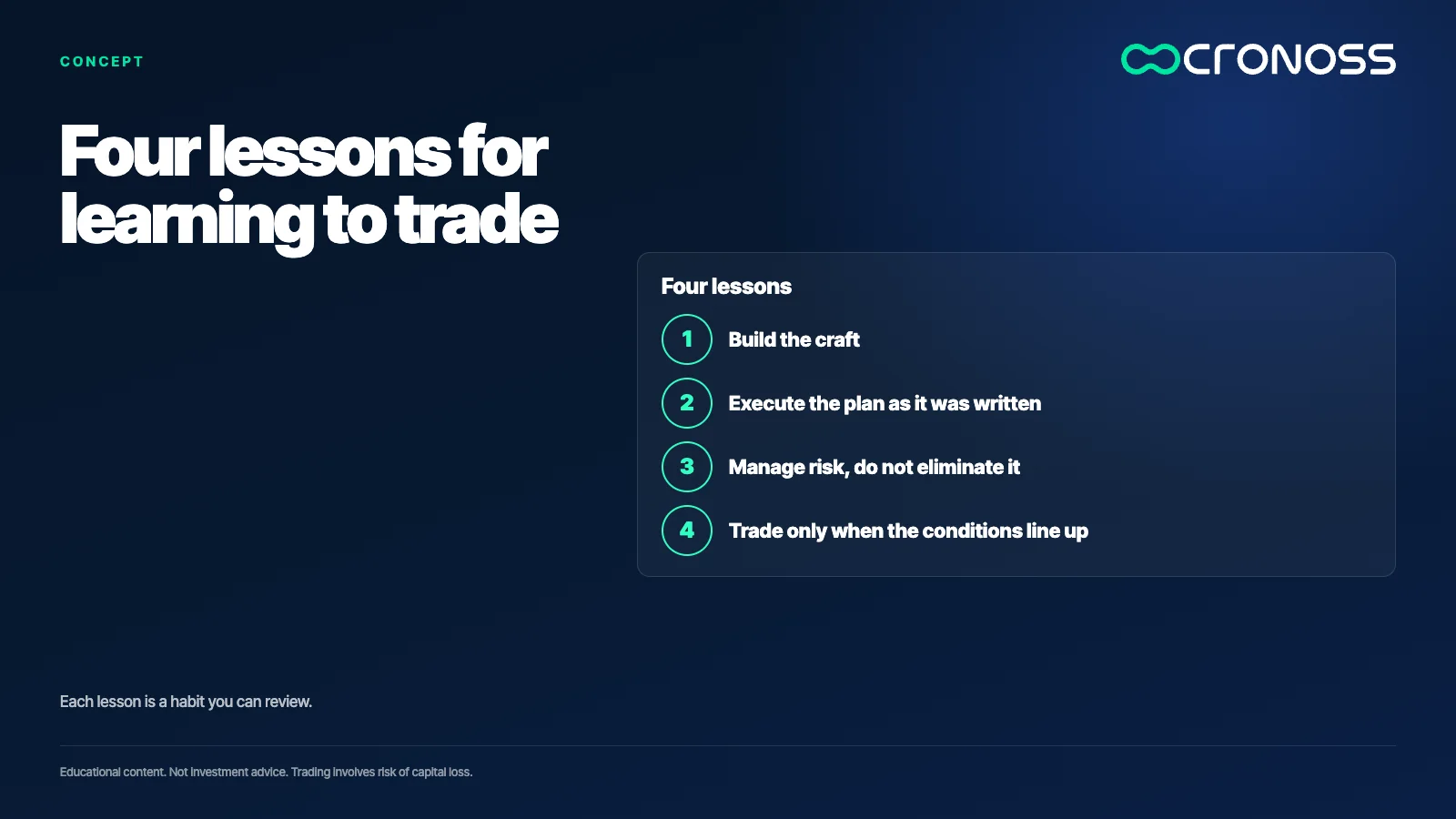
Three steps to start building the craft
- Learn the vocabulary and practice with realistic amounts. Use a demo account with the capital size you will really handle.
- Write a plan with entry conditions and a maximum loss, and execute it the same way. If you change it midway, note why.
- Record what you did and what the plan said. The gap between the two is the first thing to fix.
The craft is built, not improvised
None of the four lessons is a profit formula. They are habits that protect capital and let you learn from each mistake with data. Whoever adopts them does not stop losing on some trades, but stops losing for avoidable reasons.
If you want to build that vocabulary and understand how markets connect, the program Fundamentos de Estilos de Trading (Fundamentals of Trading Styles) is a good starting point.
Educational content. Cronoss is not a broker, investment firm or financial adviser, and nothing above is an investment recommendation.
Frequently asked questions
How long does it take to learn to trade?
There is no fixed timeline, because trading is a profession built through practice, study and measured mistakes. You learn the vocabulary first, then analysis, and finally gain fluency through repetition.
Is practicing on a demo account useful?
Yes, if it is taken seriously and used with amounts similar to those you will handle with real money. It has a limit: with real money emotions change and a demo does not fully reproduce them.
Why is risk management so important?
Because large losses are hard to recover. If an account loses 50%, it needs to gain 100% to return to the starting point. Risk is not eliminated, it is measured and limited before trading.
Is it a good decision not to trade after a day of analysis?
Yes. Having spent hours analyzing does not oblige you to trade. Entering only when the plan's conditions line up is part of the method and avoids impulse decisions.