
Key takeaways
- A true integration joins the platform and the order book; a link only connects systems that remain separate.
- Liquidity is the ease of buying or selling without moving the price, and it depends on real trading, not just on more listed companies.
- Depth matters for large orders: a market with more orders near the price lowers the cost of getting in or out.
- Buying in another currency adds a second result: your gain in pesos depends on both the share and the exchange rate.
- Taxes, local rules and the risk of each listed company do not change just because the trading platform is shared.
When three stock exchanges announce that they work as a single market, the headline tells only part of the story. For someone investing from Colombia, the useful question is more specific: what improves in how easily you can buy and sell, what changes in the range of available companies, and what stays the same in currency, taxes and risk.
An investor who buys Chilean or Peruvian shares from Colombia gains access to more companies and, in theory, to more trading activity. That access does not by itself change local rules or the currency. Separating the market's infrastructure from what applies to each investment avoids wrong expectations.
The integration improves market infrastructure. It does not remove currency, tax or company-level risk.
What NUAM is and how it differs from a link
NUAM is a regional holding company that integrates the Santiago, Lima and Colombia exchanges. According to its official website, it brings the three exchanges together to build a single regional capital market.
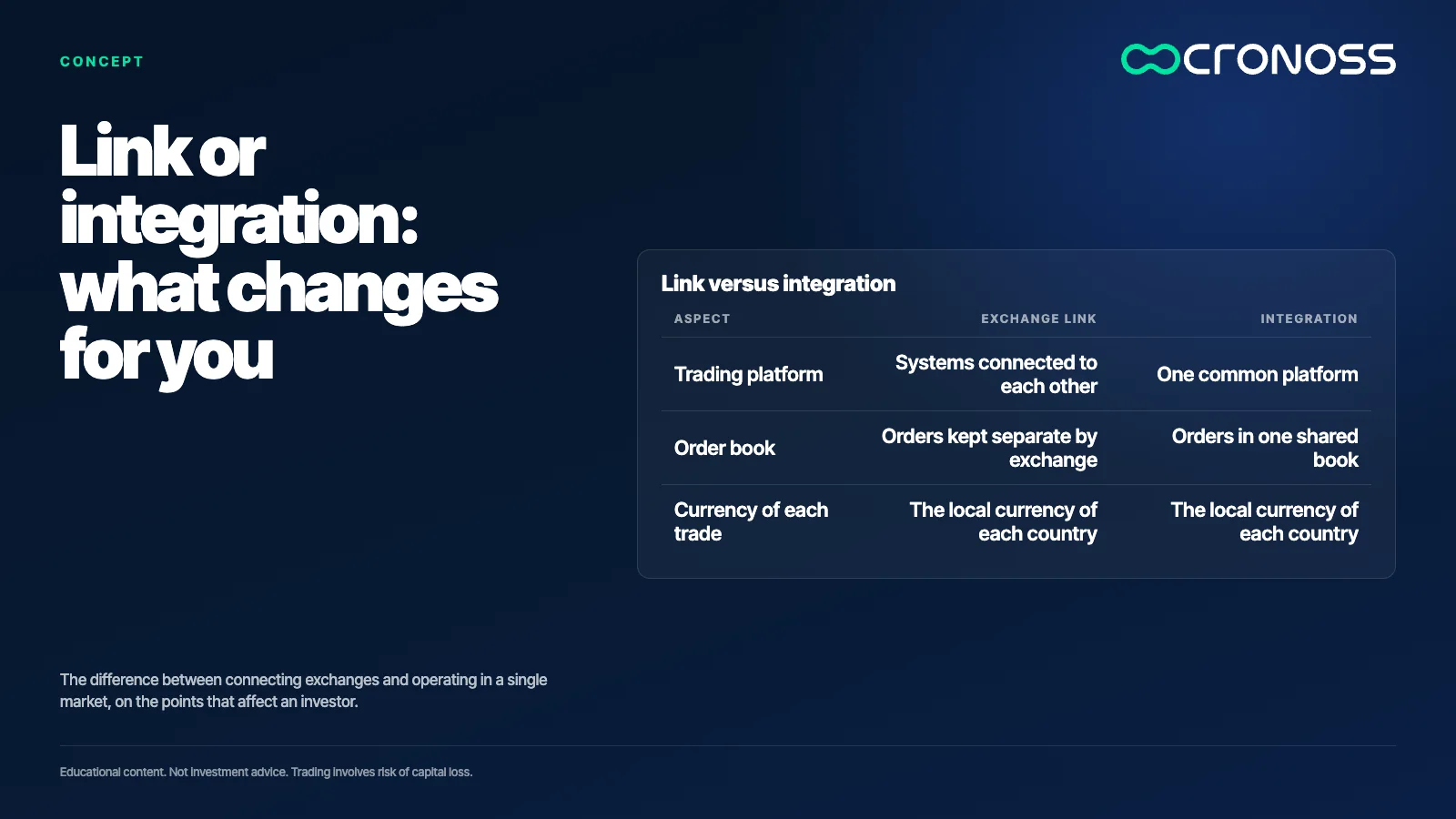
The difference between integrating and linking is the starting point. A link connects two systems so that an order can reach one market from the other, but each exchange keeps its own platform, its own order book and its own rules. An integration points to one platform and one order book, so orders from the different countries compete for the same flow. That is why NUAM is often contrasted with MILA: the question is whether the integration reaches the platform or stops at the connection.
The table below summarizes that difference on the points that most affect an investor.
Liquidity: exiting without moving the price
Liquidity is how easily an asset can be bought or sold quickly, without its price changing much. A liquid asset has many buy and sell orders close to the current price, so you can enter or exit without waiting for a specific counterparty.
For an individual investor, liquidity matters most under pressure. If you need the money, being able to sell the same day changes the risk of the position entirely. An integration can improve it because it brings the supply and demand of several countries into one place.
The improvement is not automatic. A unified market with little trading is still illiquid. Illustrative example: if a share trades an average of a few dozen units a day, a moderate order can push the price on its own. An integration aims to add participants and volume that can absorb that kind of order.
Depth: why large investors need it
Market depth describes how many orders sit at different price levels around the current price. A deep market absorbs a large order with little impact. A shallow one absorbs it by moving the price against the buyer.
Illustrative example with invented figures: a fund wants to buy 100,000 shares with a reference price of 100. At 100 there are 20,000 shares for sale, at 101 there are 30,000, and at 102 there are 50,000.
Step 1: 20,000 × 100 = 2,000,000. Step 2: 30,000 × 101 = 3,030,000. Step 3: 50,000 × 102 = 5,100,000. Total: 2,000,000 + 3,030,000 + 5,100,000 = 10,130,000, an average price of 101.30.
The extra cost against the reference price is 1.30 per share, or 1.3%. With more orders near 100, that extra cost would shrink. This is why depth matters so much to large investors, and why an integration is also measured by how much supply it pools.
Diversification: more countries does not always mean different risks
Diversification reduces the weight of any single company or sector in a portfolio. An index that covers companies in three countries can offer more variety than a portfolio that is only Colombian, because each economy has different dominant sectors.
The variety has limits. If companies in different countries depend on the same commodity price or the same economic condition, they tend to move together. Holding companies in three countries is not the same as holding three independent sources of risk.
Before assuming you are diversified, check three things: which sectors carry the most weight in the index, how each company's weight is calculated under the official methodology, and what share of your portfolio would sit on the same risk factor.
Currency: buying in another currency means two markets
If you buy a Peruvian share, your result in Colombian pesos depends on two movements: the share price in soles and the exchange rate between the sol and the peso. A gain in the share does not guarantee a gain in your currency.
Illustrative example with invented figures: you invest the equivalent of USD 1,000 in a Peruvian share. The share rises 10% in soles, but the sol falls 5% against the Colombian peso.
Step 1: 1.10 × 0.95 = 1.045. Result: a 4.5% gain in pesos, not 10%.
If the sol had instead risen 5% against the peso, the calculation would be 1.10 × 1.05 = 1.155, or 15.5%. Currency can add to or subtract from your return, and a sustained move against you can offset the company's gain even when the share price has risen.
What does not change: taxes, local rules and risk
An integrated trading platform does not, by itself, unify taxes, regulation or investor rights in each country. Withholding, reporting and protection rules in each jurisdiction still apply, and they may treat you differently depending on your tax residence. Check those rules for your specific case with a tax adviser before you trade.
Company risk does not change either. A company with high debt, a bad quarter or a regulatory change remains exposed. A more liquid market makes it easier to sell, but it does not decide whether the price goes up or down. Settlement times and the cost of converting money also depend on your broker and on each market, so check them before you place an order.
Investing in shares carries a real possibility of losing capital, even in large, well-organized markets.
Three steps to review an offer in an integrated market
- Check the structure. Ask whether the assets you are interested in trade on one platform or only have an access channel. Confirm which rules apply to the order you plan to place.
- Measure real liquidity. Look at traded volume and the depth of the order book for each company, not just the number of listed companies. If volume is low, your order can move the price.
- Calculate the result in pesos. For each scenario you want to evaluate, combine the share's move in its own currency with the exchange-rate move, and compare the result with your time horizon and the loss you are willing to accept. If you cannot run this calculation, you do not yet have the full picture.
A bigger market does not replace your judgment
Integrating exchanges improves infrastructure, widens the range of available assets and, in some cases, may reduce the cost of getting in and out. That has value. But each investment still depends on the company you buy, the price you pay, the currency you are paid in and when you will need the money.
The decisive question does not change: how much could you lose, and how soon would you need that money back? A larger market widens your options, but it does not make that decision for you.
If you want to practice these calculations with real data and a method, the program Introducción Práctica a los Mercados Financieros (Practical Introduction to Financial Markets) walks you through them step by step.
Educational content. Cronoss is not a broker, investment firm or financial adviser, and nothing above is an investment recommendation.
Frequently asked questions
What is NUAM?
NUAM is a regional holding company that integrates the Santiago, Lima and Colombia exchanges. Its stated goal is to operate as a single market for the three economies.
Does integrating exchanges make a share more liquid?
It can, if the integration concentrates buy and sell orders. Real liquidity is measured by traded volume and how close orders sit to the price, not by the number of listed companies.
If I gain on a Chilean or Peruvian share, do I also gain in pesos?
Not necessarily. Your result in pesos combines the share move in its own currency with the exchange rate between that currency and the Colombian peso. A gain in the share can shrink or turn into a loss if the local currency falls against the peso.
Does integration change the taxes I pay in Colombia?
A shared trading platform does not, by itself, unify each country tax rules. Check with a tax adviser how the rules apply to your case, because it depends on your situation.


