Key takeaways
- A promise of high returns with little or no risk is a classic sign of investment fraud, not a real opportunity.
- Pressure to decide today and group chats that appear after an ad are frequent warning signs of a scam.
- In a social media mania, the price rises on other people's buying, and the promoter can sell at that inflated price.
- Before you invest, search for the person and the firm in Investor.gov's tool to confirm their registration.
- If you do not understand the strategy or cannot withdraw your funds, stop adding money until it is clarified.
Every year-end brings new offers: tips on social media, group chats with a self-described adviser, assets that jump in a single day and promise more than any market delivers. Many people reach these offers with extra cash on hand and a nagging sense that the moment will pass them by.
That moment is exactly what fraudsters and social-media-driven manias count on. Telling them apart from a legitimate investment does not require being an expert. It requires recognizing a handful of warning signs and verifying before you transfer anything.
Before you invest, the question is not how high it can go, but what you would have to believe for the offer to be true.
A promise of high returns with no risk is the first warning sign
Every investment carries risk, and high returns usually come with high risk. The U.S. Securities and Exchange Commission (SEC) puts it plainly: a promise of high returns, often accompanied by a guarantee of little or no risk, is a classic sign of investment fraud. Some offers on social media promise returns of 100 percent or more.
To see what such a promise implies, run your own calculation. Suppose an offer of 30 percent per month on USD 1,000, reinvested for 12 months:
- Monthly growth factor: 1.3 raised to the 12th power.
- Result: USD 1,000 times 23.3 is approximately USD 23,298.
This is a worked example of our own arithmetic, not the return of any product. Its purpose is to show that, if the promise were real, every dollar would multiply more than twentyfold in a year. A figure like that should create more skepticism, not more excitement. Real returns rise and fall, so an asset that rises every month regardless of what the market does also deserves doubt. A useful question is this: if the return were real, why would the person need your money or your contacts' money to achieve it?
Urgency and pressure to act now
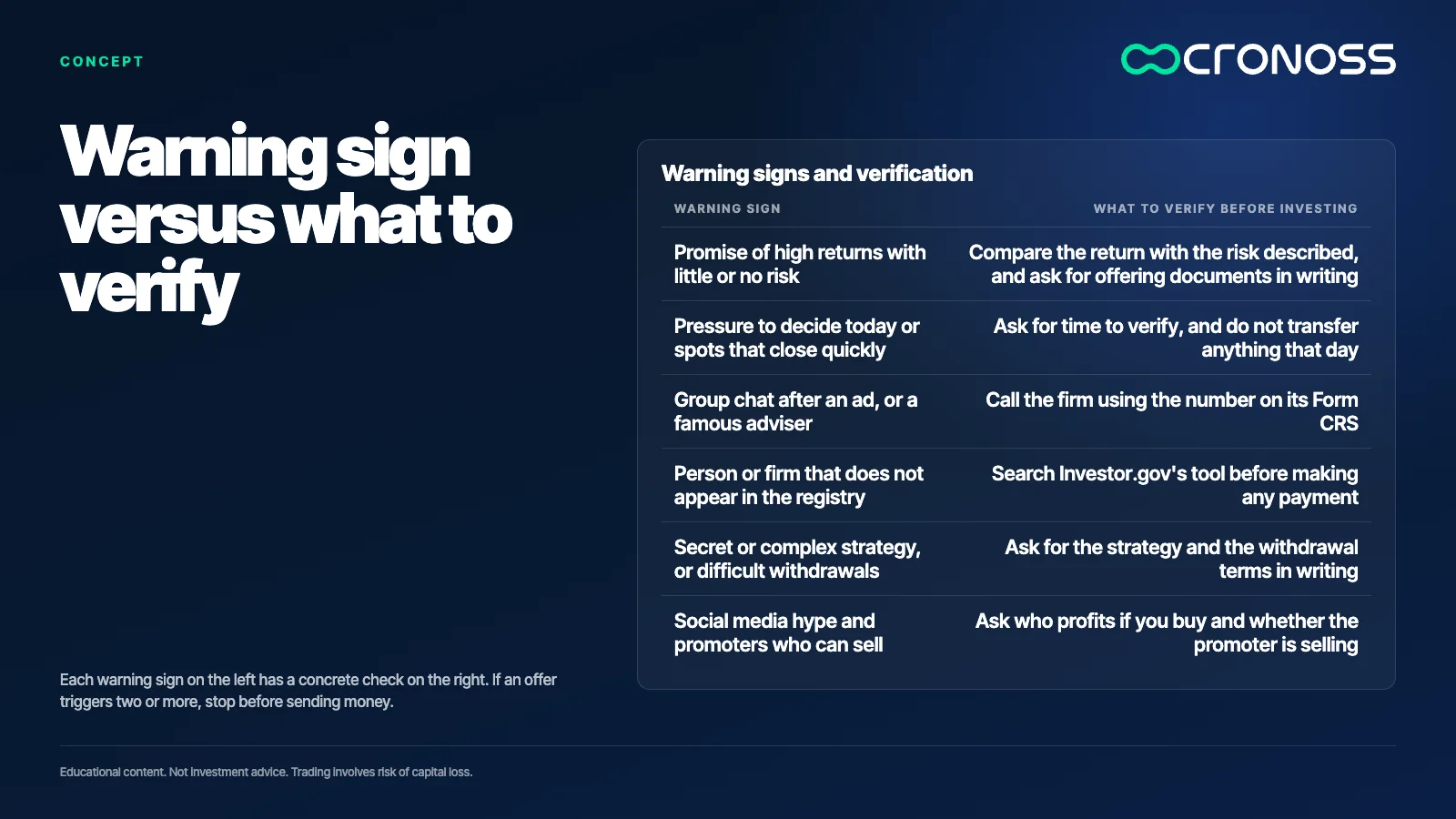
Scams rarely leave room to think. A group chat that appears after you click an ad, a supposed analyst who insists you decide today, or a spot that closes within hours is designed to keep you from checking anything. Investor.gov's red flags checklist lists pressure to invest right now among its three main warning signs.
A common variant is someone who claims to be a famous professional, an employee of a registered adviser or a well-known broker. Before you believe them, contact the firm using a phone number or website listed in its Form CRS, the relationship summary that registered firms give their clients. If someone claims to be registered when they are not, or impersonates a registered professional, you can report it to the SEC.
The principle is simple: a legitimate offer can wait while you compare, check and think. One that cannot wait has already given you its answer.
Manias and memes: when fashion replaces analysis
A social-media-driven mania has a recognizable mechanism. Someone promotes an asset, a chorus of enthusiasts appears, the price climbs under buying pressure and emotion takes the place of analysis. The SEC describes the pump and dump: a stock price is inflated with false or misleading statements to create a buying frenzy, and the person promoting it sells their own shares at the elevated price.
The mechanism also runs in reverse. Some people spread negative rumors so that others sell cheap, letting the fraudsters buy at an artificially low price. Fraudulent stock promotions on social media can take many forms, including memes.
A meme is not a thesis. Before you put money behind a trend, ask who profits if you buy, whether that person is selling their own positions, and whether you can explain in one sentence why the asset deserves your money. If the only reason is that others are buying, you are inside a mania, not an investment.
Opacity: if you do not understand the strategy, do not invest
Ponzi schemes pay earlier investors with money from newer ones. Investor.gov flags several warning signs that tend to appear before the collapse: secretive or complex strategies, errors on account statements, and difficulty receiving payments or cashing out.
The last sign is the most revealing. When someone struggles to withdraw and is offered even higher returns to stay put, the money is probably not invested as promised. A statement that does not match what you were told is another clue: ask for an explanation in writing before you contribute anything more.
Risk note: if money is already in, do not keep adding funds to recover what you lost. That is one of the most expensive traps. Seek independent advice, and report any sign of fraud to the SEC.
Check registration before sending a single dollar
The most concrete test is whether the person or the firm is registered. Investor.gov offers a free search tool to check brokers and investment advisers. For advisers, the information comes from the SEC's Investment Adviser Public Disclosure (IAPD) database. If a firm is also registered as a broker, the tool sends you to BrokerCheck, FINRA's system.
The report shows whether the individual is licensed or registered, whether they are currently suspended in any jurisdiction, and their disciplinary history, along with the firms they have worked for. If a firm is registered as both a brokerage and an adviser, review both sets of information.
If you cannot find someone in either database, that is information too. Investor.gov explains that most Ponzi schemes involve unlicensed individuals or unregistered firms. Treat the absence of registration as a warning sign, not as a pending formality. Keep a copy of the report with the date you checked it, because registration status can change.
Three steps before you invest a single dollar
- Confirm identity and registration. Search for the person and the firm in Investor.gov's tool, and contact the firm through the phone number or website listed in its Form CRS. If they do not show up in the registration records, stop.
- Check the promise and the pressure. Write down the return promised, the time frame and any guarantee. If you are asked to decide today or promised little or no risk, the offer already shows two warning signs.
- Ask for the strategy and the terms in writing. Request how your money will be invested, how and when you can withdraw it, and what fees apply. If you do not understand the answer or cannot withdraw, do not contribute.
Learning takes time, and haste works in the fraudster's favor
Frauds repeat because the temptation of easy money repeats. Manias return because each generation gets excited about something new. That does not mean everything is a scam. It means judgment is built through practice, through reading good information and through giving yourself time to make small mistakes before making big ones.
Telling a legitimate offer from a trap is a long-term exercise. Someone who spends weeks studying an asset, comparing sources and checking registrations has an advantage that does not depend on luck or on market timing.
What you can control is your pace. An investment that is genuinely worth considering can wait while you verify it.
No legitimate investment needs you to decide today.
If you want to learn how to measure the real risk of an investment and divide your capital with judgment, review the program Fundamentos de Riesgo en las Inversiones (Fundamentals of Investment Risk).
Educational content. Cronoss is not a broker, investment firm or financial adviser, and nothing above is an investment recommendation.
Frequently asked questions
How do I know if an investment offer is a scam?
Look for a promise of high returns with little or no risk, pressure to decide immediately, and no registration you can verify. If one or more of these signs appear, stop and verify before sending money. The Investor.gov checklist is a good starting point.
How do I check whether someone is a registered adviser or broker?
Use Investor.gov's free search tool, which draws on the SEC's IAPD database for advisers and sends you to FINRA's BrokerCheck for brokers. The report shows registration status, suspensions and disciplinary history. If you cannot find the person or the firm, treat that as a warning sign.
What is a pump and dump scheme?
It is a scheme in which a stock price is inflated with false or misleading statements, and the person promoting it sells their own shares at the elevated price. Investors who buy at that price often end up with losses.
What should I do if I already sent money and cannot withdraw it?
Do not add more money to recover what you lost, because that usually increases the loss. Keep contracts, account statements and messages. You can report a possible securities fraud to the SEC.


