Key takeaways
- Buying a share makes you a shareholder, with political rights (a vote) and economic rights (dividends and subscription).
- A CFD is a contract for difference: it settles the price change and gives you no shareholder rights.
- To receive a dividend you must have bought the share before the ex-dividend date.
- A CFD allows short positions and leverage, but it amplifies risk and has costs such as the spread.
- ESMA found that between 74% and 89% of retail CFD accounts lost money.
On many trading platforms "Apple" shows up in a list with a button to buy. What does not always show up at first glance is what you are buying. It can be a share of the company, or it can be a contract for difference, a CFD, whose only link to the share is that it follows its price.
The difference is not cosmetic. It determines whether you own a piece of the company or only bet that its price will rise or fall, with which rights, which costs and which level of risk. European authorities reviewed retail CFD accounts and found that between 74% and 89% lost money.
Buying a share makes you a shareholder, with political and economic rights; trading a CFD on that share only exposes you to its price change, without those rights and with risks of its own.
What is a share and where does it come from?
A share is a security that represents a piece of a company. The company that issues it is called the issuer, and it offers the share to the public on a stock exchange through a public offering, normally through a brokerage firm. With that money it raises capital.
No company is obliged to be listed. Listing means its financial statements and shareholder meetings become public and that it reports results regularly. That is why many mid-sized and large companies prefer to finance themselves with loans or bonds, which promise a payment to the investor at the end of the period.
The first sale of the share takes place in the primary market. From there on, everything investors buy and sell among themselves happens in the secondary market, and that is where supply and demand set the price.
The rights that come with being a shareholder
When you buy the share on an exchange, through an intermediary, you acquire rights that a non-shareholder does not have.
- Political rights. In ordinary shares, a voice and a vote at shareholder meetings. With small amounts the weight of your vote is minimal, but the right exists.
- Economic rights. A share in the profits that the meeting decides to distribute as dividends.
- Subscription right. Priority to buy new shares when the company issues more.
Preferred shares usually carry no vote, and in exchange may offer a higher dividend, especially in the first years after issuance. No company is obliged to issue a particular type: some issuers have both classes and others only one.
How a dividend works
A dividend is a distribution of profits to shareholders. It is not automatic: a company can have profits and not distribute them if its meeting decides so or its bylaws provide so.
Meetings usually take place early in the year and set how much is paid and on which dates. Three dates are worth telling apart. The declaration date is when the company announces the payment. The ex-dividend date is the first day the share trades without the right to the dividend: to receive it you must have bought before that date. The payment date is when the money reaches your intermediary.
An illustrative example: a company declares USD 0.21 per share. If you hold one share before the ex-dividend date, you will receive USD 0.21. If you hold two, you will receive USD 0.42. That flow is part of why some investors prefer shares of companies that distribute profits year after year.
What a CFD is and what it gives you
A contract for difference is an agreement between you and a provider, usually outside an exchange, in which the difference between the price at opening and the price at closing the position is settled. You do not receive shares or become a shareholder. You buy or sell a contract.
An illustrative example with simple numbers: you open a position at USD 22 and close it at USD 42. The difference is USD 20 per unit in your favor. If you close it at USD 12, the difference is USD 10 per unit against you.
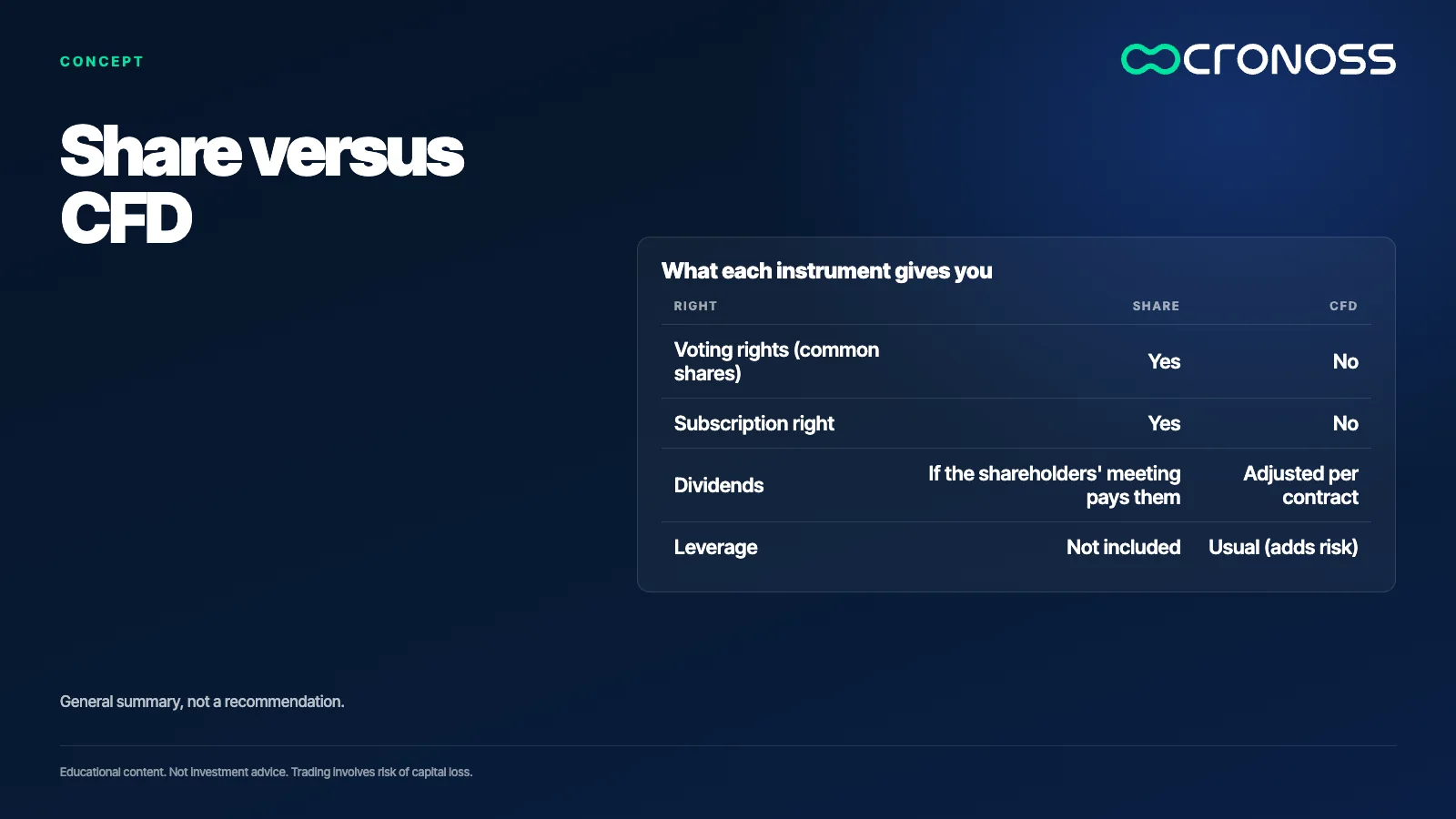
What you do not have as a CFD holder: a voice and vote at the meeting, the subscription right and the right to receive dividends. Some providers apply a dividend adjustment, but that depends on each contract and is not a shareholder right.
What a CFD adds, and what it costs
A CFD allows short positions, that is, profiting when the price falls, without having bought the share first. It also usually allows leverage, which means controlling a position larger than the capital deposited.
Those two features are exactly what add the most risk. Leverage amplifies gains and also losses, and a short position has no natural loss limit because the price can rise without a ceiling. There are also costs that do not appear when buying shares: the spread, which is the difference between the buy and sell price, and charges for holding the position open.
It is not a good or bad product in the abstract, and it is not the only way to trade on the downside. But the regulatory data is clear: ESMA restricted CFDs for retail clients in the European Union precisely because of the losses observed. Risk depends on use, and the data shows that most retail accounts lose. If you want to see why, the analysis of why most retail traders lose money develops it with evidence.
Two questions before choosing the vehicle
What fits depends on what you are after. If your idea is to take part in a company for years, collect dividends and have a voice as a shareholder, the coherent vehicle is the share. If you want short-term exposure to price changes, there are contracts that offer it, with all the conditions and costs described above.
In both cases, what rises or falls is the same price, and the result depends on how much it moves. Also measure the volatility of what you buy: the larger the percentage swing, the larger the risk, on the way up and on the way down. And remember that the price of a share is moved by buyers and sellers, who often act out of enthusiasm or fashion, not only fundamentals.
What to check before trading on a share
- What instrument is it? Read the name on the platform and the contract sheet. If it says CFD, you are not buying the share.
- Which rights and which costs does it carry? Dividends, vote, spread, charges for holding the position and, if there is leverage, how much.
- How much can I lose and how fast? Set the maximum loss you accept before opening the position.
Instrument first, price second
Many mistakes start with not knowing what was bought. The price of the share and the price of the CFD can look the same on screen, and yet one makes you an owner of part of the company and the other does not. Before asking whether something will rise, ask what you are buying.
If you want to understand better how asset classes, instruments and the vehicles used to access them relate, the program Clases de Activos e Instrumentos de Inversión (Asset Classes and Investment Instruments) develops it from scratch.
Educational content. Cronoss is not a broker, investment firm or financial adviser, and nothing above is an investment recommendation.
Frequently asked questions
What is the difference between a share and a CFD on that share?
The share makes you the owner of a piece of the company, with a vote in ordinary shares, dividends and subscription rights. The CFD is a contract that settles the price difference and gives you none of those rights.
Do I receive dividends if I trade a CFD?
Not as a shareholder right. Some providers apply a dividend adjustment, but it depends on the terms of each contract and should be checked before trading.
What is the ex-dividend date?
It is the first date on which the share trades without the right to an already declared dividend. To receive it you must have bought the share before that date.
Is trading CFDs risky?
Yes. They allow leverage and short positions, which amplify losses, and they carry their own costs. ESMA reported that between 74% and 89% of retail CFD accounts lost money.