Key takeaways
- An index is not an asset: it is a figure that sums up a basket of stocks under a rule set by whoever administers it.
- Company size is measured by market capitalization: share price times shares outstanding.
- In a capitalization-weighted index, one large company can lift it even when most of the others fall.
- Components are reviewed periodically (rebalancing), so today's index does not hold the same companies as ten years ago.
- Before using an index as a benchmark, read its methodology and look at its largest components.
The news says the S&P 500 rose or the Nasdaq fell, and it sounds like something you can touch. But an index is not a stock. It has no issuer and no certificate. It is a number that someone calculates from a list of stocks and a rule for combining them.
That rule is what almost nobody reads. Two indices that both seem to measure "the market" can tell different stories on the same day, and an index can rise even when most of its companies fell.
A stock index is a rule that selects stocks and weights them into a single reference number, and it can only be read well once you know the rule.
What is a stock index, and why can't you buy it like a share?
An index is a performance measure. It takes a basket of assets and sums up what happened to them in one value. There are indices for fixed income, currencies and commodities, but the best known are stock indices, also called equity indices.
A share represents a piece of a company. An index represents nothing: it is a figure published by whoever administers it. What you can buy are products that aim to track it, such as index funds and ETFs, or contracts that follow its value. Each has its own costs, risks and conditions, and none of them is "the index".
A useful picture is a private club. The body that creates the index decides who gets in, under which requirements and how much each member counts. Companies that do not meet the conditions are not in the club, however good they are.
Where do indices come from?
The oldest is still running. Charles Dow created the Dow Jones Industrial Average in 1896 to summarize a small group of industrial companies, which were the core of the US economy at the time. It is still a reference today, although it is no longer the most representative gauge of that market.
The underlying idea has not changed. Reading hundreds of prices one by one is not practical, so a measure is built to summarize them. That is why there are now indices by country, region, sector and company size, and each exchange or provider sets its own methodology.
The club rules: sector, size, country and style
When an index is designed, at least four entry decisions are made.
- Sector. An index can bring together only technology companies or only financial ones. The widely used GICS classification splits the market into 11 sectors.
- Size. It is measured by market capitalization, the share price multiplied by the number of shares outstanding. It is what the market pays for the company today, not what its financial statements say.
- Geography. It can be one country, like the Colcap in Colombia, or several, like the Euro Stoxx 50, which groups large companies from the euro area.
- Style. The Russell 2000, for example, holds small US companies, very different from the giants in the S&P 500.
Market capitalization deserves a clarification. Market price and book value are different things: supply and demand move the first, balance sheets produce the second. Indices use the first.
Why companies do not all weigh the same
This is the point that surprises people most. Most large indices are capitalization weighted: the more a company is worth on the exchange, the more it influences the result. It is not a simple average.
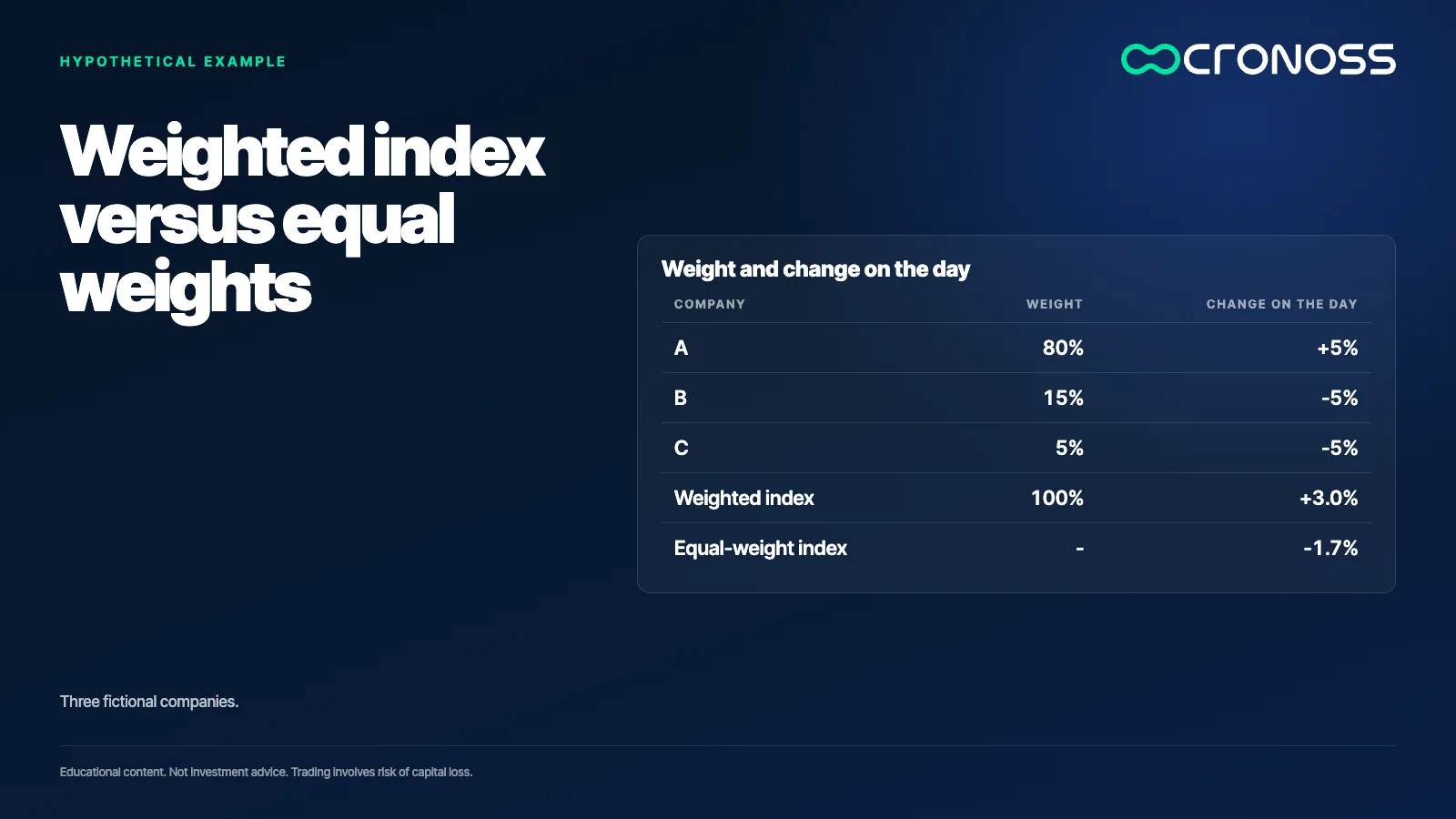
An illustrative example with three fictional companies shows the effect. Company A weighs 80%, B 15% and C 5%. In one day, A rises 5% and B and C each fall 5%.
- Contribution of A: 80% times 5% = +4.00 percentage points.
- Contribution of B: 15% times -5% = -0.75.
- Contribution of C: 5% times -5% = -0.25.
The weighted index rises 3.0% even though two of the three companies fell. If all three weighed the same, the result would be (5 - 5 - 5) / 3 = -1.7%. It is the same reality with two different rules and two opposite headlines.
Real indices work the same way at scale. When a few very large companies hold a meaningful share of the weight, the index moves mostly because of them. The exact weight changes over time, so the right way to know it is to open the index's official fact sheet and look at its largest constituents.
A quick map of the reference indices
Almost every country has at least one main index, and knowing the most quoted ones helps you read any market news.
- United States. The S&P 500 brings together about 500 large companies and is the most used reference to compare portfolios. The Nasdaq 100 groups 100 large non-financial companies, with a heavy technology weight. The Dow Jones has only 30 components. The Russell 2000 follows small companies.
- Europe. The Euro Stoxx 50 mixes large euro area companies. The FTSE 100 collects the largest on the London exchange, the CAC 40 those in Paris and the IBEX 35 those in Madrid.
- Asia. The Nikkei 225 represents Japan and the Hang Seng represents Hong Kong.
- Colombia. The MSCI Colcap is the local reference index.
This list describes what each one measures. It is not a recommendation of where to invest: each index has its own makeup and its own risk.
The club also changes its members
No list is fixed. Whoever administers the index reviews, usually every quarter or every six months, whether each component still meets the requirements. That adjustment is called rebalancing.
If a company stops meeting the size or sector criterion, it leaves, and another that does meet it comes in. That is why comparing today's index with the index ten years ago is not comparing the same companies. It is also why you should know the current members and not those of a few years back: the weight of each company in a local index can change a lot after a rebalance.
What an index is for, and what it does not tell you
An index serves three practical functions.
- Thermometer. One number sums up what hundreds of stocks are doing. If the world's major indices fall together, something is happening; if they rise together, risk appetite is high.
- Comparison benchmark. Whoever manages a portfolio compares the result with the index that matches the strategy. If it does not beat it, a fund that tracks it is a reasonable alternative.
- Risk gauge. Sharp drops and volatility in the index show whether there is uncertainty in the market.
It has limits. An index is not an exact mirror of the economy: markets tend to anticipate or move at a different pace, and a heavy weight in a few companies can distort the reading. What moves stocks, such as growth, interest rates, inflation and political expectations, also moves the index, but not automatically or evenly.
What to check before using an index as a benchmark
- Read the methodology. Find which sector, size and country it covers, how it is weighted and how often it is rebalanced.
- Look at the largest components. If ten companies hold a large share of the weight, the index speaks mostly about them.
- Compare like with like. A technology index does not measure the same thing as a small-cap index or a single-country index.
One number, one rule
The value of an index cannot be understood without its rule. The useful question is not whether the index rose, but which companies made it rise and with what weight.
If you want to place indices within the asset classes and instruments that exist, the program Clases de Activos e Instrumentos de Inversión (Asset Classes and Investment Instruments) covers them from scratch.
Educational content. Cronoss is not a broker, investment firm or financial adviser, and nothing above is an investment recommendation.
Frequently asked questions
What is a stock index?
It is a measure that sums up the performance of a basket of stocks in a single number. An exchange or a provider calculates it under a methodology that defines which companies enter and how much each one weighs.
Can you buy an index like a share?
Not directly, because an index is a figure and not a security. Products exist that aim to track it, such as index funds and ETFs, or contracts that follow its value, and each has its own costs and risks.
Why can an index rise when most of its companies fall?
Because most large indices are weighted by market capitalization, and bigger companies weigh more. If the heaviest ones rise enough, they offset the drop in the rest.
What is index rebalancing?
It is the periodic review of its components. If a company stops meeting the size or sector criteria it leaves the index and another that does meet them comes in.