Key takeaways
- The invented trade is a trade that breaks the plan's rules and is taken to relieve the anxiety of not trading.
- The market pays for the quality of decisions, not for time spent in front of the screen.
- Stretching the plan's criteria produces extra trades with no edge, and costs turn them into a sure loss.
- A previous loss is not a reason to trade: revenge with bigger size turns a normal day into a bad one.
- Before trading, you should be able to name the plan rule that was met; if you cannot, there is no trade.
There are days when the market simply offers nothing. Price sits still, volume drops and none of the plan's conditions are met. For many people that silence is uncomfortable. Sitting in front of the screen doing nothing feels like wasting the day.
From that discomfort comes one of the most expensive and least visible losses in trading: the invented trade. It is the trade that is not in the playbook, that breaks the plan's rules and that gets taken to calm the anxiety of feeling useful.
A trade that is not in your plan is not an opportunity: it is a way to relieve anxiety, and the market pays for the quality of decisions, not for activity.
The activity bias: we were taught that doing means producing
Almost all of us come from jobs or schools that reward activity. Someone who spends four hours staring at the ceiling in an office gets scolded; someone who leaves the exam page blank loses. We learn that activity equals results.
In trading that logic fails. The market does not pay for time spent in front of the screen. It pays for decisions consistent with a measurable edge. In a sideways or low-volume market the best decision can be to do nothing, and that clashes with everything we were taught.
Seeing patterns where there is only noise
When nothing is happening, the mind starts manufacturing signals. It is similar to seeing faces in clouds: a movement that is pure noise gets the look of an opportunity. The plan's criteria turn elastic without you noticing.
Think of a rule that requires a reaction zone to have been touched three times. The zone has two touches, but "it came close a third time, so it counts". And the confirmation that did not arrive is replaced by "I saw something". With made-up numbers: if the strict rule yields 5 trades per week and the flexible version yields 12, the 7 extra ones have no edge at all. If each costs 0.1R in spread and commissions, that is 0.7R per week, about 2.8R per month. At 1% risk per R, that is around 2.8% of the account given away for no reason.
Case 1: the afternoon boredom
A trader works on 15-minute charts. Two hours have passed with no signals and the market has entered the quiet stretch of the day, when volume drops and price drifts without direction. The coffee is cold and there is a pang of guilt for not having traded. So the trader drops to a 1-minute chart, "just to see if something is there", and finds a green candle that looks strong.
No moving average backs it, there is no volume, no clear structure. But the decision to enter is already made, and the story gets built: that candle is the start of a big trend. The trade goes in, price rises a little, stalls and comes back. It ends up closed out of boredom or by an unnecessary stop. The warning sign was changing time frames to force an opportunity.
Case 2: the midday revenge
A small loss, within the plan, opens the day. Nothing should happen, but the ego hurts, especially after a good streak. Midday arrives, the market gives no signals and the right decision would be to close the computer. Instead a thought appears: I can't leave in the red.
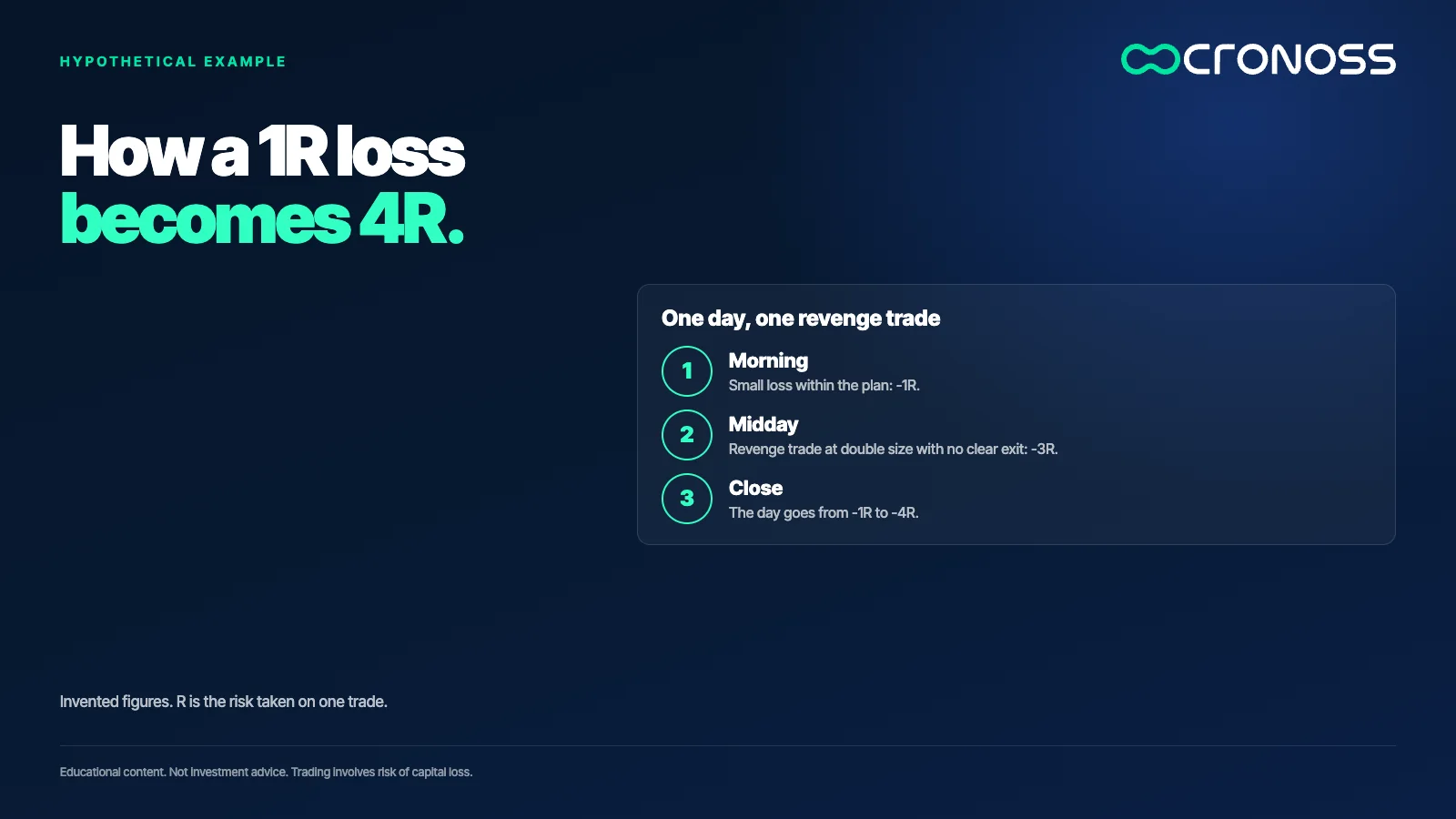
That sentence is the origin of many invented trades. The person looks at an asset they never trade, sees a random bounce and raises size to win back what was lost. With made-up numbers: the morning loss was 1R. The revenge trade uses double the size, has no clear exit point and closes with a loss equal to 3R. The day goes from −1R to −4R. The talk is no longer about strategy but about emotional accounting.
Case 3: the message that says "don't get left out"
The market is sideways and a message arrives on social media: gold is going up, don't stay out. The trader's own indicators say there is no way in. But the fear of missing out kicks in, and the doubt: what if that person sees something I don't?
Instead of trusting their analysis, the trader adjusts the trend line and levels until the chart "agrees" with the message. They enter and price falls. It turns out the person who posted trades on a monthly time frame and the trader works on a daily one. Analysis from a different horizon does not work as a signal for another. Noise from outside is the enemy of the strategy inside.
What is legitimate flexibility and what is bias
A plan can have flexible parts. For example, the exact entry point within a zone. And it can have parts that allow no margin, such as the confirmation that validates that zone. The problem is not flexibility itself but deciding on the fly, with anxiety on top, which criterion gets stretched.
The useful rule is to write down beforehand which criteria are flexible and which are not. If it is not written, what gets stretched is the bias.
Three questions before any trade
- Which rule of my plan was met? If you cannot name the rule, there is no trade.
- Would I enter if I had not read that message or were not bored? If the answer changes, the cause is not the market.
- Am I trying to win something back? A previous loss is not a reason to trade; it is a reason to stop.
Staying still is also a decision
Not trading is not losing the day. A journal with a column for no-trade days, recording which signals were missing and what was felt, turns silence into information. Over time those records show that most unnecessary losses were born in stretches when nothing was happening.
Trusting your own strategy, reviewing it with data and respecting it even when it offers nothing is what separates a method from a collection of impulses.
If you want to go deeper into how the mind reacts under pressure and how to train it, the program Fundamentos del Psicotrading y Neurotrading (Foundations of Psychotrading and Neurotrading) works through these topics step by step: Fundamentos del Psicotrading y Neurotrading.
Educational content. Cronoss is not a broker, investment firm or financial adviser, and nothing above is an investment recommendation.
Frequently asked questions
What is an invented trade?
It is a trade that breaks the rules of the trading plan and is taken to calm the anxiety of not trading. It usually comes from boredom, a previous loss or the pressure of other people's opinions.
How do you recognize a revenge trade?
It appears after a loss, usually uses more size than normal, trades an asset you normally do not trade and has no clear exit point. The typical thought is that you cannot end the day in the red.
Is it wrong to be flexible with the plan?
No, if the flexibility was defined beforehand in writing. The problem is deciding on the fly which criterion to stretch under anxiety, because then what stretches is the bias.
What should you do when the market offers no signals?
Accept that not trading is a valid decision. Recording no-trade days in the journal, which signals were missing and what was felt, helps turn silence into information.


