Key takeaways
- Between 74% and 89% of retail CFD accounts lost money, according to analyses by European authorities.
- Trading often and with leverage speeds up losses: it raises the size of each move and the number of decisions.
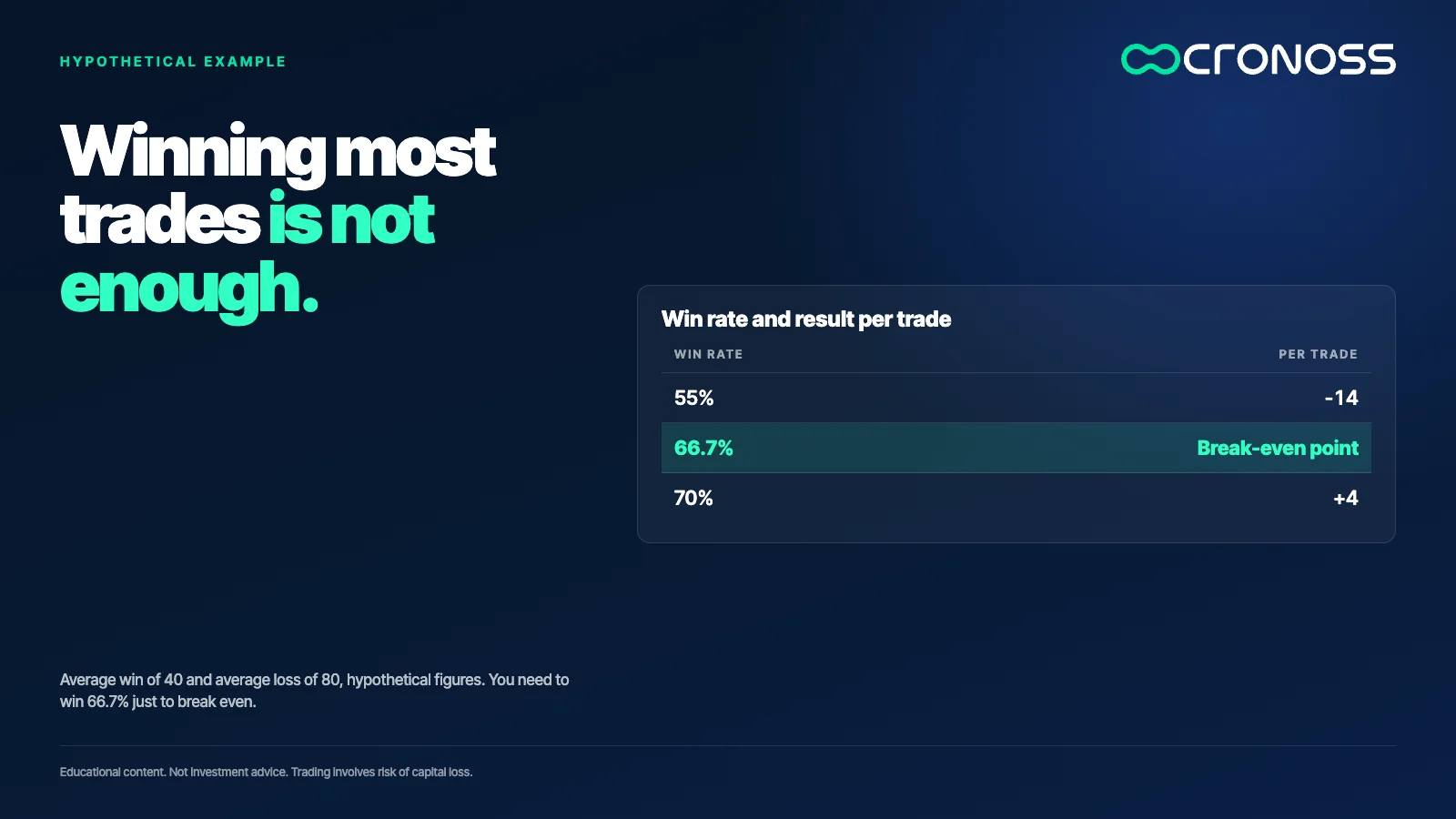
- With an average win of USD 40 and an average loss of USD 80 you must win 66.7% of trades just to break even.
- Loss aversion, fear of missing out, confirmation bias and revenge trading push decisions toward System 1.
- Rules written before entering do not guarantee results, but they make trading measurable and curb impulsive decisions.
When European authorities reviewed retail CFD accounts across several countries, they found that between 74% and 89% lost money, with average losses per client ranging from EUR 1,600 to EUR 29,000. It was not a hidden product or the mistake of a few: it was the typical outcome.
That number forces an uncomfortable question. If most people lose, the cause cannot be that each trader had bad luck separately. There must be repeated patterns, and almost all of them have to do with how one trades more than with what one trades.
Most retail traders do not lose for lack of information about the market, but because a combination of leverage, overtrading and impulsive decisions leaves the math working against them.
What the data says
European regulators require CFD providers to warn what percentage of their retail accounts lose money. That warning exists because leveraged products concentrate the problem: a small price move becomes a large move in capital.
A study using data from futures traders in Brazil followed people who tried to make a living from day trading for more than 300 days and concluded that 97% lost money and only 1.1% earned more than a minimum wage. The finding does not say that winning is impossible, but that sustaining a profitable daily operation is exceptional.
Trading more is not earning more
A classic of the behavioral finance literature compared how often investor households traded with how they performed. Those who traded most earned less than the market, and those who traded least earned more. Frequent activity has costs, and it also feeds the sense of control that leads to trading even more.
The practical reading is less doing and more selecting. Someone who trades many times a day with leverage adds two factors that speed up the loss of capital: the size of each move and the number of decisions.
The math of winning little and losing a lot
A repeated pattern is closing winning trades too early, out of fear that the gain will vanish, and letting losing trades run in the hope that price recovers. The result is a small average win and a large average loss.
An example with arithmetic, hypothetical in nature. If the average win is USD 40 and the average loss is USD 80:
- Break-even point: you need to be right 80 / (40 + 80) = 66.7% of the time just to break even.
- With 55% winners: 0.55 x 40 - 0.45 x 80 = 22 - 36 = -USD 14 per trade.
- With 70% winners: 0.70 x 40 - 0.30 x 80 = 28 - 24 = +USD 4 per trade.
Being right most of the time is not enough if each error costs twice what each success brings in.
The biases that push people to trade this way
The psychologist Daniel Kahneman, a Nobel laureate in economics, described two ways of thinking. System 1 is fast, automatic and emotional. System 2 is slow, logical and conscious. The trouble starts when a decision that needs System 2, such as calculating the risk of a trade, is made with System 1.
Four biases show up again and again:
- Loss aversion. Losing hurts more than winning the same amount satisfies, which pushes people to close gains fast and postpone losses.
- Fear of missing out. Entering an already extended trend only because of the fear of missing the opportunity.
- Confirmation bias. Looking for news that supports the position you already hold.
- Revenge trading. Attributing intent to the market after a loss and re-entering to win it back.
What changes with written rules
Rules defined in advance take the decision out of the moment of greatest pressure. Before entering, the exit point, the position size and the criteria for not trading are set. When the impulse arrives, an answer already exists that was made calmly.
This does not guarantee results. A badly designed rule also loses. What it offers is consistency and the ability to measure: if the same rule is always followed, you can tell whether it works.
What to check in your own trading
- Calculate your break-even point with the formula average loss / (average win + average loss) and compare it with your real win rate.
- Write down before entering the exit price, the size and the maximum loss in money. If you cannot write it, the decision belongs to System 1.
- Count your trades per week and check whether the weeks with more trades were better. If they were not, doing less is a measurable option.
Naming the pattern
Recognizing the pattern does not remove it, but it makes it visible. The market does not need to defeat someone who is already defeating themselves with the arithmetic of their own trades. Measuring, writing down and reducing are three concrete actions that do not depend on guessing the price.
If you want to work on the psychological side with applied exercises, the program Fundamentos del Psicotrading y Neurotrading (Fundamentals of Trading Psychology and Neurotrading) covers these biases and how to manage them: see the program.
Educational content. Cronoss is not a broker, investment firm or financial adviser, and nothing above is an investment recommendation.
Frequently asked questions
What percentage of retail traders lose money?
Analyses by European authorities of retail CFD accounts found that between 74% and 89% lost money. The share varies by product, country and period. Leveraged products concentrate the problem.
How many trades do I need to win to avoid losing money?
It depends on the ratio between the average win and the average loss. With an average win of USD 40 and an average loss of USD 80 you must win 66.7% just to break even. The formula is average loss / (average win + average loss).
Does trading more often increase profits?
Evidence on investor households suggests the opposite: those who traded most earned less than the market. Each trade has costs and adds a decision exposed to bias. Fewer, better-selected trades is a measurable alternative.
What are Kahneman's System 1 and System 2?
System 1 decides fast, automatically and emotionally; System 2 is slow, logical and conscious. Calculating the risk of a trade calls for System 2. Many errors appear when that decision is made on impulse.


