Key takeaways
- A range has a ceiling and a floor that price has tested more than once, best seen as zones and not exact lines.
- Trend systems suffer in a range; mean-reversion ones start from the opposite idea and tend to behave better.
- Many assets in a range at once can move together and weaken a diversification that looked solid.
- Range width must be compared with the cost of getting in and out: in narrow ranges costs take a large share.
- A breakout is confirmed when price holds on the other side, not when it merely touches the edge.
There are periods when price seems to be going nowhere. It rises a little, falls a little, rejects one level, rejects the other. Candles get small, moves feel incoherent and trading becomes tiring. Many people assume the market "broke" or that their method stopped working.
Almost always something simpler is going on: the market changed environment. It went from having direction to moving inside a range, and the rules that served in a trend have no reason to serve in the other scenario.
A range-bound market is not a broken market: it is a different environment, and the first job is to recognize it before deciding what to do in it.
How to recognize a range
A range has two edges that price has touched and respected more than once: a ceiling and a floor. Between them, price oscillates without building higher highs and higher lows, or lower highs and lower lows. The more times the edges are tested, the more information the range holds.
It helps to think in zones, not exact lines. A ceiling tested three or four times without breaking is a sign something is building up, but it does not say which way price will leave. A market that looks still does not have to stay that way.
Trend strategies suffer; mean-reversion ones do not, at least not as much
A trend-following system earns when price advances in a sustained direction. In a range, it enters breakouts that do not continue and exits with small repeated losses. A mean-reversion system starts from the opposite idea: price tends to return toward an average after moving away from it, and a range is its natural ground.
That is why a portfolio of strategies of different nature tends to balance itself: while some go through a bad stretch, others compensate. The outcome is not spectacular growth but steadier accounts. Once the market has wide moves again, the balance flips. The condition is that the set was designed before the range arrived, not during it.
Diversifying is not repeating the same assumption
When many assets enter a range at the same time, apparent diversification weakens. Someone who launches strategies across several assets to spread risk may find that they all react to the same factor and move together. Ten positions that depend on one idea are not ten ideas.
For a long-term investor the reading is similar: geographic and cross-asset diversification offer different paths, but only while those paths do not depend on the same cause. Keeping the planned structure, reviewing liquidity and rebalancing calmly are portfolio decisions that can be made without trying to guess when the range will break.
Trading the range sounds easy: buy low, sell high
In theory it is simple. In practice, the uncomfortable question is what happens if the range breaks just when you are positioned. An example with made-up numbers: a range between 100 and 110, entry at 101, stop at 99 and target at 109. Risk is 2, potential reward is 8, a ratio of 4 to 1. It looks generous, but the stop sits right below the floor: if the floor gives way, the loss arrives fast and with no nuance.
So trading a range demands the same rules as any other scenario: the stop is respected, position size is computed beforehand and the plan is not loosened because the market is boring.
Range width against costs
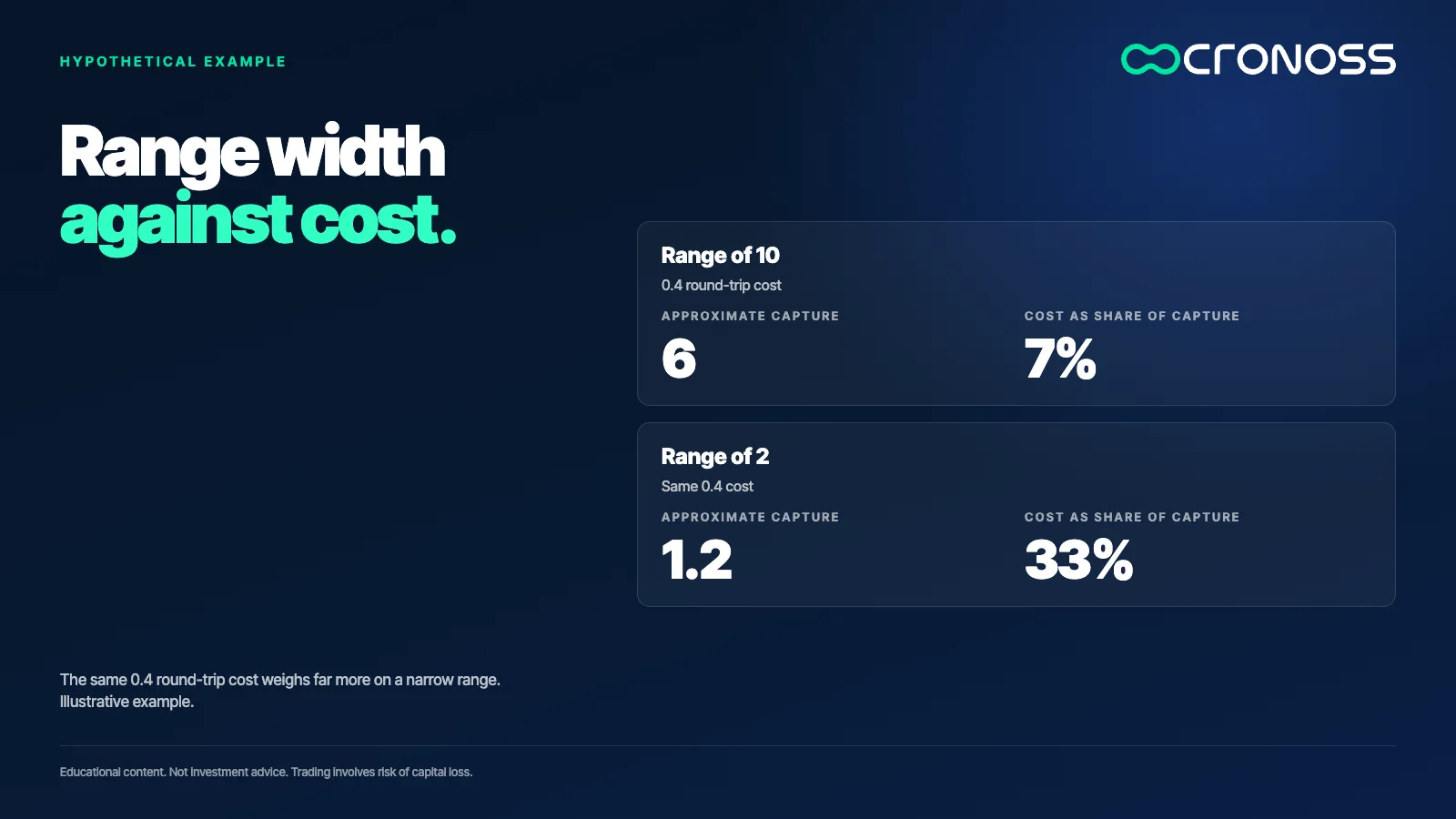
A narrow range can be a silent trap. Suppose a cost of 0.4 per round trip between spread and commissions. In a range 10 wide, where about 6 is captured, the cost takes close to 7% of what was captured. In a range of 2, where 1.2 is captured, the same cost takes 33%.
The takeaway is practical: before trading a range, measure what its width is worth against what it costs to get in and out. If cost eats a large part of what can be captured, the range is not worth it however clean it looks.
False breakouts and decision weeks
Ranges usually end with a breakout, and not all of them are real. A false breakout pushes past the edge and returns inside almost immediately. Weeks with monetary policy decisions or other high-impact events are a context where that kind of false move shows up often, because the market waits for the data before committing.
Knowing this helps you avoid mistaking a feint for a change of environment. A breakout is confirmed when price holds on the other side for several candles and advances, not when it merely touches the edge.
Boredom is also a risk
In a sideways market the temptation is to force trades: look for movement where there is none, skip a rule "just this once", lose patience. The emotional wear of a range can cost more than the range itself. A trade outside the plan almost never comes from analysis; it comes from the urge to do something.
One way to handle it is to decide in advance what you will do when there are no valid signals, including the option of not trading.
A three-question test for a market with no direction
- Can I mark the ceiling and the floor? If each edge has not been tested at least twice, there may be no range yet.
- Is my method designed for this environment? A trend system does not lose because it is wrong; it loses because the environment does not suit it.
- What does getting in and out cost against the range width? If cost is a large share of what can be captured, it is better to wait.
Recognize the environment before acting
Ranges do not last forever and they do not announce when they end. What you can control is coherence: knowing which environment you are trading in, using rules built for it and not forcing the rest.
If you want to go deeper into how systems are designed for different environments, including trend-following and mean-reversion ones, the program Fundamentos del Trading Sistemático (Foundations of Systematic Trading) covers them in order: Fundamentos del Trading Sistemático.
Educational content. Cronoss is not a broker, investment firm or financial adviser, and nothing above is an investment recommendation.
Frequently asked questions
How do you recognize a range-bound market?
When price oscillates between a ceiling and a floor it has tested more than once, without forming higher or lower highs and lows. These are zones, not exact lines.
Why do trend strategies lose in a range?
Because they enter breakouts that do not continue and exit with small repeated losses. Their edge depends on sustained moves in one direction, which a range does not offer.
How do you tell a false breakout from a real one?
A false one pushes past the edge of the range and returns inside almost immediately. A real one holds on the other side for several candles and advances.
Why does range width matter against costs?
Because the cost of getting in and out weighs more the narrower the range. With the same cost, a wide range dilutes it while a narrow one can take a third of what can be captured.


