
Key takeaways
- Scalping, day trading, swing and position trading are points on one spectrum, not four separate categories.
- Each style changes duration, decision frequency and emotional load, not just its name or the time involved.
- Time and energy are different resources: two hours with an exhausted mind are not two hours of real trading.
- When time runs short, passive management replicates an index with few decisions; active demands study, costs and accepts human error.
- Choose the style whose limitations you can sustain, filtering by time, energy, decision rhythm and sustainability.
- To decide between staying and switching, check how long you ran it, where the problem comes from and when the wear appears.
Choosing a trading style takes five minutes. You just pick whichever sounds best: the thrill of fast scalping moves, the calm of swing trading, or the freedom of trading a few times a month. The problem shows up weeks later, when the initial motivation runs out and all that remains is executing every day from the time, energy and decision rhythm the person actually has.
That mismatch explains why a style that works for someone else stops working for you, and it is almost never a knowledge problem. Someone can have sound technical judgment and still fail consistently because they trade under conditions that do not let them perform.
A trading style should be chosen for the limitations a person can sustain, not for the advantages that attract the most.
Styles are a spectrum, not four boxes
Picture a line. At one end is the short term: trades lasting seconds or minutes, fast decisions and very brief exposure. At the other is the long term: trades lasting weeks or months, few decisions and prolonged exposure. Scalping, day trading, swing trading and position trading are points on that line, not separate categories.
What changes along the spectrum is trade duration, decision frequency, time in the market and, above all, the whole experience: the speed demanded, the type of analysis and the emotional load. Seeing styles this way changes the question. It stops being "which box do I fit in?" and becomes "at what point on this path can I trade well?".
The short term: pace, speed and wear
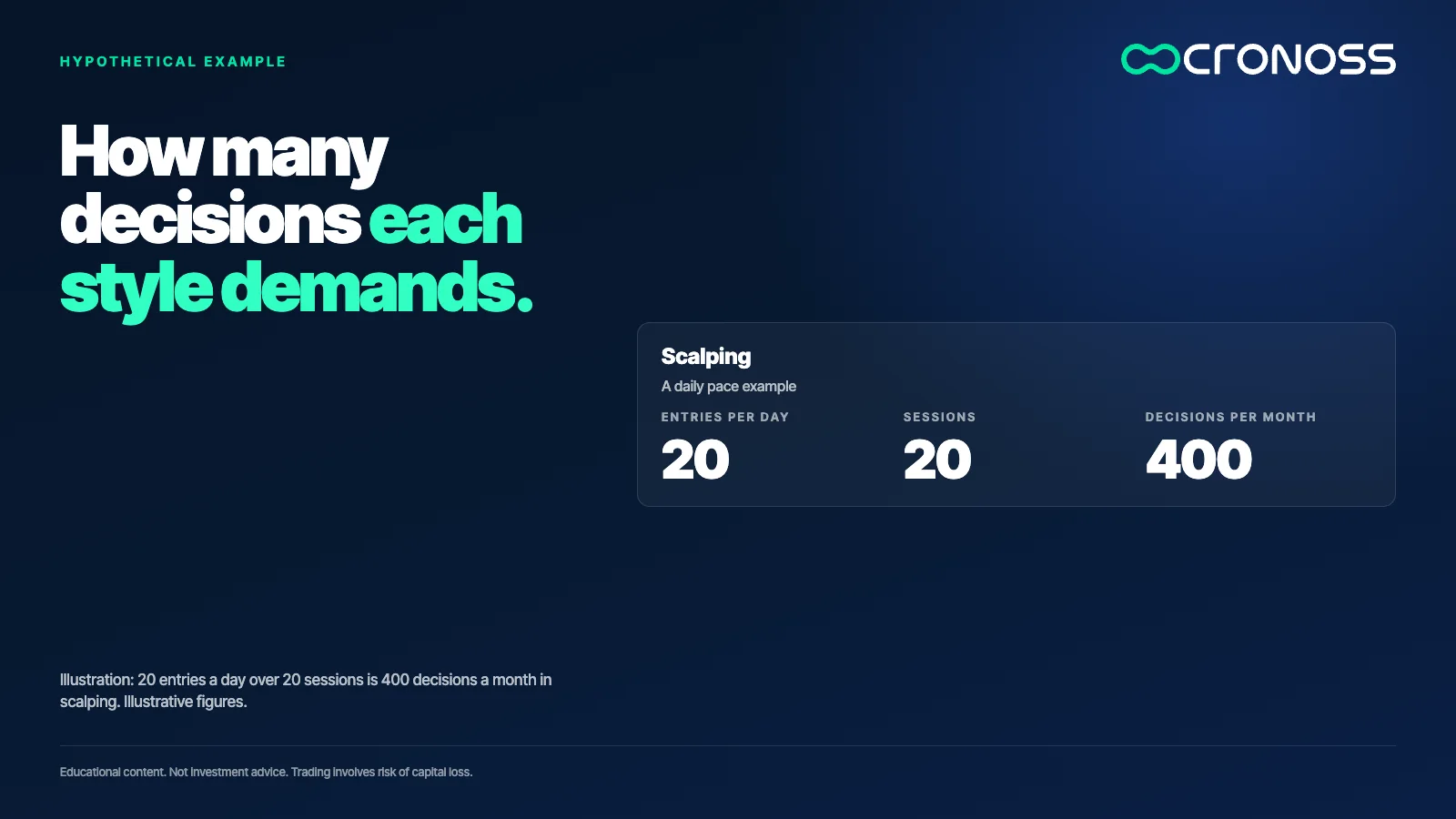
Scalping and day trading close everything before the session ends, but they feel different. Scalping means trades of seconds or a few minutes, dozens of decisions per session and almost no pause. For illustration, 20 entries a day over 20 sessions is 400 decisions a month. It demands high, sustained concentration, and execution errors are paid for immediately.
Day trading leaves more room to analyze the session's context and wait for a scenario to develop. Its characteristic risk is different: overtrading out of boredom or the urge to win back losses.
The long term: the difficulty is waiting
Swing trading (trades of days) and position trading (weeks or months) reduce screen time, but not difficulty. They trade speed for waiting. The market almost never goes straight where you expect: it pulls back, moves sideways and breeds doubt, and the person has to hold the decision without stepping in when they should not.
A skill that helps in one style can hurt in another. Reacting fast is an advantage in the short term and an obstacle when the plan calls for letting the trade develop. That is why a style should not be inherited from past experience without review.
Time and energy are not the same thing
Two free hours after an exhausting day, with interruptions, are not two hours of real trading. They are two hours in front of a screen. Decisions made when tired are not the same as decisions made with a clear head, and the attention you can hold first thing in the morning is not what you can hold after eight hours of work.
Each style asks for something different. Scalping needs a continuous, clear block. Swing can be worked in short analysis windows, as long as they are good ones. Position trading needs little time but a lot of conviction over weeks. The question that comes first is when you can trade well, not how many hours you have.
When time runs short: passive and active management
Time is the most limited resource. A day has 24 hours, a third goes to sleep and the remaining 16 have to be split among work, family, friends and hobbies. Trading or investing goes into that same bucket, unless it is a full-time professional occupation.
That is why the spectrum continues beyond position trading, toward investing. The same type of asset, for example the stocks of one country, can be managed in two ways with very different time demands:
- Passive management. An index is replicated, meaning an already diversified basket. There are few decisions, low costs (a hypothetical 0.5% annual cost is USD 0.50 on USD 100) and a discipline that runs on its own, because the index does the rebalancing. In exchange, you accept all of the market's volatility: if the index falls 20%, the investment falls 20%.
- Active management. Assets and the timing of buying and selling are chosen to try to beat the index. It demands much more time, constant study, more buying and selling costs and the acceptance that human error is part of the risk.
The underlying question is the same as in trading: not which earns more, but which fits the time available, the horizon and the tolerance for being wrong. Someone with little time, a long horizon and low tolerance for errors often finds passive a sustainable option. Passive does not mean doing nothing: it means a simpler methodology for taking on a risk, with a return close to the market's.
A market that alternates between range and trend
Style also relates to how price behaves. The same asset can go through range-bound stretches with no clear trend and stronger trending stretches. Mean-reversion strategies try to exploit stretches where price overextends and returns toward its average, while trend-following approaches need the move to continue.
Classic indicators such as the RSI, which measures how saturated price is toward one side, and the ADX, which measures the strength of a trend, were designed by the same author, J. Welles Wilder, and serve different purposes. Knowing what kind of behavior each approach exploits helps in understanding what each style demands.
Four questions to filter a style
Before choosing, it is worth running the style through this filter, answering from today's reality and not the one you would like to have:
- Time. How much time is available, and does it match the sessions that style requires?
- Energy. What level of concentration do you bring to that time?
- Decision rhythm. Is the style's pace compatible with how you naturally process information, not with the one you hope to develop?
- Sustainability. Can you repeat it for weeks and months, including on hard days?
The filter does not tell you which style to choose but which one not to choose, and ruling out well is worth as much as choosing well. Someone who can only trade at night, after a draining workday, with one free hour, quickly rules out scalping and can evaluate a swing approach with one daily review, or even passive management for part of their capital.
Stay or switch: three questions, in order
Switching style too fast costs as much as staying with one that does not work. To decide with judgment rather than impulse:
- Have I run it long enough? Long enough means having been through different market conditions and through good and bad streaks. Before that, what you are evaluating is the adaptation curve, not the style.
- Is the problem the style or the execution? Entering late, moving the stop for no reason or exiting earlier than planned are process failures. Friction that persists even when you execute well is a fit problem.
- Does the wear show up only in bad streaks? If the process feels forced even when results are good, the style probably does not fit.
A starting point, not a label
A style framework gathers four personal definitions: the point on the spectrum you trade from, the time available, the sustainable pace and the type of operating decision. It is not a strategy and it does not say what to look for on the chart. It is a reference for asking whether what you do is consistent with the person doing it.
Styles are not a fixed identity. Life changes, availability changes, and your point on the spectrum can move too. Choosing well is not finding the perfect style, it is finding the one you can execute consistently with the life you have today.
If you want to build your own style framework with guided exercises, the program Fundamentos de Estilos de Trading (Fundamentals of Trading Styles) walks through each step: see the program.
Educational content. Cronoss is not a broker, investment firm or financial adviser, and nothing above is an investment recommendation.
Frequently asked questions
What is the difference between scalping and day trading?
Both close positions before the session ends, but scalping trades seconds or a few minutes with many decisions, while day trading trades minutes or hours with fewer decisions. The first demands continuous concentration; the second leaves more room to analyze context.
Which trading style is best for someone with little time?
It depends on the energy you bring to that time, not only the hours. Swing trading allows reviewing the market in short windows, but that window must be a good one. Run each style through a filter of time, energy, rhythm and sustainability.
Is it better to invest passively or actively?
Neither is better in the abstract: they are tools with different demands. Passive management replicates an index with few decisions and low costs; active picks assets to beat the index and demands more time, study and tolerance for being wrong. The useful question is which one fits your time, horizon and profile.
When should I switch trading styles?
When you have run it long enough, the process is reasonably sound and the wear shows up even in good moments. Before that, switching is usually a reaction to a bad streak. If the problem is execution, switching style only moves it elsewhere.
Are trading styles mutually exclusive?
No. They can be seen as points on a spectrum between short and long term, and a person can move within it when their reality changes. The advice is to choose a starting point and adjust it with experience, not to trade several styles at once.


