Key takeaways
- Nature, asset class, instrument and vehicle are four different layers, and mixing them is a common source of confusion.
- Capital can go to companies, projects, assets with value of their own or governments, and those destinations are grouped into asset classes.
- An ETF is a wrapper, not an asset class: what matters is what it holds.
- An investment earns a place in a portfolio if it passes four filters: understanding the asset, fitting your risk profile, having liquidity for your horizon and clear costs and taxes.
- Passive management replicates a basket and active management tries to beat it; choosing between them is deciding how much effort to put in, not which is better.
You look up information about investing and find, in the same sentence, fixed income, equities, ETFs, funds, crypto and private markets. They look like options at the same level, as if they were six products in a shop window. They are not.
One of the biggest sources of confusion when starting to invest is mixing things that live in different layers. Each institution highlights the product it sells and the map becomes hard to read.
Before deciding what to invest in, you need to know which layer you are looking at: the nature of the investment, the asset class, the instrument and the vehicle are four different things.
Why does everything look the same?
When a bank, a broker or an intermediary presents its star product, it uses its own vocabulary. The same concept shows up under different names, and different concepts show up under the same name. As a result, "ETF", "bond" and "fixed income" end up in one list even though they describe things of a different nature.
Organizing the map is the cheapest way to avoid buying something you do not understand.
The four layers
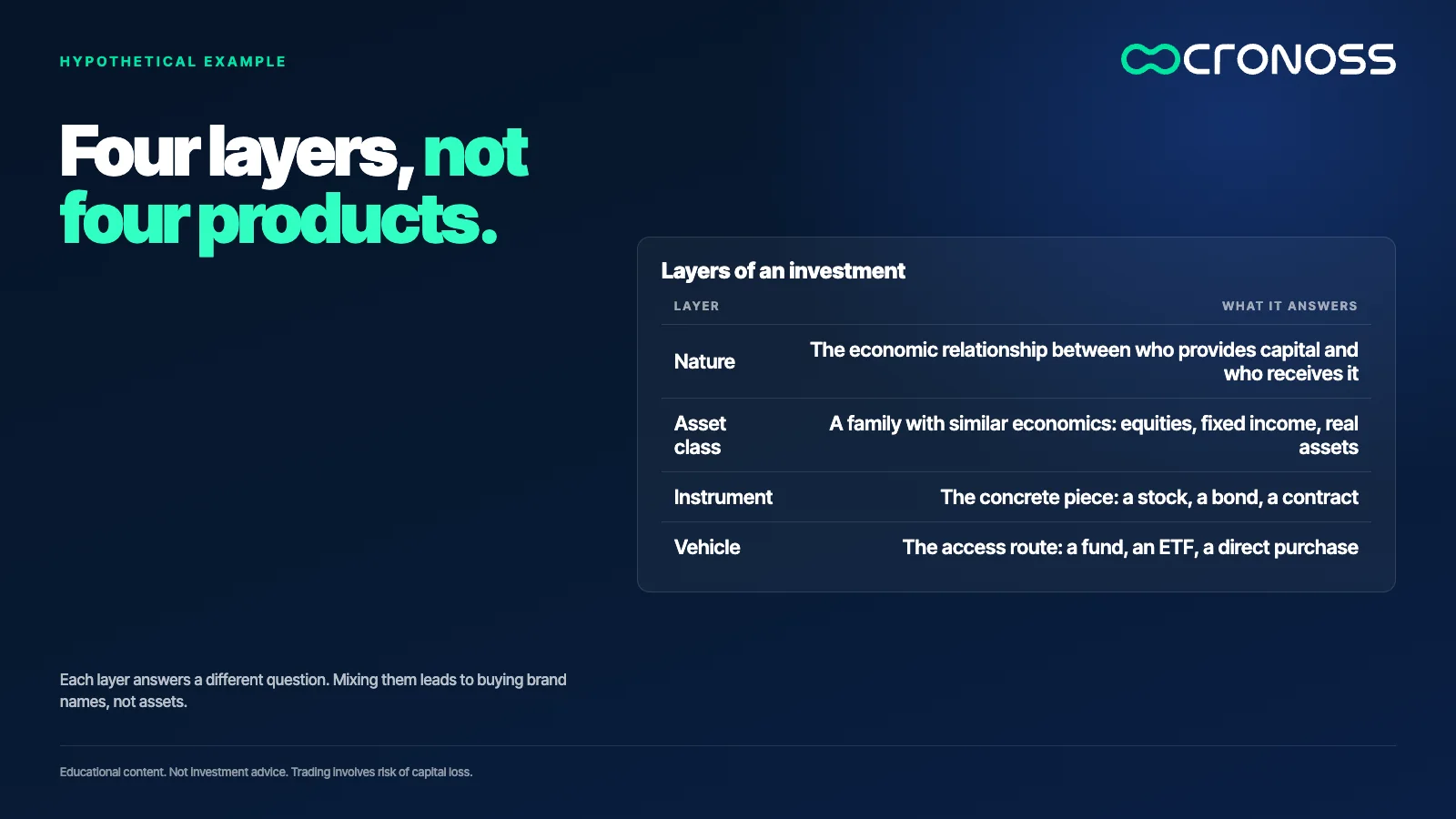
Think of a company that wants to build a plant. It can bring in partners, borrow money or sell an asset it already owns. So far we are at the nature of the investment: the economic relationship between whoever provides capital and whoever receives it.
The financial system sorts those relationships into large families, the asset classes. Then come the financial instruments (stocks, bonds, contracts) as the concrete pieces, and finally the vehicles, which are the way to access them (a fund, an ETF, a direct purchase).
Where can capital go?
Investing is putting capital to work to earn a return, and that capital can go to four places:
- Companies: as a partner or as a lender.
- Projects: an infrastructure build or an agricultural project, which do not need an incorporated company behind them.
- Assets with value of their own: a plot of land, a metal or an artwork, which are worth something because they are scarce and can be kept.
- Governments: through bonds, which are loans to the state.
Those destinations are grouped into asset classes. An asset class is not a product, a contract or a place where trading happens: it is a family of investments with a similar economic nature, which tend to react in a similar way when rates rise, the economy slows or a new regulation appears.
- Equities. You take part as an owner of the business and bear the risk of whatever happens to it.
- Fixed income. You lend capital and expect agreed cash flows; mainly you bear the risk of not being paid.
- Real assets. The asset itself (a property, a metal) is the investment.
An example with invented numbers shows the difference between the first two. A property costs USD 350,000 (USD 200,000 to buy and USD 150,000 in renovations). The buyer puts in USD 100,000 of their own money and receives a USD 250,000 loan. The owner bears the risk of everything that happens to the property; the lender bears only the risk that the owner does not pay.
An ETF is not an asset class
An ETF is not an investment by itself: it is a wrapper. It can hold stocks, bonds, currencies or commodities. That is why it cannot be classified as an asset class. The right question is not "do I invest in an ETF?" but "what does this ETF hold, and which class does it belong to?".
Indexes are a good example. You cannot buy an index directly, because it is a measure. The vehicle that makes it accessible is an exchange-traded fund that pools the money of many investors, like a shared pot. When you hold a share of it you own, indirectly, everything it contains, in proportion to its weight.
How to decide whether an investment belongs in your portfolio
The asset defines risk and potential return; the vehicle is the legal mechanism through which you reach that risk. Before admitting an investment, it helps to run it through four filters:
- Understand the asset and its risk: what it is, how it generates return and what can go wrong.
- Fit your risk profile: it should be within what you can bear (your capacity) and within what you are willing to bear (your tolerance).
- Liquidity against your horizon: how quickly you can get cash back. An emergency reserve cannot be locked up long term.
- Taxes and costs: how each vehicle treats the payout of returns and what fees it charges. Rules depend on the country, so they should be checked.
A cost example with invented numbers, assuming no return at all: on USD 10,000, an annual fee of 0.10% equals USD 10 a year and one of 1.00% equals USD 100. The difference is USD 90 a year, or USD 900 over ten years, before any compounding effect. Real fees vary by product and provider.
Passive and active management
Choosing between passive and active management is not choosing which is better: it is deciding how much time and effort you want to put into carrying out your exposure. It is a different decision from the vehicle.
Passive management tries to resemble a basket, usually an index. Think of moving from buying a single technology stock to buying several companies in the sector, and from there to a broad index: at each step you stop depending on one company and take on the risk of the market. If the index adds a company, the fund does too, and if it drops one, the fund sells it. It does not try to beat the market. Active management analyzes companies, sectors and economies to decide what to buy and sell, aiming to outperform a benchmark.
The difference is not in what is bought but in how the purchases are decided. Passive tends to be simpler and cheaper; active requires more specialization and usually charges more. Neither is better in every case.
Three questions before buying anything
- What am I really buying? Identify the nature and the asset class behind the commercial name.
- How do I access it? Recognize the vehicle: direct purchase, fund, ETF or another, and what it holds.
- What does it cost and how long to exit? Look at fees, liquidity and tax rules before committing money.
Derivatives and leveraged contracts can amplify both gains and losses, so they call for understanding the risk before using them.
Understanding the map is the first investment
Someone who does not tell class, instrument and vehicle apart buys names, not assets. Someone who does can compare options that used to look incomparable.
First you understand what you are buying. Then you decide how to buy it.
If you want to walk through that map class by class, with examples of fixed income, equities and real assets, take a look at the program Clases de Activos e Instrumentos de Inversión (Asset Classes and Investment Instruments): Clases de Activos e Instrumentos de Inversión.
Educational content. Cronoss is not a broker, investment firm or financial adviser, and nothing above is an investment recommendation.
Frequently asked questions
What is an asset class?
It is a large family that groups investments of a similar economic nature, which tend to react alike when rates, growth or regulation change. Examples are equities, fixed income and real assets. It is not a product or a trading venue.
Is an ETF an asset class?
No. An ETF is a vehicle, a wrapper that can hold stocks, bonds, currencies or commodities. To know which class it belongs to, you have to look at what it holds.
What should I check before choosing an investment?
Four things: that you understand the asset and its risk, that it fits your risk profile, that its liquidity matches your horizon and that its costs and taxes are clear. Tax rules depend on the country.
What are passive and active management?
Passive management tries to replicate the behavior of an index or basket. Active management analyzes and selects investments to try to beat a benchmark. Passive usually costs less, but neither is better in every case.


