
Key takeaways
- A portfolio is well integrated when each asset class performs a role that the others do not cover.
- Stocks provide growth, bonds stability, gold a safe haven and alternative assets an engine of their own.
- The role of each class is defined by the factor that moves its price, not by the name of the asset.
- Integration reduces dependence on a single scenario and pays for it with less upside in favorable scenarios.
- Roles are not fixed: when inflation is high, bonds and stocks can fall together.
Four different assets can perform a single role in a portfolio.
This happens when all of them depend on the same economic engine. A portfolio with stocks from four sectors looks diversified on paper, but its four positions fall together when companies earn less.
A portfolio is well integrated when each asset class performs a role that the others do not cover. That assignment of roles comes before any percentage.
What defines the role of an asset class?
An asset class is a group of investments driven by the same economic factors. The Integración class (Integration) works with four: stocks, bonds, gold and alternative assets.
The role of each class is defined by the factor that moves its price. The name of the asset says little. Two positions with different names can respond to the same factor and, in practice, occupy the same place.
A soccer team helps illustrate the mechanism. With eleven forwards, the team attacks well, but nobody covers the goal when the opponent wins back the ball. Each position exists because it covers a situation that the others leave open.
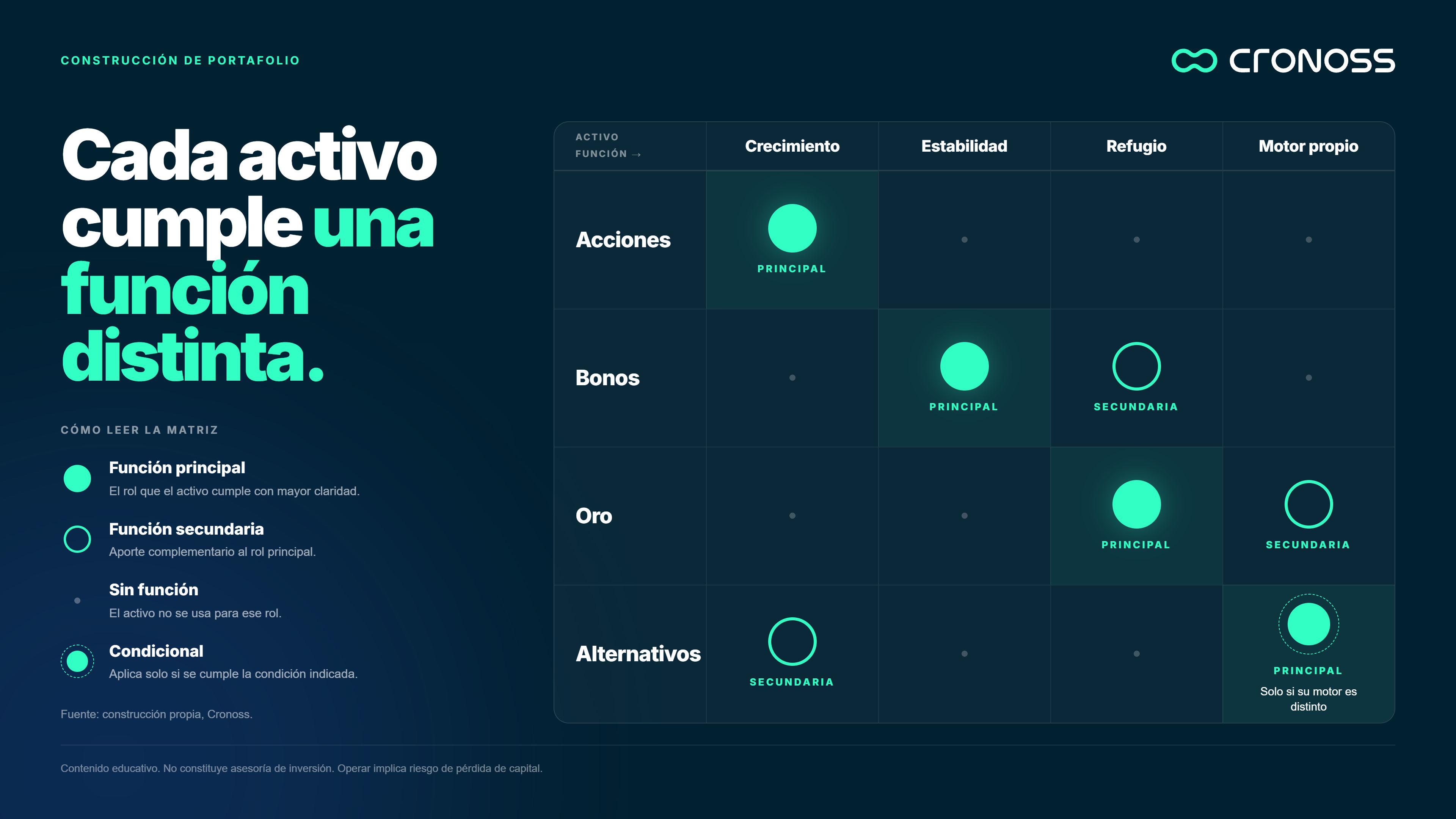
The chart organizes this logic into a matrix. The rows are the four asset classes. The columns are four roles: growth, stability, safe haven and own engine.
Stocks provide growth
A stock is a fraction of ownership in a company. Its price follows that company's earnings and what the market expects from them.
That is why stocks occupy the main growth cell in the matrix. When the economy expands and companies sell more, this class captures that advance more strongly than the other three.
The same mechanism explains its weak point. If earnings fall in a recession, stocks absorb the blow first. In the safe haven column, its cell stays empty.
Bonds provide stability and predictable cash flows
A bond is a loan that an investor makes to a government or company in exchange for interest (as we explain in the bonds explainer from our Fundamentos de las Finanzas program, Fundamentals of Finance). Payments are agreed in advance, and that predictability makes its price swing less than that of a stock.
Bonds also have a compensating mechanism. When the economy cools, central banks usually cut interest rates. A bond issued earlier, with a higher coupon, becomes more attractive and its price tends to rise.
That inverse relationship with rates underpins its role as a stabilizer. It also sets its limit, which appears further down among the common mistakes.
Gold works as a safe haven when confidence falls
A safe-haven asset is an investment that tends to hold its value in times of stress. Gold occupies that place in the matrix.
Gold pays no interest and no dividends. Its price depends on how many people seek shelter in it, and that demand tends to grow during episodes of distrust in the economy or the financial system.
Gold provides protection in exchange for growth. A large gold position reduces the portfolio's sensitivity to crises, and it also gives up participation when the economy advances.
What do alternative assets provide?
Alternative assets provide their own engine when they depend on factors different from those of the other three classes. They are investments outside stocks, bonds and cash, such as real estate or commodities.
The alternative label does not guarantee that role. Some assets in this category depend on the same economic cycle as stocks. An alternative adds to the portfolio only if its engine is truly different.
How the four roles combine
The matrix is read first by rows and then by columns. Each row shows what an asset class contributes. Each column shows which scenario is covered and which class covers it.
An integrated portfolio has at least one main cell occupied in each column. An empty column leaves a scenario without an answer inside the portfolio. A column that concentrates all the positions reveals dependence on a single engine.
The combination works because the engines fail at different times. When corporate earnings fall, the safe haven and stability hold up part of the value. When the economy grows, stocks offset gold's smaller gains.
The same portfolio in three scenarios
A hypothetical example shows the mechanism with numbers. The figures are illustrative: they do not come from market data or represent a recommended allocation.
Portfolio A puts 100 units into stocks from four sectors. Portfolio B splits the same 100 units into 40 in stocks, 30 in bonds, 15 in gold and 15 in alternatives. Each scenario applies an assumed move to each class.
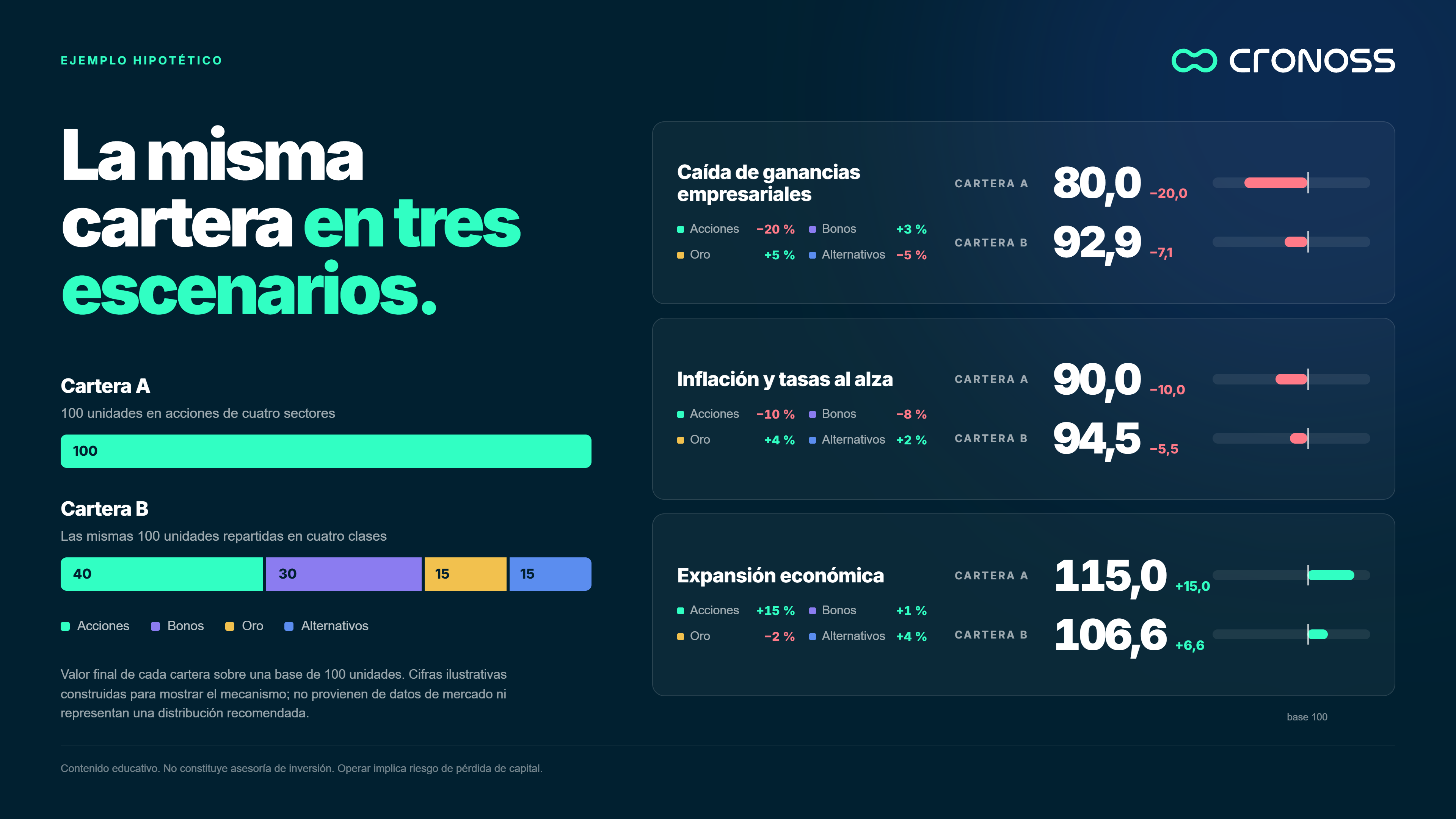
In the earnings decline, portfolio A loses 20 units because its four positions respond to the same factor. Portfolio B loses 7.1, because bonds and gold offset part of the drop in stocks.
In the expansion, the result reverses. Portfolio A rises to 115 and B to 106.6. Integration reduces dependence on a single scenario and pays for it with less upside in favorable scenarios.
That cost reflects the risk-return trade-off that the program covers in the Balance class.
Where assigned roles fail
Two mistakes come up often when applying the matrix.
The first is treating roles as fixed. In the second scenario of the example, bonds fall 8% along with stocks.
The mechanism is concrete: inflation pushes rates up, bond prices fall and company valuations shrink at the same time. The stabilizer can fail precisely in the scenario that tests it.
The second mistake is adding assets without asking what role they play. A fifth stock that depends on corporate earnings adds a name to the list and leaves the same matrix cells empty.
That kind of redundancy is what the Optimización class (Optimization) teaches you to detect, in the program's final module.
A test any portfolio can pass
The matrix also works as a review tool. Any reader can apply it to a real or hypothetical portfolio using these steps:
- List every position in the portfolio.
- Write next to it the factor that moves its price: corporate earnings, interest rates, demand for safe havens or another.
- Place each position in the matrix cell that corresponds to that factor.
- Check which columns are empty and which factor repeats across most rows.
The test is also falsifiable. In the next market stress episode, it is enough to compare the move of the position labeled as a safe haven with that of stocks. If both fell in the same direction and with similar force, the label was wrong and the matrix needs correcting.
Integration is decided before the percentages
Choosing percentages without assigned roles produces portfolios that look balanced but depend on a single engine. The useful order starts by asking which scenario each piece covers, and leaves the weights for later.
The Integración class closes Module 3, Gestión Aplicada de Riesgo y Diversificación de Capital (Applied Risk Management and Capital Diversification), with this same matrix applied to stocks, bonds, gold and alternatives. The program spans 5 modules and 20 classes, and Rafael Gómez, PhD, walks through the path from exposure diagnosis to a final portfolio with a risk strategy. Explore the program Gestión Aplicada de Riesgo y Diversificación de Capital.
Frequently asked questions
What role do stocks, bonds and gold play in a portfolio?
Stocks provide growth because they follow company earnings. Bonds provide stability and predictable cash flows. Gold works as a safe haven when confidence falls. Alternative assets provide an engine of their own only if they depend on different factors.
Is owning many different stocks the same as diversifying?
Not necessarily. If all of them depend on corporate earnings, they perform a single role and fall together when companies earn less. Diversifying means covering different roles, not adding names.
Do bonds always protect when stocks fall?
No. When inflation pushes rates up, bond prices fall at the same time as company valuations, so the stabilizer can fail precisely in that scenario.
How do I check whether my portfolio is well integrated?
List each position, write the factor that moves its price, place it in the role it corresponds to, and check which roles are empty and which factor repeats across most positions.