Key takeaways
- A bond is a loan divided among many investors: each one hands over money today, and the issuer promises periodic interest and the return of principal.
- The coupon is the fixed interest the bond pays each period.
- A bond's rate compensates for four things: time, inflation, default risk and liquidity.
- A bond's rate measures how much uncertainty the market perceives about its issuer.
- A higher rate is not a free advantage: it is the price of the additional risk taken on by whoever collects it.
A government needs USD 50 billion and does not ask a bank for it.
It asks thousands of investors at the same time, through bonds. A bond is a loan divided among many investors: each one hands over money today, and the issuer promises to pay periodic interest and return the principal on an agreed date.
Those interest payments follow a precise logic. They compensate the investor for waiting, for inflation and, above all, for the risk that the issuer does not pay. That is why two governments asking for the same sum can face very different costs.
What exactly is exchanged in a bond?
A bond exchanges money today for a promise of future payments. The investor gives up liquidity today. The issuer, whether a government or a company, receives immediate financing and takes on dated obligations.
The mechanism resembles a promissory note with public terms. The document sets how much is lent, what rate is paid, how often payments arrive and when the principal is returned.
Those periodic payments have their own name. The coupon, the fixed interest the bond pays each period, is the income received by whoever buys it. A bond of USD 1,000 with an annual coupon of 6% pays USD 60 every year until maturity.
Every financial instrument shares four elements, and the bond shows them clearly:
- Resources that change hands: the money the investor hands over.
- Promised future flows: the coupons and the return of principal.
- Risks that are transferred: the investor takes on the possibility that the issuer defaults.
- Contractual conditions: term, rate, payment dates and guarantees.
The last element supports the other three. Without written and verifiable conditions, few investors would lend money to an issuer they do not know in person.
Governments use bonds to finance infrastructure, cover deficits or handle crises. Companies use them to build plants, buy equipment or refinance earlier debts. An airline, for example, can finance part of its fleet by issuing bonds instead of taking a bank loan.
Why does a bond pay interest?
A bond pays interest because the lender gives up using their money for years and demands compensation for that. The compensation blends four components, and each one responds to a different loss.
The first is time. The investor who buys a ten-year bond cannot spend or invest that capital in another option during that period. Every interest rate starts by paying that opportunity cost.
The second is inflation. If someone lends USD 1,000 and receives exactly USD 1,000 a year later, they recover bills that buy less. The rate builds in compensation for that expected loss of purchasing power.
The third is default risk. The issuer may face a recession, lose income or run out of resources to pay. Investors charge more the more likely they see that scenario.
To measure that risk, the market examines the issuer closely. For a government, it looks at economic stability, the level of public debt, inflation, growth and the credibility of its institutions. Each sign of weakness translates into a demand for a higher rate.
The fourth is liquidity. A bond locks up capital, and selling it before maturity may force the holder to accept a lower price.
These components explain a rule that runs through the entire debt market. A bond's rate measures how much uncertainty the market perceives about its issuer. A reliable issuer pays little. A doubtful one pays a lot, or simply cannot find lenders.
Who buys bonds and why do they need them?
The main buyers of bonds are institutions that need predictable cash flows for decades. Pension funds, insurers, banks and professional investment managers concentrate much of that demand.
A pension fund illustrates the logic well. It receives monthly contributions from workers and must pay retirement benefits in twenty or thirty years. It needs assets that deliver known payments over a long time, and a long-term bond fits that need.
Insurers follow similar reasoning. They collect premiums today and must cover claims in the future, so they invest part of their reserves in debt that pays regularly.
People also take part, directly or through funds. When a worker contributes to their pension, part of that money can end up lent to a government through bonds.
The bond connects two opposite needs. The government needs capital today. The pension fund needs future returns that are predictable.
How much does it cost to finance USD 50 billion with bonds?
The cost depends almost entirely on the rate the market demands from the issuer. An example with two hypothetical countries shows the scale of the difference.
Suppose both governments issue ten-year bonds for USD 50 billion to finance energy and transport infrastructure. The rates are illustrative and do not correspond to any real country.
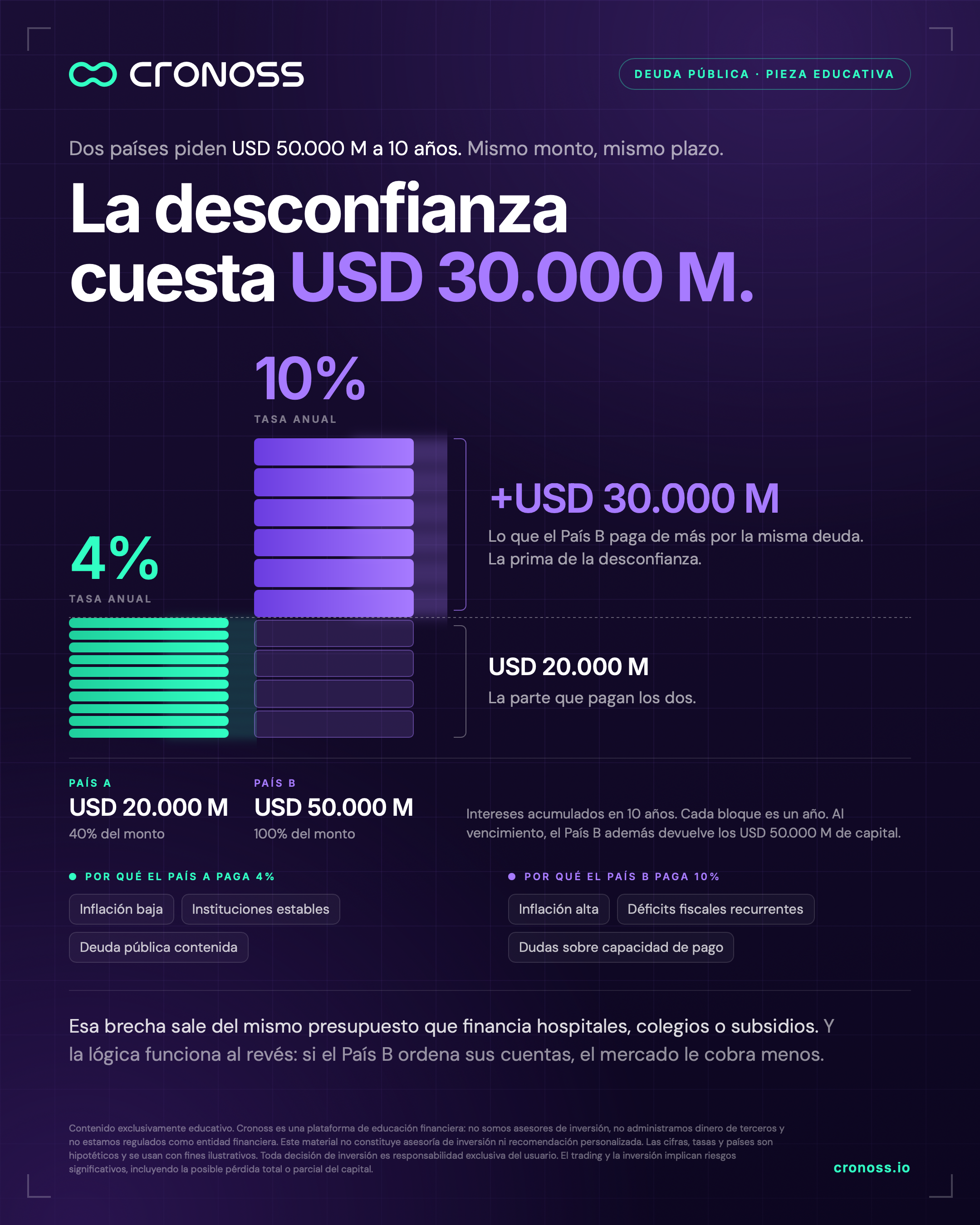
Country A has low inflation, stable institutions and little public debt. Investors demand 4% per year from it. Country B has high inflation, recurring fiscal deficits and doubts about its ability to pay. Investors demand 10% per year from it.
Country A pays USD 2 billion per year in interest. Over ten years, that cumulative cost reaches USD 20 billion. Country B pays USD 5 billion per year and accumulates USD 50 billion over the same term.
Country B ends up paying in interest an amount equal to everything it borrowed. On top of that, it must repay the original USD 50 billion at maturity.
The USD 3 billion annual difference comes out of the same budget that funds hospitals, schools or subsidies. The market's distrust has a concrete cost, and taxpayers pay it.
The relationship also works in reverse. If Country B reduces its deficit and stabilizes its inflation, investors may accept lower rates on its next issues.
What mistakes are made when reading a bond?
The two most frequent mistakes are treating every bond as safe and reading a high rate as an advantage without asking what causes it.
Mistake 1: assuming a bond has no risk. Many people associate the word “bond” with stability, because the payments are agreed in advance. The promise, however, is only worth what the issuer is worth. A government or a company can default, and inflation can erode the real value of each coupon.
There is a third risk that is less visible. If market rates rise, a bond issued earlier with a lower coupon loses appeal against the new ones. Whoever needs to sell it before maturity will receive a lower price than they paid.
Mistake 2: chasing the highest rate. A 10% rate looks better than 4%. That reading ignores the mechanics: the high rate exists because the market perceives a higher probability of trouble. The difference between the two rates is the price of the additional risk, and whoever collects that price also takes on that risk.
What can you check on your own?
You can compare the rate your country's debt pays with that of other governments and watch how it moves when the perception of risk changes.
Central banks and finance ministries in the region usually publish the rates on their sovereign bonds by maturity.
A concrete test: note today the ten-year bond rate of your country and that of a country with low inflation and stable finances. Check both again after a relevant fiscal or political news item.
If this article's explanation is correct, the gap between the two rates should widen when uncertainty about your country rises. It should also narrow when that uncertainty declines.
Where does the bond fit in the financial system?
The bond is one of the pieces that allow the savings of millions of people to finance projects that take decades to pay off. Understanding it requires understanding, at once, the value of money over time, risk and the trust between parties that do not know each other.
The criterion for reading any bond fits in two questions. How likely is this promise to be kept? And what part of the rate is paying for that risk?
That full path is what the Fundamentos de las Finanzas program (Finance Fundamentals) from Cronoss develops, with Miguel Cristancho, CFA. Its third module explains how banks, pension funds and governments connect, what contract stands behind each financial instrument and why interest rates reflect time, inflation, risk and expectations. It is 1 hour and 44 minutes of content across three modules, with a verified certificate. Explore the Fundamentos de las Finanzas program.
Frequently asked questions
What is a bond?
A loan divided among many investors. Each one hands over money today, and the issuer, whether a government or a company, promises to pay periodic interest and return the principal on an agreed date.
Why does a bond pay interest?
Because the lender gives up using their money for years. Interest compensates for time, the loss of purchasing power to inflation, the risk that the issuer does not pay and the lack of liquidity.
Who buys bonds?
Mainly institutions that need predictable cash flows for decades, such as pension funds, insurers, banks and investment managers. Individuals also take part, directly or through funds.
Can a bond lose value?
Yes. The issuer may default, inflation can reduce the real value of each coupon and, if market rates rise, a bond with a lower coupon sells for less than was paid for it before maturity.