Key takeaways
- Forex is the currency market: exchanging a central-bank currency against another; gold, oil or cryptocurrencies are not Forex.
- In a pair, the first currency is the base: if the rate rises, the base strengthens and the other weakens.
- Central banks, banks, funds, companies and small investors take part for hedging or speculation.
- It is a liquid, volatile, decentralized market open almost 24 hours, five days; many instruments carry no explicit commission, but they carry a spread.
- Between 74% and 89% of retail CFD accounts lost money according to European authorities.
The word Forex has carried a bad reputation. For years it was used to sell pyramid schemes that claimed to "trade Forex" without those promoting them, or those joining, knowing what the market is. The name became tied to promises, when it actually describes something very concrete: the exchange of one currency for another.
Understanding it well avoids two mistakes. The first is to confuse any product that appears on a platform with "Forex". The second is to believe that a large, fast market open almost all day is an easy market. It is the opposite: it is one of the most volatile.
The Forex market is the exchange of one currency for another, with high liquidity and high volatility, and understanding how to read a currency pair and what moves it matters more than any promise of returns.
What Forex is and what it is not
Forex comes from Foreign Exchange, the international currency market. A currency is money issued by a central bank, what we call fiat money. What does not meet that definition is not a currency.
That is why gold, oil or cryptocurrencies are not Forex, even if a platform offers them next to currencies. A broker showing other assets to trade does not turn them into currencies. When someone says they "trade Forex" and actually trade gold or crypto, they are using the name with another meaning.
How to read a currency pair
In Forex you never trade a single currency: you always exchange one against another. That is why prices are called exchange rates and instruments are called pairs. With a stock there is one asset to analyze. With a pair there are two economies to know.
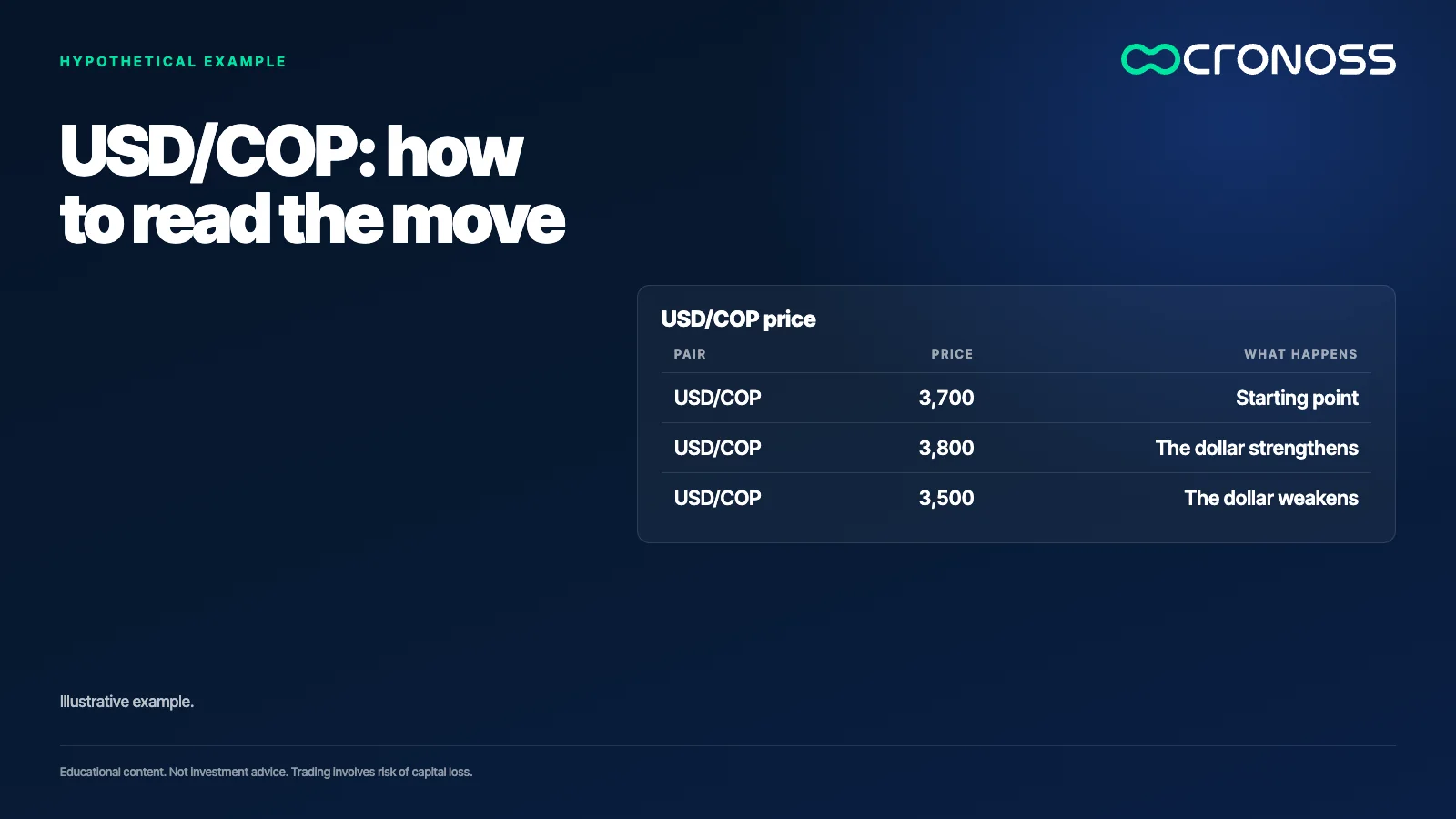
The first currency in the pair is the base currency and always represents one unit. The second is the quote currency and expresses how many units of it you receive for that one unit of the base. An illustrative example: if the dollar against the peso trades at 3,700, you receive 3,700 pesos for each dollar.
The reading rule is simple. If the rate rises, the base currency strengthens and the other weakens. If it falls, the opposite happens. In the example, if the pair moves from 3,700 to 3,800, the dollar strengthened and the peso weakened, because each dollar now buys more pesos. If it moves from 3,700 to 3,500, the dollar lost value against the peso. The two currencies cannot strengthen at the same time: what one gains against the other, the other loses.
Who moves this market
Central banks are central participants, because their monetary policy and their decisions on rates and reserves influence the value of a currency. Around them operate commercial banks, investment funds, pension funds, importers and exporters that need to exchange currency, and liquidity providers.
Not all of them operate for the same reason. Some seek hedging: a portfolio with assets in euros protects itself against the risk of the euro falling. Others seek speculation, which consists of anticipating a price move. Small investors belong to this second group.
As for size, the triennial survey of the Bank for International Settlements (BIS) measured that the foreign exchange market averaged USD 9.6 trillion per day in April 2025.
What moves the price: macroeconomics
Since each pair compares two economies, macroeconomic data weighs heavily: interest rates, unemployment, inflation and activity data. If one country has much better prospects than another, investors direct their money toward it and its currency tends to strengthen, because buying assets from that country requires buying its currency.
That is the theory. In practice the market reacts to what it expected versus what is published, not only to the figure itself. That is why those who study Forex spend time on macroeconomics, not just charts.
The characteristics of the market
- Liquidity. There are buyers and sellers at every moment, so an order in the most traded pairs usually executes in fractions of a second and close to the expected price. This is not true in every market: in an illiquid one there may be no one selling the quantity you want at the price you are after.
- High volatility. Price changes are frequent. In finance, more volatility means more risk: what lets you gain quickly lets you lose just as quickly.
- Decentralized market. There is no single exchange. It trades over the counter, and each country decides, through its regulators, who can act as an intermediary. You access it through a broker.
- Almost 24 hours, five days. It runs Monday to Friday with several sessions: Asian, European and American.
A nuance on costs: in many Forex instruments there is no explicit commission, but you pay the spread, the difference between the buy and sell price. It is not a free market. The cost just sits somewhere else.
The sessions and why price does not move the same all day
Each session is a different environment. During the Asian session movements tend to be smaller. When Europe opens they widen, and when the United States comes in, which concentrates many of the important news items, movement tends to be larger. Relevant macroeconomic data is published on fixed dates of the economic calendar, and it pays to know them before trading.
That allows strategies for different environments: more volatility when there is news, less when the market is quiet. More volatility does not mean more opportunities, it means more risk in each decision.
Three groups of pairs
Pairs fall into three categories.
- Majors. The dollar against the currencies of other large economies: the euro, the yen, the pound, the Swiss franc and the Canadian and Australian dollars. They concentrate most of the volume, have lower spreads and plenty of public information and analysis.
- Crosses. Combinations of those same currencies without the dollar, such as euro and yen or pound and yen.
- Exotics. Currencies of emerging economies, such as the Colombian, Mexican or Chilean peso or the Turkish lira. They tend to have less liquidity, wider spreads and less information.
Learners usually start with the majors for exactly those reasons: they are the most liquid and the most studied.
Currency codes
The three-letter codes you see on any platform follow the ISO 4217 standard. The first two letters indicate the country and the third the name of the currency: COP is the Colombian peso. Some pairs also have nicknames: the pound against the dollar is called "cable".
The risk that does not show up on the chart
An accessible market with instant execution can give a false sense of ease. The data on retail CFD accounts, an instrument widely used to trade currencies, shows that between 74% and 89% of them lost money, according to European authorities. The analysis of why most retail traders lose money explains which patterns repeat.
Trading is an activity you prepare for, not a bet. A thought-out strategy, a risk limited before opening the position and a clear sense of how much you are willing to lose are the starting point.
What to check before trading a pair
- Do I understand what the pair compares and what moves it? Identify which is the base currency and which macro data affects both economies.
- Do I know its cost and its schedule? Look at the spread and at which session it tends to move most.
- How much am I willing to lose? Define it beforehand, and practice on a demo account.
A big market is not an easy market
Forex is real, liquid and open almost all day. That explains why it attracts, and it does not change the fact that its volatility demands judgment, rules and limits. Removing the noise and the easy promise is the first step to understanding it.
If you want to place this market among the others and learn its basics, the program Introducción Práctica a los Mercados Financieros (Practical Introduction to Financial Markets) is a good starting point.
Educational content. Cronoss is not a broker, investment firm or financial adviser, and nothing above is an investment recommendation.
Frequently asked questions
What is the Forex market?
It is the international currency market, where a currency issued by a central bank is exchanged against another. Prices are expressed as exchange rates in pairs, such as dollar against peso.
How do you read a currency pair?
The first currency is the base and equals one unit. The second shows how many units you receive for it. If the pair's price rises, the base currency strengthens and the other weakens.
What moves the price of a currency?
Mainly macroeconomics: interest rates, inflation, unemployment and central bank decisions, together with market expectations against each published figure.
Is trading Forex risky?
Yes. It is a high-volatility market, and European data on retail CFD accounts shows that between 74% and 89% lost money. It is wise to define how much to lose before trading and to practice on a demo account.