Key takeaways
- USD 100 at 10% for 10 years is not USD 200 but USD 259.37: the USD 59.37 difference is interest on interest.
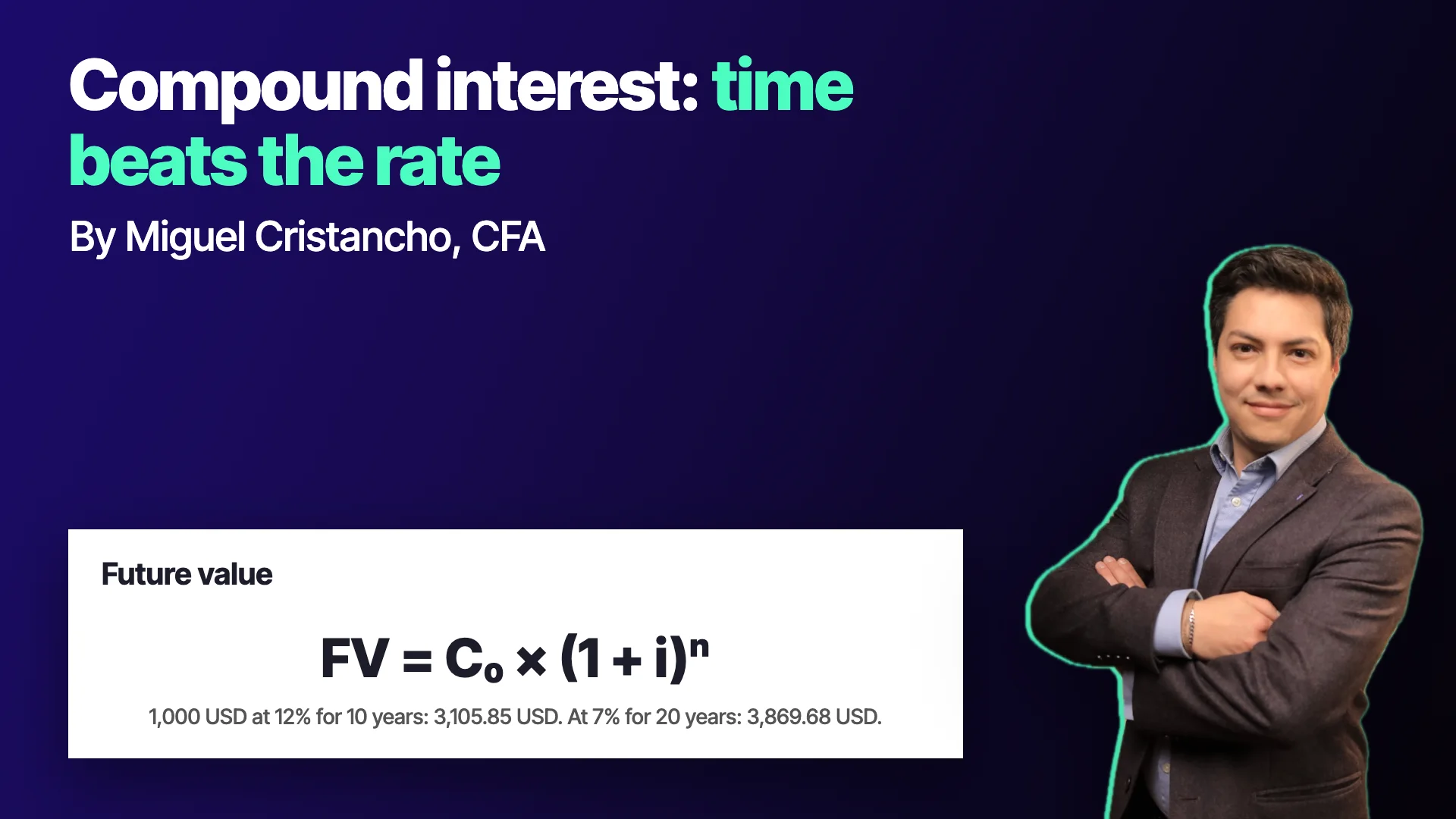
- The future value formula is FV = C0 × (1 + i)^n: capital is multiplied by (1 + i) each period.
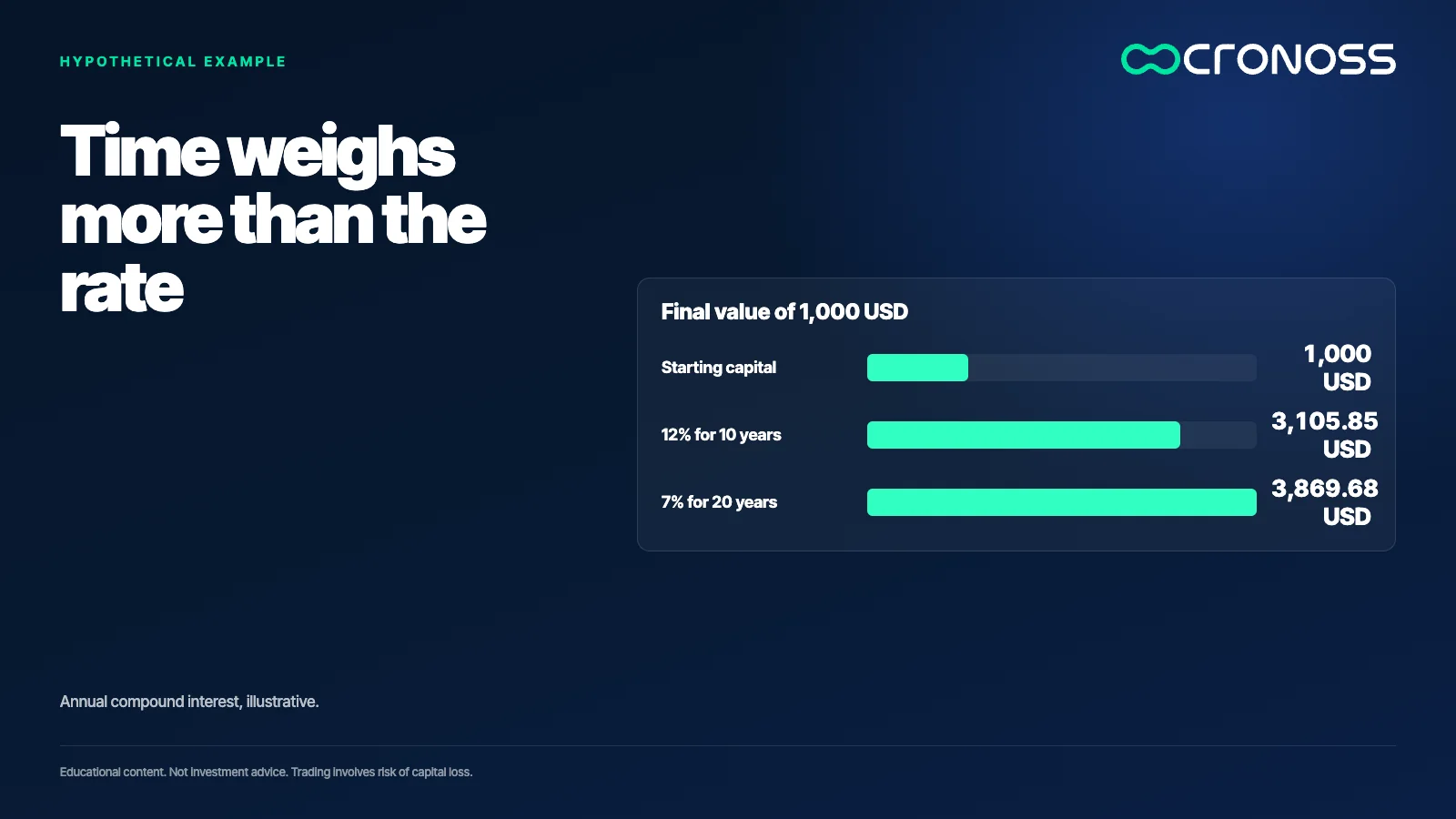
- USD 1,000 at 7% for 20 years ends with more capital than at 12% for 10 years: time weighs more than the rate.
- Applying the formula to promises such as 15% a month works as a filter: USD 10,000 would become about USD 43.8 million in 5 years.
- An average return is not enough: gaining 50% and losing 50% leaves a 25% loss, which is why consistency matters.
If you invest USD 100 at 10% a year for 10 years, how much will you have at the end? The intuitive answer is USD 200: 100 of capital plus 10 of gain per year. The correct answer is USD 259.37. That USD 59.37 difference is not luck or magic: it is interest earning interest.
That small gap is compound interest, one of the concepts that underpins almost everything in finance, from how a company is valued to how a loan is calculated. Understanding it well also protects you: it helps you notice when a promise of returns does not fit any math.
Compound interest makes money grow faster and faster because gains are reinvested; its power depends more on time and consistency than on a spectacular return.
Simple interest versus compound interest
With simple interest, the gain is always calculated on the initial capital. With USD 100 at 10%, that is USD 10 each year, for 10 years: 100 plus 100 of accumulated gains, that is, USD 200.
With compound interest, gains are reinvested. In year 1 you earn USD 10 and the balance becomes 110. In year 2 the 10% is calculated on 110, not on 100: that is USD 11. In year 3 it is calculated on 121. Each year the gain is larger than the previous one, and after 10 years the balance is USD 259.37. The difference with simple interest, USD 59.37, is exactly interest on interest.
The future value formula
This idea is summarized in a formula: FV = C0 × (1 + i)^n, where C0 is the initial capital, i is the rate per period and n is the number of periods over which it compounds.
Checking it: 100 × (1.10)^10 = 259.37. The formula is a power, and powers grow faster than intuition expects. The legend of the chessboard illustrates it: if one grain is requested on the first square and it doubles on each of the 64, the total exceeds 18 quintillion grains, more than any kingdom could pay.
In real life the rate is neither constant nor guaranteed. The formula describes how money behaves when reinvested at a given rate, not how much a specific investment will yield.
Why time weighs more than the rate
Here a surprising result appears. Compare USD 1,000 invested for 10 years at 12% a year with USD 1,000 invested for 20 years at 7% a year.
- At 12% for 10 years: 1,000 × (1.12)^10 = USD 3,105.85.
- At 7% for 20 years: 1,000 × (1.07)^20 = USD 3,869.68.
The lower rate ends with more capital because it had twice the time to compound. At first the 12% investment is ahead, but at some point the other catches up and overtakes it by a wide margin. The practical lesson: before chasing a higher return, ask how much time you can give the investment.
Do you need a lot of capital to start?
It is a common myth. Many people believe investing is only worthwhile with a large capital, because 10% on USD 100 "is nothing". But USD 1,000 at 7% for 20 years becomes about USD 3,870, without adding another dollar.
With regular contributions the effect is larger. An illustrative example, assuming a constant return of 7% a year, which is not guaranteed: contributing USD 50 a month for 20 years adds up to USD 12,000 contributed and would reach about USD 25,377. If you start 10 years later and contribute the same USD 50 a month for 10 years, you contribute USD 6,000 and would reach about USD 8,553. Contributing half produces one third. What makes the difference is not an enormous capital, but starting early and being consistent.
A test for promises that sound too good
The same calculation works as a filter. Some offers on social media promise returns of 15% a month. You can apply the formula to that promise: USD 10,000 at 15% a month for 5 years, that is, 60 months, would be 10,000 × (1.15)^60, about USD 43.8 million. Anyone who had really achieved that would not need to look for clients on Instagram.
Investment authorities warn that offers of very high returns with little or no risk are a typical sign of fraud, such as pyramid and Ponzi schemes. Wealth built steadily tends to rest on moderate returns sustained for decades, not on strokes of luck. That is where compound interest lives.
Consistency versus volatility
An average return does not tell the whole story. If an investment gains 50% one year and loses 50% the next, the two-year average is 0%. But the real result is 100 → 150 → 75: a loss of 25%. Losses weigh more than gains of the same percentage, because they apply to a larger base.
That is why a very steady result of 5% or 6% a year can be better than a higher average that arrives through violent swings. In investment and trading strategies, consistency often matters more than the peak that was seen. The same is true of complexity: simple tends to be more robust than a system so fine-tuned that it stops working outside its sample.
Compound interest also works against you
When you take a loan, the math is the same, but the one who gains is the bank. A 30-day debt is nothing like a 20-year one. That is why it helps to tell productive debt, which finances something that gains value or generates income, from unproductive debt, which finances consumption. With the first, the cost of the debt is compared with how much the financed asset appreciates. With the second, you simply pay.
Paying down principal, or renegotiating a lower rate, reduces what compounds against you.
How to apply the concept
- Calculate before believing. Apply the formula to any promise of returns: if the result is absurd, so is the promise.
- Put time and consistency before rate. Starting earlier and contributing regularly weighs more than hunting for the spectacular investment.
- Look at the path, not just the average. A steady return and a volatile one with the same average do not end in the same place.
A simple concept, a large consequence
Compound interest is not magic or a shortcut. It is patience turned into math, and also the reason a misused debt weighs so much. Understanding it lets you make decisions more calmly and distrust in time what sounds too good.
If you want to keep building this base, the program Fundamentos de las Finanzas (Fundamentals of Finance) starts precisely from the time value of money.
Educational content. Cronoss is not a broker, investment firm or financial adviser, and nothing above is an investment recommendation.
Frequently asked questions
What is compound interest?
It is interest calculated on the initial capital plus the interest already accumulated. Because gains are reinvested, each period earns more than the previous one and capital grows faster and faster.
What is the future value formula?
FV = C0 × (1 + i)^n, where C0 is the initial capital, i the rate per period and n the number of periods. With USD 100 at 10% for 10 years it gives USD 259.37.
Do I need a lot of capital to benefit from compound interest?
No. What weighs most is starting early and being consistent. With an assumed 7% annual return, which is not guaranteed, contributing USD 50 a month for 20 years would reach about USD 25,377.
Why distrust a return of 15% a month?
Because compounded over 60 months, USD 10,000 would become about USD 43.8 million, something no real market offers. Authorities flag promises of high returns with little risk as a sign of fraud.