Key takeaways
- A loan is understood through five elements: amount, rate, term, currency and type of rate (fixed or variable).
- Lenders are compared using effective annual rates: 24% EA and 20% EA compare directly.
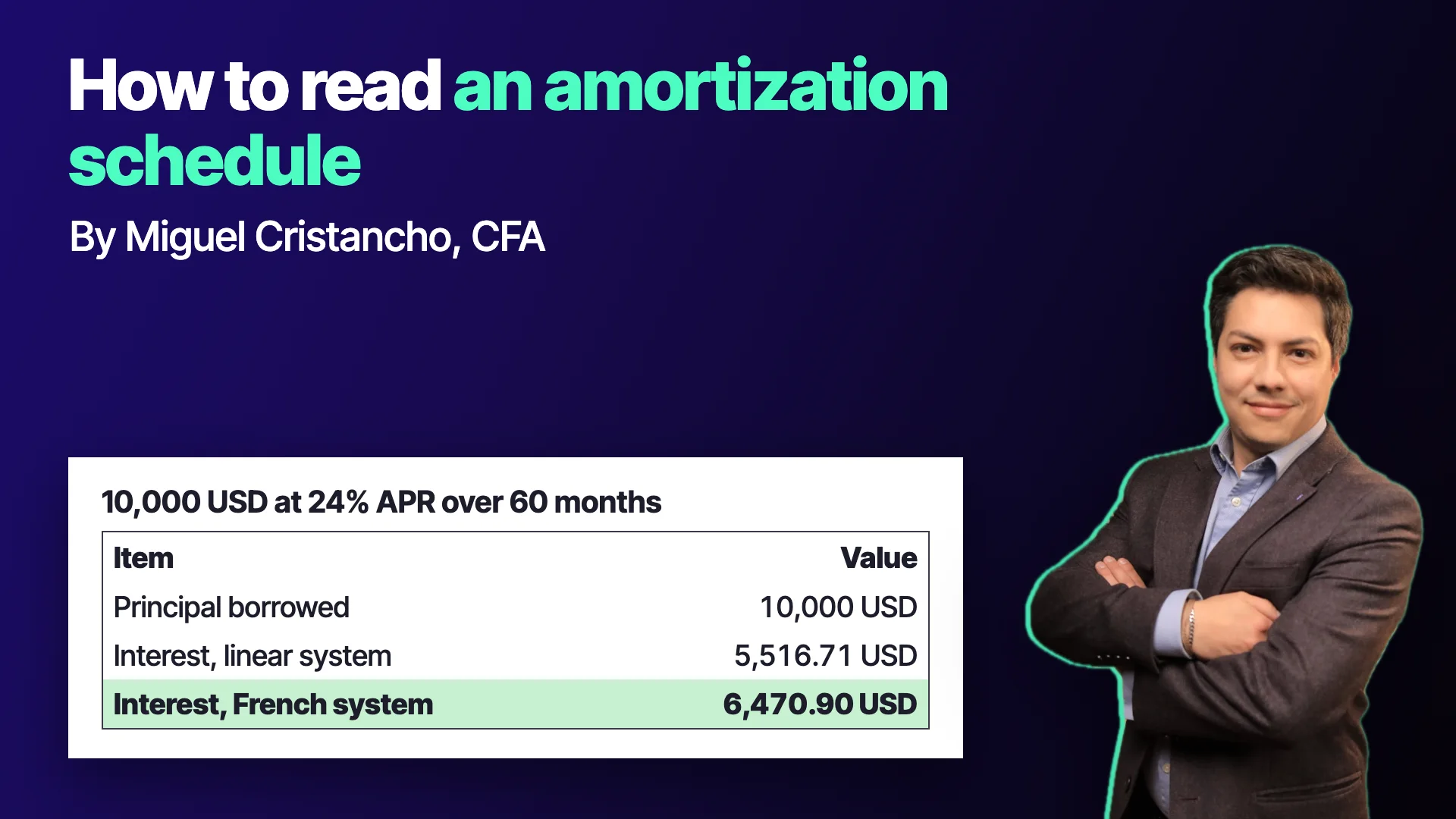
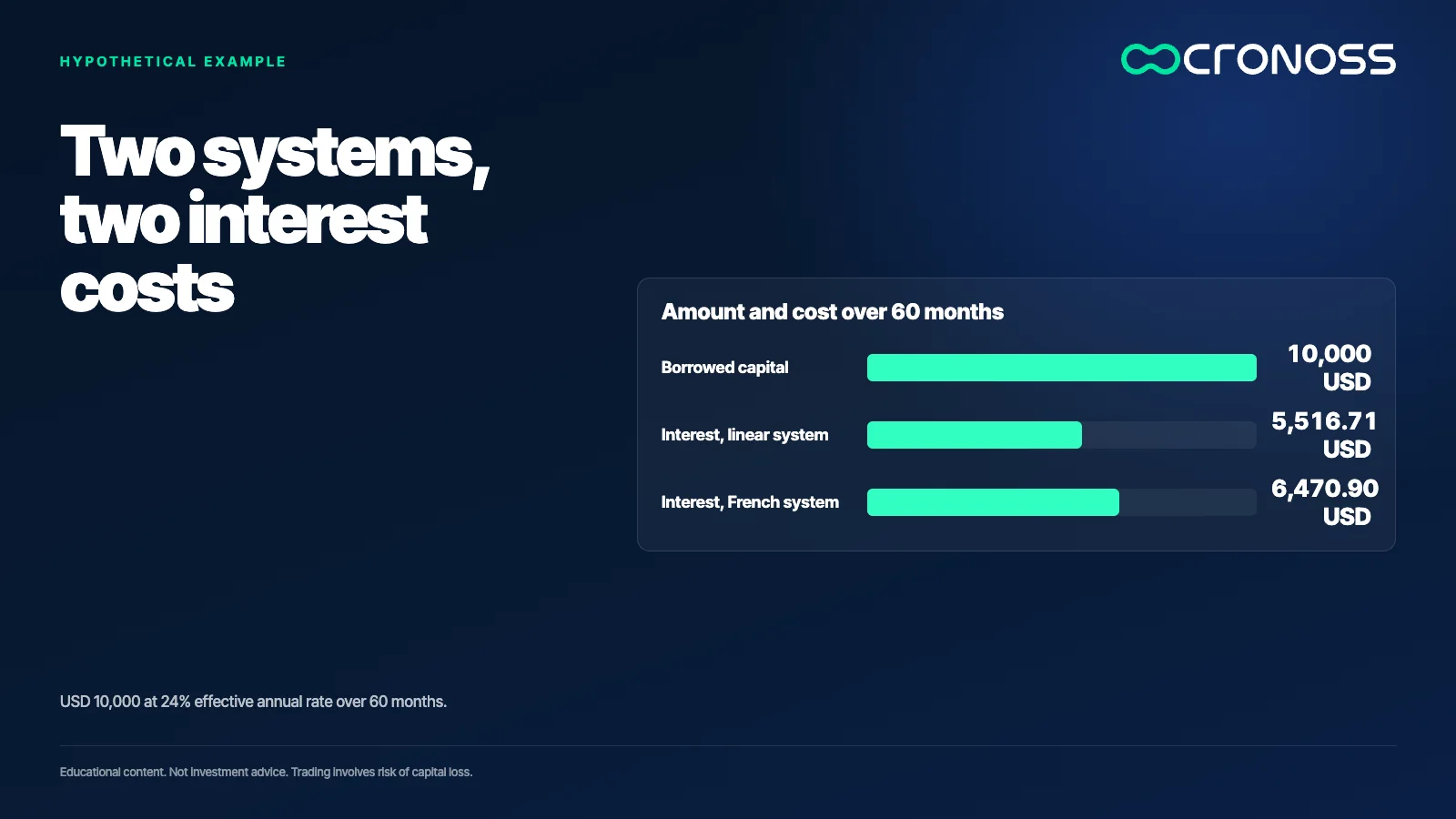
- In the French system the installment is constant but more interest is paid first; in the example it adds up to USD 6,470.90 of interest.
- In the linear system the principal is constant and total interest is USD 5,516.71, about USD 954 less with the same amount, rate and term.
- An extra payment reduces future interest, as long as the lender applies it to principal and the pace is sustainable.
Two people take out the same loan: USD 10,000, same rate, same term. One ends up paying almost USD 1,000 more in interest than the other. There was no trick and no hidden fine print. One thing changed: how each of them paid back the principal.
That difference sits in a document almost nobody reads, the amortization schedule. Banks use it every day. Knowing how to read it lets you compare offers, understand a debt purchase and decide whether a loan helps or hurts.
A loan is understood through its structure (amount, rate, term, currency and how it amortizes), and that structure, not only the rate, decides how much interest you pay.
Credit is not good or bad: it is a tool with a cost
Many people associate credit with a bad decision, or inherit a bad experience with it from their family. Misused credit does cause problems. But it also does two useful things.
The first is bringing consumption forward. An illustrative example: a flight costs USD 1,500 today and, close to the travel date, would cost USD 1,700. Paying today in installments can be cheaper than waiting, even after paying interest. The second is amplifying your own resources, known as leverage: with USD 20,000 of your own and a loan of USD 80,000, you can buy a USD 100,000 house.
Both come with an opportunity cost. Bringing consumption forward today means giving up part of tomorrow's, like someone who eats the whole week's snack on Monday. And leverage multiplies risk: if a USD 10,000 account trades as if it were USD 100,000 and the maximum loss per trade was set at 1%, that loss stops being USD 100 and becomes USD 1,000, which is 10% of the account.
The components of a loan
Five elements explain almost everything that happens in a loan.
- Amount. What was borrowed. It shrinks with each principal payment and reaches zero with the last installment.
- Interest rate. The price of using someone else's money. It is charged on the balance not yet repaid.
- Term. A longer term means a lower installment but more interest overall. A shorter term means a higher installment and less interest.
- Currency. Usually the same one your income is earned in.
- Type of rate. A fixed rate stays the same for the life of the loan. A variable one rises or falls when rates in the economy change.
On the rate, it helps to read its "surnames". The effective annual rate (EA) is the cost of the full year, with compound interest, and that is why it allows comparison across lenders: 24% EA against 20% EA compares directly. The month-in-arrears rate (MV) is the one applied each period. If a lender shows a nominal rate, always ask for its effective annual equivalent. Colombia's financial regulator offers a rate conversion simulator.
The amortization schedule: why the installment is not just interest
An amortization schedule has five columns per period: opening balance, interest payment, principal payment, installment and closing balance. The installment is the sum of interest (the cost of using the money) and the principal payment (the return of the money borrowed). Each month's interest is calculated on that month's opening balance.
The working example: USD 10,000, 24% EA, 60 months. A rate of 24% EA is equivalent to 1.81% per month. In the first month, interest is 10,000 times 1.81% = USD 180.88. If the installment were only USD 180.88, nothing would go to principal and the debt would remain at USD 10,000. That is the key: how the installment is split between interest and principal changes the total cost.
French system: constant installment, principal that arrives late
In the French system, the most common in mortgages and consumer loans, the installment is the same every month. In the example, USD 274.52. What changes is the composition. In the first month, USD 180.88 is interest and only USD 93.64 is principal. In the last month, interest is USD 4.88 and principal USD 269.64.
More interest and less principal are paid first, and the reverse at the end. Adding up the 60 months, total interest is USD 6,470.90, 64.7% of the amount borrowed.
Linear system: higher installment at the start, less interest overall
In the linear system, the principal payment is the same every month: 10,000 / 60 = USD 166.67. Because the balance falls faster, interest falls faster. The installment starts at USD 347.54 and ends at USD 169.68.
Total interest is USD 5,516.71. With the same amount, the same rate and the same term, the linear system costs USD 954.19 less in interest than the French one. The trade-off is cash flow: the first linear installment is about USD 73 higher than the French one. Paying more at the start reduces total cost, but it demands more cash flow from the first month.
A practical question when you get a debt purchase offer: what type of amortization does it have? The statement for your current loan tells you. If the installment is always the same, it is French. If it falls month after month, it is linear.
Extra principal payments
There is another lever. Every extra payment reduces the balance and, with it, future interest. An illustrative example with the linear system: an extra payment of USD 1,000 at the end of month 12 reduces total interest from USD 5,516.71 to about USD 4,694, a saving of about USD 823. The calculation assumes the fixed principal payment stays the same and the loan ends earlier.
Two cautions. The first is about form: some lenders treat the payment as an advance on installments rather than as a principal payment, and then charge interest in advance. You have to state explicitly that it is a principal payment. The second is about sustainability: paying too fast and being left with no room for the rest of life can be unsustainable, like a diet so strict that it is dropped after a few weeks. A reasonable pace is better, even if it lasts more years.
When credit works in your favor
Back to the flights. Today they cost USD 1,500 and later USD 1,700. They are paid in 6 equal monthly installments at the same 24% EA rate. The installment is USD 266.06 and total interest adds up to USD 96.38. The gross saving is USD 200 and the net saving, after interest, is USD 103.62.
The same reasoning applies to store cards that offer discounts: the discount can exceed the cost of interest, but you must add the card fees and other charges before deciding. When the discount is smaller than the financing cost, credit stops being an advantage.
What to check before signing
- Compare effective annual rates. Ask for the EA equivalent of any nominal rate before comparing lenders.
- Ask for the amortization schedule and look at the system. Identify whether the installment is constant or decreasing, and how much of the first payment is principal.
- Calculate the total cost and your cash flow. Add up the interest over the whole life of the loan and check that the installment leaves your essential spending intact.
Understanding the structure removes the fear
Credit is neither an enemy nor a trick. It is a tool that charges for its use and whose cost can be calculated before signing. Whoever understands the structure can say no with arguments, or say yes knowing how much will be paid.
If you want to keep building these foundations, the program Gestión y Planificación Financiera Personal (Personal Financial Management and Planning) develops them step by step.
Educational content. Cronoss is not a broker, investment firm or financial adviser, and nothing above is an investment recommendation.
Frequently asked questions
What is an amortization schedule?
It is the period-by-period detail of a loan: opening balance, interest payment, principal payment, installment and closing balance. It shows how much of each installment is the cost of money and how much is repayment of what was borrowed.
What is the difference between French and linear amortization?
In the French system the installment is constant and more interest than principal is paid at first. In the linear system the principal payment is constant, the installment falls over time and total interest is lower, but the first installment is higher.
How do I compare the rates of two lenders?
Compare effective annual rates (EA) with EA. If a lender shows a nominal rate, ask for its effective annual equivalent, because only then are both expressed under the same conditions.
Is it worth making extra payments on a loan?
They reduce future interest if the lender applies them to principal and not as an advance on installments. But a pace so demanding that it becomes unsustainable and ends up forcing new borrowing is not advisable.